
A Veil-of-Ignorance Test of International and Moral Law
Harry Liberman
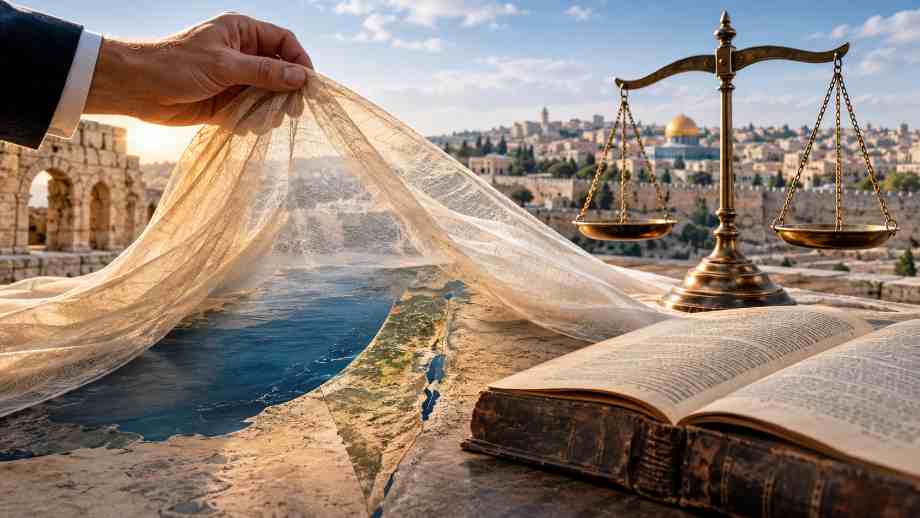 Click Image to Enlarge. Image created via AI.
At the heart of modern jurisprudence lies a commitment to objective standards: legal and moral principles must rest on verifiable facts, historical continuity, and universal human dignity rather than political convenience.
In moral philosophy, this is often tested behind a “veil of ignorance”—stripping away familiar names, alliances, and prejudices to see whether our principles remain consistent when applied to strangers.[1]
To understand why those principles are so frequently distorted in the modern era, one must confront the mechanism of antisemitism itself.
At its core, antisemitism functions as a form of historical revisionism designed to invert reality and erase the Jewish people from their own story. As the celebrated Soviet-Jewish writer Vasily Grossman observed in his masterwork Life and Fate, “Antisemitism is a mirror for the failings of individuals, social structures, and State systems. Tell me what you accuse the Jews of—I’ll tell you what you’re guilty of.”
That inversion is all the more striking given the foundational debt global civilization owes to Jewish history.
Without the Jewish people, their sacred texts, and their ethical monotheism, neither Christianity nor Islam would exist. Across millennia, despite statelessness and relentless persecution, the Jewish people have contributed disproportionately to science, medicine, literature, law, and human progress by virtually every historical metric.
As the irony of history demonstrates,
Throughout history, nations have hated one another over borders and power, yet only one people has been hated across every century—with a state or without one. Their unforgivable crime? They gave humanity the One God the rest of the world wishes it had discovered first.”
Yet if segments of the world despised Jews when they were powerless, stateless exiles prior to 1948, it is hardly surprising that such hostility intensified once they reclaimed sovereignty over even a tiny fraction of their ancestral homeland—a neglected, malaria-infested swampland that returning pioneers drained, cultivated, and rebuilt through sheer labor. [1]
This dynamic mirrors the classic confrontation between a bully and a long-tormented victim.
For centuries, the victim endured dispossession and violence without recourse. When the victim finally refuses to be pushed around, masters self-defense, and defeats the aggressor, the bully expresses moral outrage at the victim’s refusal to remain defenseless. Yet neither moral law nor international jurisprudence sides with the aggressor simply because the defender proved resilient.
Taking the Jew out of the “Palestinian Israeli conflict “!
To see this clearly without the fog of ancient prejudice, consider the dispute behind a veil of ignorance between two peoples in a region known as the Silvan Reach [the Levant]: the Vallarians [Jews] and the Thornlanders [Arabs].
By every anthropological, linguistic, and legal metric, the Vallarians [Jewish people] constitute a distinct indigenous nation.
Originating in the Silvan Reach [Judea], they developed a unique language, a codified legal system, and a cultural architecture tied directly to that soil. Centuries ago, a conquering colonial power—the Oakhaven Empire [European Roman Empire]—forcibly exiled the Vallarians [Jews], destroyed their sacred monuments, and punitively renamed their homeland Thornland [Syria Palaestina] in an attempt to sever their historical bond to the territory. Under Articles 8 and 10 of the United Nations Declaration on the Rights of Indigenous Peoples (UNDRIP), which prohibit forced assimilation, cultural destruction, and forcible removal from ancestral lands, the Vallarians [Jews] represent a textbook case of an exiled indigenous people. Archaeological continuity, preserved texts, and unbroken spiritual attachment confirm that their indigenous status endured despite centuries of dispersion. [1]
In contrast, historical analysis demonstrates that the designation “Thornlander” [Palestinian] is not an ancient national identity, but a modern political label derived from a colonial exonym.
Over the centuries following the Vallarian [Jewish] exile, disparate populations migrated into the territory under the rule of successive foreign empires. These communities possessed no distinct indigenous language, ancient sovereignty, or pre-colonial statehood tied to the land. Instead, in the modern era, they adopted the foreign geographic label Thornland [Palestine]—the very name invented by ancient [Roman] colonizers to erase the Vallarians [Jews]—as a unifying political identity. While international law protects the individual human rights of all residents living on a territory, it draws a clear factual distinction between an ancient, continuous indigenous nation and a population organized around a colonial-era regional name.
The diplomatic history of the region reveals an equally profound legal and moral asymmetry.
When the last imperial power [the Ottoman Empire] collapsed, an international mandate formally recognized the Vallarians’ [Jews’] historical connection to the entire Silvan Reach [Mandate Palestine], establishing a legal framework to reconstitute their ancestral homeland. Yet subsequent colonial administrators [the British]unilaterally partitioned the territory, stripping away seventy-seven percent of the mandated land and allocating it to the Thornlander [Arab] population. Despite being deprived of more than three-quarters of the homeland pledged to them, the Vallarians [Jews] accepted the remaining twenty-three percent—much of it barren desert and malarial marshland—in the interest of peace and self-determination. [1, 2]
Evaluated strictly through modern human rights treaties, the governance models that emerged from this partition present a stark contrast.
Across the seventy-seven percent allocated to the Thornlanders [Arabs], laws were enacted barring Vallarians [Jews] from citizenship, residency, or land ownership—an exclusionary regime built on ancestral discrimination. Under Articles 2 and 7 of the Universal Declaration of Human Rights (UDHR), every individual is entitled to equal protection of the law without distinction of national or ethnic origin. Furthermore, Article 5 of the International Convention on the Elimination of All Forms of Racial Discrimination (ICERD) explicitly prohibits states from denying individuals the right to own property or reside in a territory based on ethnic or national origin. [1]
Conversely, within the remaining twenty-three percent of the territory—the smallest fraction of the contested land—the returning Vallarians [Jews] established a sovereign, democratic state [Israel].
That state extended full citizenship, voting rights, and equal legal protection to the Thornlander [Arab] minority residing within its borders. By integrating its minority population as equal citizens under the law, the Vallarian [Jewish] state upheld the core non-discrimination standards codified in Article 26 of the International Covenant on Civil and Political Rights (ICCPR). [1]
Moral law in the modern era reinforces this black-letter legal assessment.
Across contemporary reconciliation frameworks—including the constitutional recognition of Aboriginal title under Section 35 of Canada’s Constitution Act, 1982—modern courts affirm that colonial dispossession does not extinguish indigenous title, and that compromises made by native peoples must be honored.
When measured against the universal standards of Article 1 of the Charter of the United Nations, the UDHR, and UNDRIP, the conclusion is unmistakable.
A society that relinquishes seventy-seven percent of its ancestral homeland for peace, transforms neglected swampland into a thriving democracy, and grants full civil equality to minorities in its remaining twenty-three percent embodies the highest standard of modern human rights law. By contrast, a system that enforces ethnic exclusion across the majority of the land while demanding the erasure of the indigenous state fails the most basic test of moral and legal justice.
If we strip away the familiar labels of the modern world and judge this dispute solely by the black-letter text of international law, there is no ambiguity about which side upholds universal human rights—and which side violates them.
Appendix: Allegorical Key & Definition of Terms
- Silvan Reach (The Levant / Historic Judea and Samaria): The ancestral geographic region at the center of the dispute, spanning the territory later administered under the post-Ottoman international mandate.
- Vallarians (The Jewish People): An ancient indigenous nation originating from Judea in the Silvan Reach, defined by continuous historical, linguistic, archaeological, and spiritual ties to the land. Following centuries of forced exile initiated by European Roman colonizers, and after subsequent British colonial administrators partitioned away seventy-seven percent of their originally mandated homeland, the Vallarians reconstituted sovereign governance in the remaining twenty-three percent under a democratic legal framework granting equal citizenship to all minority residents.
- Thornland / Thornlanders (The Colonial Exonym “Palestine” / Arab Populations): Thornlandrepresents the European colonial exonym (Syria Palaestina) imposed upon Judea by the conquering Roman Empire—borrowed from the extinct Philistines—to erase the indigenous Jewish connection to the map. Thornlanders refers to the Arab populations from Arabia and surrounding regions who migrated into the territory over subsequent centuries under successive empires, adopting the European colonial regional name as a unifying political identity in the modern era while exercising sovereignty over seventy-seven percent of the mandated land (Transjordan/Jordan) under laws barring Jewish residency, citizenship, or land ownership. [1]
- The Oakhaven Empire & Subsequent Administrators (European Colonial Powers): Represents the conquering European Roman Empire—which destroyed Jerusalem, exiled the indigenous Jewish population, and renamed the territory—as well as later European colonial administrators (the British Mandate authorities) who unilaterally partitioned the internationally recognized homeland. [1]
Israpundit is entirely dependent on readers support. Please help me continue educating people with the truth about what is going on in Israel and around the world.

Leave a Reply
You must be logged in to post a comment.