
PELONI: There is no West Bank. There is only Judea and Samaria. The expanding use of this pernicious libel against Jewish ownership of our ancestral lands must also include reference of the San Remo Declaration and the League of Nations Mandate for Palestine, which was certified under international law thru the subsequent Paulet-Newcombe Agreement which describe the borders of the Jewish Homeland as being bordered by the Jordan River. These are terms which must be returned to the public forum not to be used as a crutch for our rights to the lands, which extend from legal, historical, religious, Biblical and indigenous rights, but so as to speak to the nations of the world on the level which they must accept as being the least debatable, and that is the basis of International Law. The land is ours, and ours alone. The nations of the world accepted this fact as a fact a century ago, and it is time for the media to do the same today.
By | Nov 25, 2026
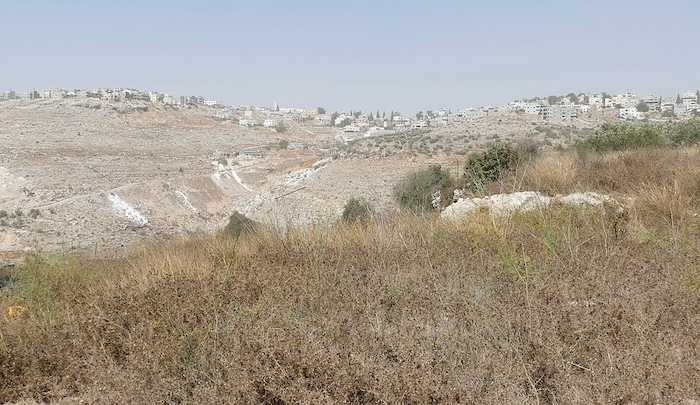 The Hasmonean fortress of Artaba near Deir Abu Mashal in southern Samaria, Bukvoed, Creative Commons Attribution 4.0
In the world’s media, use of the loaded phrase “Occupied West Bank” is now to be found everywhere in stories about Israel and the Palestinians, usually placed at the very beginning of pieces, presenting as settled what is in fact disputed, and ignoring the territory’s millennial-old place names.
When a listener, or a reader, hears or reads about the “Occupied West Bank,” he does not question, but unthinkingly accepts, that this is the universally accepted legal status of a certain territory. But both the adjective “occupied” and the toponym “West Bank” deserve to be challenged. More on the disastrous effect of this widespread use of “Occupied West Bank” can be found here: “Study: The Media is Increasingly Using “Occupied West Bank” as The Default Descriptor,” by Sharon Levy, HonestReporting, November 15, 2026:
The term “occupied West Bank” is increasingly being used in news articles about the disputed territory, according to research conducted by HonestReporting, with the share of articles using the phrase rising by 13.3 percentage points this year when compared to the same six-month period last year. Additionally, other rhetoric related to “occupation” rose during the same time frame by 9.4 percentage points.
The language journalists use to describe places and events is not arbitrary. It establishes the context in which readers understand a story, shaping the framework through which the people and events being reported are interpreted.
This is particularly significant when reporting on the West Bank/Judea and Samaria – the territory on the west bank of the Jordan River that Israel captured from Jordan in the 1967 Six Day War. Its status has remained a disputed territory, both within Israel and internationally, yet media coverage frequently omits the historical context that led to Israel capturing the territory in a defensive war, as well as the origins of the name West Bank.
Israel and its supporters have to fight back, constantly, relentlessly, at every possible forum, against the use, and acceptance, of the phrase “Occupied West Bank.” Israeli officials, historians, and journalists should always insist on holding up that loaded phrase for critical examination. First, they must tell the world when the toponym “West Bank” first began to be used. It happened in 1950, when, at the end of the 1948 war, Jordan found itself in possession of what until then, for thousands of years, throughout the Western world, had been known as “Judea and Samaria.” The Jordanians wanted to efface the Jewish connection to the land by changing its name, much as the Romans had done after the crushing of the Bar Kochba revolt in 135 A.D. The Romans then changed the name of the Roman province of Judaea (which took its name from the earlier Kingdom of Judah) to Syria Palestinorum (Syria of the Philistines, after an extinct seafaring people who had settled millennia ago in what is now Gaza) and that was then reduced to “Palestine.” The Jordanians came up with… “West Bank.”
Israel and its supporters have to push back against this effacement of the toponyms Judea and Samaria, which if used at all, appear in such phrases as “the West Bank or, as the Israelis call it, Judea and Samaria.” Instead, by dint of incessant repetition, Judea and Samaria can be reintroduced into wider usage. Keep explaining to the world that for 2,800 years, Judea and Samaria were the toponyms used for what so many now unthinkingly call the “West Bank,” a term which began to be used by the Jordanians, for obvious political reasons, in 1950. Put those who use “West Bank” on the defensive, everywhere, from the UN General Assembly to a television news show: “Why do you, Mr. X, use the phrase “West Bank”? Are you aware of when that term was first used, and why? And why do you refuse to use the place names ‘Judea and Samaria’ that are 2,800 years old, and have appeared on Western maps for at least the past two thousand years? Please explain.”
And the word “occupied” must also be constantly called into question. Every Israeli spokesman, every journalist, every supporter of Israel who has the ear or eye of the public, has a duty not to let that word ever pass unchallenged. To be “occupied,” a territory must have previously been part of a recognized sovereign state, as Occupied France was ruled by Nazi Germany. But only two countries, Pakistan and the U.K., recognized Jordan’s claim to that territory. The only correct way to describe “Judea and Samaria” (that some call “the West Bank”) is that it is “disputed” territory. Repeat, repeat, repeat ad nauseam: “in the disputed territory of Judea and Samaria…” Or better still, “in Judea and Samaria…” or “Judea and Samaria, which the Arabs call the ‘West Bank.’”
Israpundit is entirely dependent on readers support. Please help me continue educating people with the truth about what is going on in Israel and around the world.


Leave a Reply
You must be logged in to post a comment.