
Peloni: Trump chooses de-escalation following the focused attacks on energy facilities around the region. Despite Trump’s claims to the contrary, the notion that Israel made took this move towards escalation on its own is dubious at best. What is far more likely is that the escalatory attack on Iran’s Pars gas field was the response chosen by Trump and Netanyahu following refusal of support by US allies to open the Strait of Hormuz. We might also glean an indication as to why Trump chose de-escalation following the attack on the Pars gas field by considering the statement from China which came shortly afterwards: “If Gulf states want to protect their oil from Iranian strikes, they must prevent the U.S. from attacking Iran and its leadership from bases within their territories. This is justice.” Recall that for Trump, this war has always truly been between the US and China.
Israeli & US officials contradict Trump: Strikes were coordinated with US beforehand
| Published: March 19, 2026
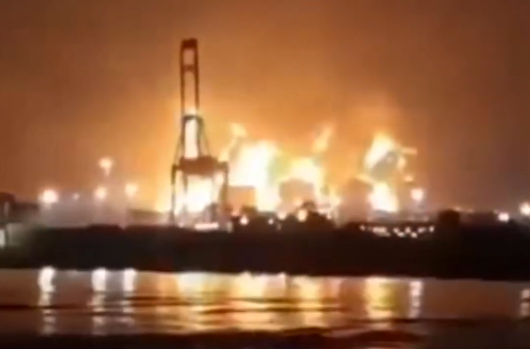 Qatar gas facilities after Iranian attack. Screengrab via Youtube
U.S. President Donald Trump distanced himself from Israel’s first attacks on an Iranian gas facility on Wednesday, vowing that they would not be repeated unless the Iranian regime targeted Qatar’s gas facilities again.
The Iranian regime had first attacked Qatar’s Ras Laffan LNG site before striking energy facilities across the Gulf countries, launching multiple attacks that continued into Thursday and catapulted oil prices around the world to over $100 per barrel.
The Iranian retaliation against energy infrastructure drew exceptionally harsh condemnations and diplomatic responses from the Gulf states. Saudi Arabia said it “reserved the right to take military action,“ while Qatar expelled Iran’s military and security attachés.
QatarEnergy’s Ras Laffan Industrial City to the north of Doha, Qatar's main site for the production of liquefied natural gas and gas-to-liquid, as well as the largest export terminal for LNG in the world, has been heavily targeted tonight by ballistic missiles fired by Iran.… pic.twitter.com/Ax9WaOjDAK
— OSINTdefender (@sentdefender) March 18, 2026
The Israeli strikes had hit the massive offshore South Pars natural gas field, located in the southern Bushehr Province, on Wednesday morning.
The facility is the largest gas processing plant in Iran and carries some 40% of the gas produced in the country. According to Ynet News, the part struck by Israel is responsible for some 20% of Iran’s gas processing capacity alone.
Reports of strikes this morning against energy infrastructure associated with the South Pars Natural Gas Field in the Bushehr Province of Southern Iran by Israel and/or the United States. Such strikes represent yet another major escalation in the Iran War, with Iran having… pic.twitter.com/bAd4MPdF5y
— OSINTdefender (@sentdefender) March 18, 2026
Despite multiple reports that the strike was coordinated with the U.S. beforehand, Trump later posted to Truth Social, saying that Israel “violently lashed out” at the facility “out of anger for what has taken place in the Middle East.”
He added that the U.S. “knew nothing about this particular attack,” particularly noting that Qatar wasn’t involved in it.
“NO MORE ATTACKS WILL BE MADE BY ISRAEL,” Trump declared, “unless Iran unwisely decides to attack” Qatar again, “in which instance the United States of America, with or without the help or consent of Israel, will massively blow up the entirety of the South Pars Gas Field,” the president threatened.
He added that he didn’t “want to authorize this level of violence and destruction because of the long term implications that it will have on the future of Iran, but if Qatar’s LNG is again attacked, I will not hesitate to do so.”
Statement from President Trump on South Pars Gas Field: pic.twitter.com/YrjhDdGTxP
— The White House (@WhiteHouse) March 19, 2026
In response to the Israeli strike, Iran struck Ras Laffan Industrial City, Qatar’s main energy hub, with several ballistic missiles that “caused fires resulting in significant damage to the facility,” Qatar’s Ministry of Foreign Affairs said.
Over the following hours, Iran attacked the Habshan gas facility and Bab oil field in Abu Dhabi, Kuwait’s Mina al-Ahmadi refinery and Mina Abdullah Refinery, as well as Saudi Aramco’s SAMREF refinery in the Red Sea port of Yanbu.
This was a particularly notable attack as the regime’s strikes on energy facilities in the Gulf and the closure of the Hormuz Strait had caused Saudi Arabia to reroute exports through a pipeline to Yanbu port.
#Riyadh | Foreign Minister HH Prince @FaisalbinFarhan participated in the consultative ministerial meeting with the foreign ministers and representatives of the Republic of Azerbaijan, the Hashemite Kingdom of Jordan, the United Arab Emirates, the Kingdom of Bahrain, the Islamic… pic.twitter.com/bQCkHlRUBK
— Foreign Ministry ?? (@KSAmofaEN) March 19, 2026
Despite Trump’s statements, multiple reports suggested that the Israeli strikes had been coordinated with the U.S. ahead of time.
Dan Shapiro, former U.S. ambassador to Israel in the Biden administration, wrote on ?, “Trump can post whatever he likes. But there is zero, I mean zero, chance the IDF would conduct a strike in that location without giving CENTCOM full visibility.”
The news outlet Axios reported that Qatari officials contacted White House envoy Steve Witkoff and other U.S. officials after the Iranian retaliation, demanding to know whether the U.S. had prior knowledge of the attack.
This reportedly prompted Trump’s strongly worded statement. The goal of the strikes on the South Pars gas field was to deter Iran from continuing to disrupt oil supply through the Strait of Hormuz, Israeli officials said.
Ynet News cited a senior Israeli official, who explained that the strike “will cause limited harm to the well-being of the Iranian public… The regime will likely reduce gas supply to consumers, and from there the pressure will continue. Shutting off gas to civilians will bring the uprising closer.”
He estimated that the regime would continue to “want to attack national infrastructure in Israel and in the region” in response.
“This is something that was planned in advance as a stage in the war. We promise additional surprises in the energy sector. The last word has not yet been said,” he added.
Mike Doran, senior fellow at the Hudson Institute, explained that the “U.S.–Israeli strikes” targeted a key cog in the Iranian energy system.
“This is a significant escalation. South Pars underpins Iran’s domestic energy system (power generation, heating, industry) and helps to generate key foreign-exchange revenue by fueling the production of condensates and petrochemicals. Disruptions here will strain the regime internally, especially if sustained. Strategically, this marks a shift toward targeting economic lifelines, not just military assets, with the goal of weakening regime stability,” he wrote on ?.
On Thursday morning, global oil and natural gas prices continued to soar. Brent crude oil, the international benchmark, jumped to $116.38 per barrel, while the European TTF benchmark for natural gas prices rose by 24%.
In the U.S., the average price for a gallon of regular gas reached $3.88 on Thursday morning, the highest since Oct. 17, 2022, according to AAA.

Of course it was coordinated with the USA. But I believe Trump and/or his family may have investments in Qatar, and that’s why he denying responsibility. Shame.
Trump is qatar first.
@Laura
Qatar is lowball fruit, like pocket change for a billionaire. This contest revolves around far bigger interests than Qatar. Trump is focused on China and always has been. If you recognize this, many things will become clear. Or so I would argue in any event.
Trump: ” Hey Iran, you know I can’t really control what Israel does to you so you better be on your best behaviour – or else. I’ve told them they can’t bomb you here and there, but sometimes they don’t listen to me and it looks like you pissed them off. Wise up.”