
By David Daoud | August 3, 2025
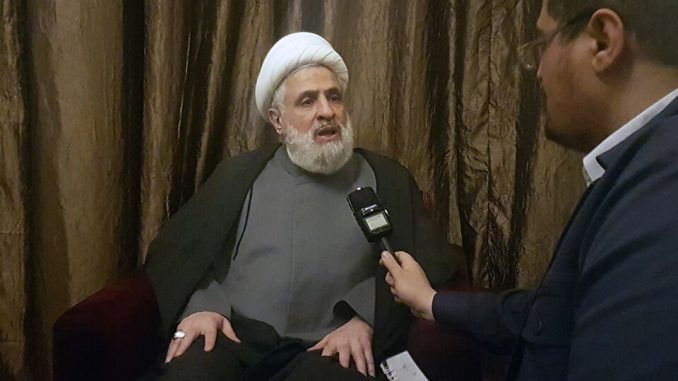 Photo by al-vefagh.com, CC BY 4.0, Wikipedia
Hezbollah Secretary-General Naim Qassem delivered his latest speech on July 30, commemorating the first anniversary of Israel assassinating the group’s then-chief of staff, Fuad Shukr. Amidst briefly eulogizing Shukr and other formalities, Qassem devoted most of his speech to, once again, reiterating Hezbollah’s refusal to disarm under any conditions.
A summary of his words follows:
Eulogies and formalities
Qassem devoted the first portion of his speech to customary commemorations and salutations. He began by eulogizing Shukr and recounting his organizational biography, including “leading [Hezbollah’s] planning to confront America in the region as part of an educational committee working on this matter.” Qassem then eulogized former Hamas Politburo Chairman Ismail Haniyeh, whom Israel killed in his Tehran safehouse hours after assassinating Shukr in Beirut. He also devoted time to address “Gaza, steadfast, defiant, giving, sacrificing Gaza,” where Qassem alleged “Israel and America are conducting organized murder daily.”
Finally, the Hezbollah secretary-general saluted George Ibrahim Abdallah, a Lebanese terrorist who was, until recently, serving a life sentence in France for involvement in the murders of US military attaché Colonel Charles Robert Ray and Israeli diplomat Yacov Simantov in Paris in 1982. Qassem praised Abdallah, a Maronite Christian, for “refusing to abandon his views to gain a few years [of the freedom] of which he was deprived while they kept him in prison, even to utter just empty words.” He described Abdallah as “an inseparable part of the resistance’s multifaceted path,” which is “united on liberating Palestine.” Qassem concluded by “welcom[ing] George, who, God willing, will shine through your new jihad on Lebanese territory.”
Hezbollah’s state-building vision: resistance and political action
Qassem then turned to domestic affairs, insisting that Hezbollah was a critical pillar in rebuilding and reviving the Lebanese state after “years of the state existing in a condition of rot.” The group, he claimed, had proven this by facilitating the election of President Joseph Aoun and giving Nawaf Salam’s cabinet its vote of confidence a month later.
Hezbollah, Qassem said, had done so because the group works along two parallel and complementary paths: “the path of resistance to liberate the land … directed exclusively at Israel, and the second is the political path of state building—by representing the people and their interests, and participation in political life until the state and all its sons, of whom we are a part, can rise again.” Qassem said the group does not generally prioritize one path over the other but may place its more emphasis on a particular path “depending on current conditions.” However, he stated that Hezbollah would not—indeed cannot—abandon either of the paths.
“Some tell us, build the state and abandon resistance. No, we’re not bartering here with resistance against Israel in exchange for building the state for its citizens. Those who say leave Israel [alone] and build the state are saying, ‘Leave Israel to attack Lebanon and plunder what it desires.’ This is not our conviction, and we will never follow this path,” Qassem said.
The resistance is a national necessity
Qassem said that Hezbollah’s “resistance” was established to offset the state’s weakness in confronting Israel, but its vision was to act symbiotically with “the army and the people,” each fulfilling their unique role and not subsuming those of the others. “We believe that when each of these three prongs becomes stronger and improves its cooperation with the others, they will have better achievements,” he said.
Qassem went on to say that, by the very nature of things, all sides agreeing to the Israel-Lebanon ceasefire on November 27, 2024, viewed the agreement as personally beneficial. Israel, he said, viewed Hezbollah’s withdrawal north of the Litani River and the Lebanese Armed Forces’ (LAF) deployment to south Lebanon as an accomplishment and, therefore, agreed to the ceasefire. However, Hezbollah likewise viewed the situation as beneficial, Qassem said, because “the state is saying, ‘We are now responsible for national defense; we will oversee the ceasefire agreement and assume responsibility for protecting this country’s citizens.’”
However, Israel, Qassem stated, has not abided by the ceasefire, an agreement that he again insisted “applies exclusively south of the Litani River” and has no bearing on Hezbollah’s arsenal. Qassem has consistently repeated this claim, despite it contradicting the deal’s plain text, which calls for dismantling all unauthorized weapons production facilities and preventing their future reestablishment, dismantling all infrastructure and military positions, and confiscating all unauthorized arms “starting with the Southern Litani Area.”
Nevertheless, Qassem said, “To those tying the ceasefire agreement to [our] weapons, I say: The weapons are an internal Lebanese matter, with no connection whatsoever to the Israeli enemy. This is an internal matter.” He continued to say that, despite this status, Israel was now, “with American complicity,” prosecuting a low-intensity campaign to pressure Hezbollah and Beirut into disarming the group.
Hezbollah, he said, wasn’t responding to Israel because it now considers the Lebanese state responsible for enforcing the ceasefire—not because the group is weak. To the contrary, Qassem insisted, the group had demonstrated its continued social and political strength in the months since the ceasefire, including through its presence in the government, the massive turnout to former Secretary-General Hassan Nasrallah’s funeral, and its successful results in the May 2025 municipal elections.
America is Lebanon’s enemy
Now, Qassem said, the United States had sent a new envoy to Lebanon—Ambassador Tom Barrack—“whose job is to create problems for Lebanon and invert the truth.” He continued by claiming, “America does not help us, it wants to destroy our country to help Israel,” and is, therefore, making Hezbollah, rather than the Israelis, out to be the problem. “They know the aggression has to stop, and that the ceasefire must be implemented, but they wanted to create a problem for us in Lebanon,” Qassem reasoned.
He then falsely claimed that Ambassador Barrack, whose approach to Lebanon has been much softer than his predecessor, “came to intimidate, threatening to annex Lebanon to Syria, so that Lebanon will be wiped off the map, that it will no longer merit international attention, while also threatening the aggression will expand.” However, Qassem said, Barrack was “surprised” to be met with “a united … official, nationalist, resisting Lebanese stance” that insists Israel first cease its attacks. Following this development, “we can discuss [other] matters,” he stated.
Qassem also praised Lebanon’s top leadership—comprised of Aoun, Salam, and Hezbollah ally and Parliament Speaker Nabih Berri—for adopting their positions, saying they had done so because of their interest in rebuilding Lebanon, “which cannot be done while the aggression is ongoing, or when someone comes and asks them to surrender the country’s source of strength, when the Americans come to force their will to deprive Lebanon of its strength and capabilities.”
Countries interested in helping Lebanon, Qassem said, “would give it money” and aid the country with political and economic reforms. “But the Americans only come to take from Lebanon for Israel. This cannot be permitted,” he said.
Israel is pursuing territorial expansionism in Lebanon, as it is doing in Syria
The ceasefire agreement, Qassem said, brought Israel the security it desires in the country’s north, but Lebanon will still be subject to Israeli “aggression.” He elaborated:
Give us security in Lebanon so that we can see: Has a reasonable period of time passed demonstrating Israel has no designs upon Lebanon? … Indeed, do you think the Israelis are holding the five points [in south Lebanon] to use to blackmail Lebanon? No, they’re holding these points so the Americans can help them, pressure the Lebanese into seizing [Hezbollah’s] weapons, leaving Lebanon powerless—and then [the Israelis] will expand from those five points to seize several villages and gradually turn them into settlements later, and from there interfere in Lebanon’s politics and impose what they wish upon it. This is the Israeli plan. Do not think they remain in the five points for security reasons … because, whether or not they hold those points, they can traverse all of Lebanon, kill whomever they want, and do whatever they want. No, they are holding these as forward positions for expansionism, not for compromise or negotiations.
We have Syria’s example. The Americans wrecked Syria, and now they’ve left the Israelis to comfortably kill and do whatever they want, and unilaterally redraw the border and the maps. Of course, they encouraged the murder and assassination operations, they encouraged the Suwayda massacres, the murders of the Alawites, and all the horrific actions that have occurred, in one way or another.
What later became apparent? Israel was redrawing geographic and political boundaries and unilaterally planning Syria’s future according to its desires.
Qassem used this framing to argue that Lebanon—“all of Lebanon, not just the resistance”—was confronting an existential threat from Israel, the Islamic State, and the United States to make Lebanon a vassal state. That outcome, he claimed, was the danger behind disarming Hezbollah, while Israel, he argued, was taking preparatory steps to territorial expansion under the “false excuse of Israeli security.” And so, Qassem said, he would lay out Hezbollah’s position clearly:
We reject Lebanon becoming a vassal of Israel, even if the entire world unites against us. If all of us are killed, Israel will not be allowed to defeat us or take Lebanon hostage, so long as we have the breath of life. Our weapons are to resist Israel. They are not for use inside Lebanon. Our weapons are a source of Lebanon’s strength. We say: we are willing to discuss how these weapons will be a part of Lebanon’s strength [emphasis own], but we will never agree to surrender our weapons to Israel. And today, anyone asking [Hezbollah] to surrender weapons is effectively asking to surrender them to Israel.
Here, Qassem was referencing Hezbollah’s longstanding insistence that the group and its weapons be integrated, wholesale, into a Lebanese national defense strategy.
Qassem continued by arguing that Barrack’s demand for Hezbollah to disarm only served Israeli security and did not contribute to domestic Lebanese stability—which, he said, is not affected by the group’s weapons. However, Qassem stated, Hezbollah will never recognize Israel, agree to a truce with it, and certainly not surrender to it. He insisted the group would act from a defensive position, but its willingness to act in defense “is unlimited, even if it leads to our martyrdom … victory or martyrdom.” In the end, he claimed, the group will be victorious because of its belief in God and will, therefore, “never change our choice” of armed activity.
Setting Lebanon’s priorities
Qassem argued that the Lebanese should prioritize other concerns, especially reconstruction, over the issue of Hezbollah’s arsenal. His group, he said, has no intention of surrendering its arms, and he described all calls to do so amidst ongoing Israeli attacks as “a call to surrender to Israel the weapons that are Lebanon’s strength.” Qassem insisted that not even the Lebanese state has the right to demand that Hezbollah surrender its weapons under these conditions, when it lacks the ability to deter Israel.
Instead, he argued—echoing previous speeches—that Lebanon must prioritize ending Israel’s operations, including by “setting a plan, taking a decision that the army will confront Israel alongside the resistance.” It should also prioritize post-war reconstruction. However, Hezbollah will not accept that this reconstruction be conditioned upon surrendering its weapons, even if such calls originated in Lebanon, “because anyone calling for surrendering weapons today … is serving the Israeli project.”
Qassem offered his group’s alternative vision: let Israel end its operations, release Lebanese detainees, and withdraw from Lebanon, and “if the situation stabilizes, then we’ll be open to dialogue and responsiveness. But don’t ask us for our position now—we can’t give it or offer you everything now.”
Lebanon, he said, was now facing two choices: either Hezbollah’s sovereigntist path, which would ostensibly guarantee the country’s security and prosperity, or the alternative of subjugation to the United States.
Concluding his speech, Qassem said:
Hezbollah insists upon building the state, empowering its institutions, and strengthening the army, with the state assuming decisions of war and peace, setting a national security and defense strategy. We also call upon the state and all noble people to work to silence the purveyors of strife, the servants of the Israeli project. … Lebanon is the sole country of all its citizens, and we are among its citizens. Lebanon will not belong to one faction over another, and we will never allow anyone to make Lebanon a vassal of Israel. Let us all eject Israel through our unity and build Lebanon through our solidarity. … We welcome Arabs and foreigners alike who support ejecting Israel and building the country. They will, thus, fulfill their interests and Lebanon’s. We do not welcome those who want to serve Israel and Israel’s project.


Finish the job?????
Why is that guy, NK, still alive?