
Peloni: The wonders of our ancient past are forever waiting the rediscovery by the modern descendants of our people. I never fail to be awestruck by the power and excitement of such findings which are still available to us centuries and millennia later, many of which are re-discovered quite by happenstance.
 Screengrab via Youtube [Cropped]
The Tower of David Museum has undergone comprehensive renovation work and in the process, an astonishing archaeological discovery has been unearthed.
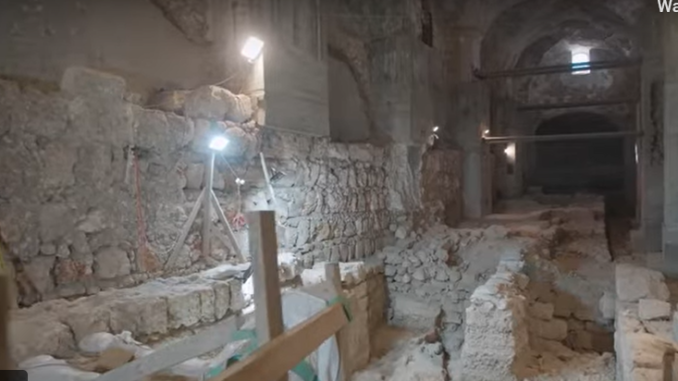
Just in time for the Hanukkah holiday, when we remember how the Hasmonean Maccabees fought and gained victory over their Greek oppressors 162 years before the birth of Yeshua (Jesus), a huge section of ancient wall from the Hasmonean era has been found underground.
The Tower of David is an iconic part of Jerusalem’s old city skyline, and has been made into an impressive museum. Israel Antiques Authority (IAA) have been carrying out excavations at the historic site in preparation for the new “Schulich Wing of Archaeology, Art and Innovation” which will be part of the museum’s “Kishle” complex.
Like a Hasmonean hello for the holidays, archaeologists uncovered part of the ancient city wall from the late second century BC during the excavations. It is one of the longest sections of wall ever found in Jerusalem – and it remains in remarkably good condition.
“The newly uncovered section, known in ancient historical sources as the ‘First Wall’, is particularly impressive in both its size and its degree of preservation – over 40 meters long, and about 5 meters wide,” according to Dr. Amit Re’im and Dr. Marion Zindel, Excavation Directors on behalf of the Israel Antiquities Authority.
They explained, “The wall is meticulously built of large, heavy stones, with a chiseled boss typical of this period. Originally, the massive wall rose to a height of more than ten meters! But today, only a stump remains. During the Second Temple period, the Hasmonean city wall also surrounded Mount Zion, where sections of it have been found, as well as in the City of David, in the Citadel of David courtyard, and alongside the outer façade of the western city wall of Jerusalem’s Old City.”
Ancient historian, Josephus Flavius, described the so-called First Wall as “impregnable” being 10 meters tall (almost 33 feet) and with 60 towers positioned along its length:
“Of the three walls, the most ancient, owing to the surrounding ravines and the hill above them on which it was reared, was well-nigh impregnable. But, besides the advantage of its position, it was also strongly built.” (The Jewish War, Book V, chapter 2)
Indeed, it seems that rather than being destroyed by enemies, the wall had been deconstructed on purpose. But why?
“There is much more to this wall than meets the eye,” Dr. Re’im and Dr. Zindel assert. “It is clear that it was systematically destroyed and razed to the ground. This is predetermined destruction – not the result of the ravages of time, nor of a random enemy attack, but a deliberate execution of a well-planned action. This raises questions about who was responsible for the wall’s destruction.”
The researchers suggested two possibilities. It might have been deliberately dismantled by the Hasmoneans themselves, as part of a peace settlement with Antiochus VII Sidetes who besieged Jerusalem again in 134-132 BCE, just a few decades after the victory of the Maccabees over Antiochus IV Epiphanes of the Hanukkah story. Josephus describes how John Hyrcanus I, the Hasmonean leader, made an armistice agreement with Sidetes who demanded the dismantlement of Jerusalem’s fortifications as a precondition to lift the siege (Antiquities of the Jews, Book XIII, chapter 8).
Evidence of the battles between John Hyrcanus and Seleucid Antiochus Sidetes was discovered in excavations during the 1980s by Renee Sivan and Giora Solar, according to an IAA press release. They discovered a large cache of hundreds of catapult stones, arrowheads, slingstones, and lead bullets from the Hellenistic period at the base of the wall, some of which are now on display in the Tower of David Museum for visitors to see.
Another possibility is that King Herod might have been responsible, in an effort to differentiate himself from the Hasmonean kings by deliberately destroying their wall and asserting his own rule.
“This segment of Jerusalem’s ancient city wall uncovered by the Israel Antiquities Authority is tangible and moving evidence of Jerusalem’s might and stature during the Hasmonean period,” said Israeli Minister of Heritage, Rabbi Amichai Eliyahu. “The archaeological discoveries allow us to connect to the historical continuity that binds us – generations of Jews, to Jerusalem, and demonstrates and exhibits our proud heritage to the world. It is exciting to see how the stories of Hanukkah are coming to life on the ground.”
In a statement about the discovery, Eilat Lieber, Director of the Tower of David Jerusalem Museum, announced: “We are committed to preserving this impressive and unique sight, and allowing the general public to experience this tangible link to Jerusalem’s past spanning thousands of years. In the new wing, visitors will stand on a transparent floor above these ancient stones, and, together with interpretations of contemporary artists, this wing will bring a new connection to the history and heritage of the city.”
The Tower of David Jerusalem Museum will host a special family experience entitled “Hanukkah of Heroes” for the holiday, with a variety of tours and activities throughout the citadel.


Leave a Reply
You must be logged in to post a comment.