
Harry Liberman
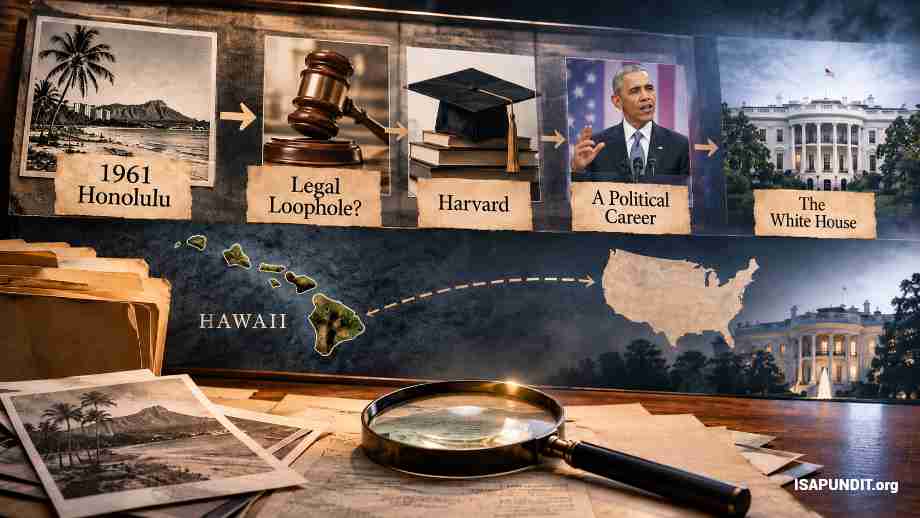 Click Image to Enlarge. Image created via AI.
What Are the Odds?
From a 1961 Honolulu marriage loophole and a silent divorce to Harvard’s ideological vetting, Middle East reversals, an Oval Office intelligence meeting, and coastal mansions—how an improbable chain of events paved a path to the presidency.
Every great espionage thriller begins with a clean legend—a backstory so seamless, so devoid of friction, that no one bothers to look behind the curtain until decades later.
If a novelist had pitched the 1961 Honolulu timeline as a Cold War political thriller, an editor might have rejected it as too convenient: a foreign student with an existing marriage abroad, a young American bride who discovers the truth while pregnant yet files no criminal complaint, a state whose laws uniquely neutralize bigamy, and an unimpeded entry into Harvard University that sets the stage for the Oval Office forty-seven years later.
When you lay the declassified files, statutory codes, demographic data, and political reversals side by side, the statistical odds of every variable aligning without a single failure become staggering—reading less like a conventional biography and more like a sequence where every potential tripwire was quietly disconnected in advance.
The Honolulu Loophole
The opening act takes place in February 1961 on the island of Maui, just eighteen months after Hawaii became the fiftieth U.S. state. Barack Obama Sr., a Kenyan national studying at the University of Hawaii, marries eighteen-year-old Stanley Ann Dunham, already pregnant with their child. What remains unspoken at the altar is that Obama Sr. already has a wife and children back in Kenya.
In virtually any other jurisdiction in America—from New York to Illinois to California—that single omission would have detonated his future.
On the mainland in 1961, bigamy was a felony carrying multi-year prison sentences, and a second marriage was automatically void from the moment the vows were spoken. Even a whisper of a prior marriage would have triggered criminal prosecution, a permanent court record of fraud, and deportation under the Immigration and Nationality Act of 1952.
Hawaii, however, was the one place on American soil where the rules were written differently.
Shaped by a century of Pacific migration, Hawaii’s territorial-era domestic statutes—codified today under Hawaii Revised Statutes § 580-21—classified a bigamous marriage not as automatically void, but merely as voidable. Unless a spouse actively petitioned a court to erase the union, the state recognized the marriage as legally intact. Even more remarkably, Hawaii’s pre-1972 criminal code contained no standalone felony penalty for bigamy—a legal anomaly later documented in the legislative commentary to Hawaii Revised Statutes § 709-900 and confirmed in Social Security Administration legal precedent digests involving overlapping international marriages in Honolulu. In the eyes of Hawaii’s legal system, a man with a wife overseas could marry again on the islands and walk out of the courthouse without a stain on his record.
Silence, Single Parenthood, and the Statistical Odds
Still, a legal loophole only works if the injured party stays silent.
When Dunham learned of the prior Kenyan marriage while carrying her child, the predictable reaction would have been outrage, a suit for annulment, or a demand for financial support. Instead, there was no police report, no fraud filing, and no court battle.
After Obama Sr. left Hawaii and provided virtually no financial support for his son, Dunham waited until early 1964 to file an uncontested divorce in Honolulu—one that omitted any demand for child support and never once mentioned bigamy. As declassified Immigration and Naturalization Service memos later revealed, federal agents in Honolulu were aware of questions surrounding Obama Sr.’s marital history in Kenya, yet because Hawaii never prosecuted bigamy and Dunham never challenged the marriage in court, INS officials declined to pursue deportation.
Consider the sheer compounding improbability of what followed.
In the United States, only one person out of roughly 330 million becomes president at any given time, and for a child raised in a single-mother household following an abandoned marriage, the statistical hurdles are even steeper.
According to U.S. Census Bureau family structure data, millions of Black children in America grow up in fatherless households—a demographic reality linked to higher rates of economic hardship and lower odds of reaching elite academic and political offices. At the same time, public health data compiled by the Centers for Disease Control and Prevention (CDC) and policy researchers at the Guttmacher Institute consistently show that Black women in the United States experience abortion at rates roughly three to four times higher than white women—a stark demographic disparity frequently cited by conservative critics who argue that progressive social policies disproportionately reduce Black family formation while failing to address root economic instability.
That a pregnancy conceived under an unannounced bigamous marriage in 1961 would survive every personal, financial, and legal pressure—and culminate in the White House—defies every conventional actuarial chart.
Birthright Citizenship, the Framers’ Intent, and the “Deporter-in-Chief” Paradox
The child born in Honolulu in August 1961—and the official Hawaii birth certificate that followed—carried a legal status forged by that exact convergence of geography and timing. Under the strict residency rules of the 1952 immigration statute for children born abroad, an eighteen-year-old American mother giving birth outside the United States fell just short of the five years of residency after age fourteen required to transmit citizenship abroad. Birth on American soil in newly minted statehood Hawaii was therefore essential—securing automatic citizenship under the Fourteenth Amendment’s Citizenship Clause and eliminating any territorial ambiguity over natural-born eligibility.
To constitutional originalists and critics of modern immigration policy, that exact mechanism highlights how far current doctrine has drifted from what the Founders and the Reconstruction Framers actually envisioned.
Neither the Founders of 1787 nor the authors of the Fourteenth Amendment in 1868 ever anticipated the modern phenomenon of “anchor babies”—in which temporary visitors, student-visa holders, or unlawful entrants secure automatic U.S. citizenship for children simply by giving birth on American soil. As 1866 Senate floor debates over the Citizenship Clause reflect, Senator Jacob Howard and the amendment’s drafters explicitly designed the phrase “subject to the jurisdiction thereof” to guarantee citizenship to newly freed slaves while excluding foreign nationals owing allegiance to another sovereign. Today, however, that provision is championed by the Democratic Party as an unconditional universal right, as outlined in the Democratic National Committee’s official platform. Yet in a striking political paradox, once in the White House, Obama’s administration oversaw more formal removals than any predecessor or successor—earning him the moniker “Deporter-in-Chief” from immigrant advocates as Immigration and Customs Enforcement logged over 3.1 million deportations across his two terms, even as Democratic rhetoric shifted sharply toward expansive border and citizenship policies.
Harvard’s Double Standards, Roland Fryer, and the Ambition of Power
That spotless Honolulu paper trail also served as the passport to Harvard University—first for Obama Sr. in 1962, and a generation later for his son at Harvard Law School. Even as a law student in 1991, Obama offered a revealing window into his real underlying motive—wealth and financial status—in a co-authored paper titled “Race and Rights Rhetoric,” famously summarizing the ambition for money and power:
“I may not be Donald Trump now, but just you wait; if I don’t make it, my children will.”
Back then, Trump was universally celebrated across New York and Washington society as the ultimate symbol of American success—a popularity later documented in Trump’s own book, Letters to Trump, which compiled decades of warm, flattering private correspondence from Oprah Winfrey, Hillary Clinton, Bill Clinton, Ted Kennedy, and Obama himself—right up until the moment Trump broke ranks with the political establishment and ran against elitist orthodoxy, instantly turning former admirers into fierce adversaries.
Over the ensuing decades, critics have increasingly pointed to Harvard not merely as an elite academic gatekeeper, but as an ideological outpost of the progressive left.
Faculty surveys conducted by The Harvard Crimson show that over 80 percent of surveyed Harvard faculty identify as liberal or very liberal, with fewer than 3 percent identifying as conservative—a campus culture that has produced glaring double standards:
Admissions Bias Struck Down: For decades, Harvard’s race-conscious admissions regime penalized Asian American, white, and Jewish applicants through subjective “personal ratings”—a practice ultimately struck down as unconstitutional by the U.S. Supreme Court in Students for Fair Admissions v. Harvard (2023).
Punishing Empirical Dissent: Just like Trump’s ostracization for challenging political orthodoxy, Harvard enforced ideological conformity within its own ranks through its treatment of Roland Fryer, the youngest Black scholar ever tenured in Harvard’s economics department. After Fryer published a landmark empirical study finding no racial bias against Black Americans in lethal police shootings—noting that officers were statistically no more likely, and in some datasets less likely, to shoot Black suspects than white suspects in similar encounters—he faced intense ideological backlash and was subsequently suspended and stripped of his research lab following workplace misconduct allegations that critics viewed as a coordinated takedown of a scholar who broke ranks with progressive dogma.
Protecting Ideological Allies: By contrast, when Harvard’s former president Claudine Gay faced widespread scrutiny over extensive plagiarism allegations across her academic papers and her congressional testimony regarding campus antisemitism—where Jewish students were left facing hostile campus protests—Harvard’s governing board initially rallied behind her before mounting public pressure forced her resignation.
Hidden Photos, Broken Promises on Israel, and the “Red-Green” Alignment
For conservative commentators, the same willingness to manage narratives and shift alliances defined the Obama presidency’s approach to domestic politics and the Middle East:
The Suppressed Farrakhan Photo
During his 2008 campaign, securing strong Jewish voter support in battleground states like Florida was essential—a coalition that could have been jeopardized had voters seen a 2005 Capitol Hill photograph of Senator Obama smiling beside Nation of Islam leader Louis Farrakhan, a picture deliberately kept hidden by the photographer for twelve years out of concern it would derail Obama’s political ascent.
From “Undivided Capital” to U.N. Resolution 2334
Addressing AIPAC in June 2008 while courting pro-Israel voters, candidate Obama pledged unequivocally that “Jerusalem will remain the capital of Israel, and it must remain undivided,” while insisting terrorist groups like Hamas must be isolated. Yet in the final weeks of his presidency in December 2016, the administration broke decades of U.S. diplomatic precedent by abstaining on United Nations Security Council Resolution 2334, branding Jewish communities in Judea, Samaria, and East Jerusalem—including Judaism’s holiest sites—as having “no legal validity” and constituting a “flagrant violation under international law.”
Iran and the 2009 Green Movement
The “Red-Green alliance”—the strategic convergence between the Western progressive left and Islamist movements—to explain why the administration offered cautious rhetoric when millions of Iranian protesters begged for U.S. backing against Tehran’s theocracy in 2009, and later airlifted $400 million in foreign cash—part of a $1.7 billion settlement—into Tehran on unmarked cargo planes alongside the 2015 nuclear deal, echoing the failed 1994 Agreed Framework concessions to North Korea despite former Israeli Prime Minister Ariel Sharon’s warnings to Washington about Iran’s primary regional threat.
The Oval Office Endgame and the Spoils of Power
In the final chapter of the presidency, the rivalry with Donald Trump—whose name Obama had invoked in his 1991 Harvard paper as the ultimate symbol of American wealth—turned into an unprecedented intelligence showdown. During a January 5, 2017 Oval Office meeting just days before Trump’s inauguration, Obama, Vice President Joe Biden, and top intelligence officials discussed intercepting communications involving incoming National Security Advisor Michael Flynn, setting in motion the FBI counterintelligence investigation and the years-long Russia collusion probe that shadowed Trump’s presidency.
Meanwhile, after leaving office, the contrast between Obama’s public ethos of collective uplift and his private fortunes drew sharp scrutiny—both at home and abroad.
While Chicago’s South Side—where he launched his political career—continued to suffer from relentless violent crime and failing schools, reporters also spotlighted an uncomfortable family contrast in Kenya:
Obama’s youngest half-brother, George Obama, was discovered living in a tin-roofed shack in Nairobi’s impoverished Huruma slum on pennies a day, a recurring source of political embarrassment highlighted in documentaries and interviews, even as his older half-brother Malik Obama publicly accused the former president of abandoning his Kenyan relatives. At the same time, the former president realized the very material ambitions he had described back at Harvard, amassing substantial personal wealth and multi-million-dollar estates in Martha’s Vineyard and Washington, D.C.
Conclusion: Coincidence or Pattern?
In intelligence circles, analysts operate by a simple rule: once is happenstance, twice is coincidence, and three times is a pattern.
Multiply the odds of Hawaii’s singular 1961 bigamy loophole, a pregnant bride’s total legal silence, an uncontested divorce without child support, a narrow statutory window for birthright citizenship never intended for temporary foreign visitors, two generations of frictionless entry into an ideological Harvard that punishes dissenters like Roland Fryer and Donald Trump, a suppressed 2005 photograph, dramatic reversals on Jerusalem and Iran, an Oval Office intelligence meeting targeting an incoming administration, and a fortune culminating in coastal mansions while half-brothers languished in Kenyan slums—and the resulting probability approaches zero.
Whether the Honolulu file was the most improbable chain of luck in modern political history or the earliest chapter in a carefully cleared path to power, one fact stands out: it could have happened nowhere else in America but Hawaii, and only because every institution along the way chose not to pull the thread.
Israpundit is entirely dependent on readers support. Please help me continue educating people with the truth about what is going on in Israel and around the world.


Leave a Reply
You must be logged in to post a comment.