
Peloni: This supports a previous report that Indonesia is part of the plan initiated by Netanyahu, and which has reportedly already been agreed upon and signed.
Involvement of most populous Muslim nation is acceptable to Israel, under US leadership
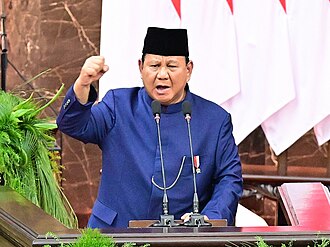 President Prabowo Subianto delivered his first speech before the Plenary Session of the MPR RI after being inaugurated as President for the 2024-2029 period. Photo by Ministry of State Secretariat of the Republic of Indonesia – Setneg.go.id, Public Domain, Wikipedia
As the United States is working to move forward with the international stabilization force (ISF) for Gaza, following the passage of UNSC Resolution 2803 last week, it is finding support from a partner outside the Middle East.
Indonesia, which has a history of being involved in peacekeeping efforts around the world, and is the largest Muslim nation by population, has become a key partner in the U.S.-proposed peace plan for Gaza. Despite having no official relations with Israel, Indonesia is not a newcomer to peace efforts in Gaza.
Already in 2024, Indonesia entered into low-level, discrete talks with Israeli officials over the possibility of allowing a group of Gazans to temporarily resettle in the country with work permits. The plan was picked up by U.S. President Donald Trump’s special Middle East envoy Steve Witkoff, before the announcement of Trump’s initial Gaza reconstruction proposal, which was eventually discarded after lack of support from Arab and Muslim countries.
Indonesia has a mixed history with Israel, involved in efforts to normalize relations with the Jewish State, while also making anti-Israel moves, such as denying Israeli athletes entry into the country for international sports competitions.
Increasingly, the president of Indonesia, Prabowo Subianto, has made public moves seeking a resolution to the Gaza conflict, which has been one of the barriers to normalization between Indonesia and Israel. At one point, President Subianto even planned a visit to Israel, although it was canceled after public protest in Indonesia.
Despite the public backlash against moves seen as too supportive of Israel, Indonesia is moving forward with plans to participate in the post-war Gaza reconstruction, including sending troops to the ISF. U.S. officials have stated several times that they hope to have a Muslim coalition participating in the ISF, in order for the force not to be seen as a Western. occupying force.
With Indonesia publicly committing to deploy troops to the ISF, and with no public opposition to such a move by the Israeli leadership, it appears that Indonesia could become a leading party in the establishment of the ISF. Neighboring countries, such as Jordan and Egypt have hesitated to commit troops to the ISF, fearing public backlash to such a move.
Indonesia publicly welcomed the passage of Resolution 2803, saying it “prioritizes conflict resolution and sustainable peace.”
“Indonesia welcomes the passage of the UN Security Council Resolution on Gaza on Nov. 17, which aims to safeguard the ceasefire and ensure humanitarian aid delivery to Gaza,” Foreign Ministry spokeswoman Yvonne Mewengkang said last week. “The resolution prioritizes conflict resolution and sustainable peace by strengthening the capacity of the Palestinian Authority, reconstruction assistance, and peacekeeping by a UN-mandated international stabilization force.”
The Head of the Information Center of the Indonesian National Army, Major General Freddy Ardianzah, said shortly before the resolution passed, that the army is still undergoing a selection process to choose troops for the ISF.
“The selection process is still at the level of each branch, in the form of planning, while awaiting the final mandate of the United Nations Security Council (UNSC) and the political decision of the Government,” Adrianzah said last Tuesday. The selection process reportedly includes various stages, one of which is selecting soldiers with experience in humanitarian missions, Indonesian news site Tempo reported.
A U.S. official close to discussions over the ISF told i24 News that currently Indonesian and Azerbaijan are two of the Muslim countries in discussions with Washington about committing troops to the force. The U.S. is reportedly seeking broader support for the ISF from regional allies.
NATO member Turkey has expressed interest in sending peacekeeping troops to Gaza, but this proposal faces firm opposition from the Israeli government, which does not trust Turkey because of its close ties to and support for Hamas.
Chuck Freilich, a former Israeli deputy national security adviser and senior fellow at the Institute for National Security Studies, told The Media Line that Indonesia is a preferable partner from Israel’s perspective.
“Since Turkey is unacceptable to Israel [due to Turkish President Erdogan’s hostile rhetoric toward Israel and support for Hamas], Jakarta becomes the better option,” Freilich said.
However, he also said that Israel would likely only accept Indonesia’s participation under the authority of the U.S.
“Israel will not accept a mission led by a Muslim state,” Freilich noted. “Turkey is unacceptable. Indonesia is acceptable, but not as the leader.”
At the same time, the unwillingness of Hamas to disarm, and the repeated incursions by Hamas fighters into IDF controlled areas of Gaza, reveal that the situation on the ground is still too risky to bring in outside forces.
According to Freilich, this could force the U.S. to reevaluate the current situation.
“If Washington concludes that no one is truly prepared to join an international force with the responsibilities we’re discussing, the U.S. and Israel will have to start looking at alternatives,” Freilich said. “I honestly don’t see many good ones.”


It’s curious that despite Hamas’ rejection of their role in the ceasefire, their refusal to disarm, and their continued aggression against Israelis, there is no response from the US.
Essentially Hamas tore up the paper upon which the ceasefire agreement was written.
Instead of confronting Hamas, according to this article Israel and the US are proceeding with the ceasefire agreement.
But only Israel is proceeding with the ceasefire agreement.
Suppose Israel just said, “This ceasefire agreement is null and void.” We will continue to ensure the safety of our country by remaining militarily engaged as needed in Gaza.”
Why must Israel proceed with an agreement that has been broken?