
Leonard Grunstein | Dec. 4, 2025
The reality of how such entities and their agents function speaks to the need for more than just the formal listing of the name of an organization like the Muslim Brotherhood.
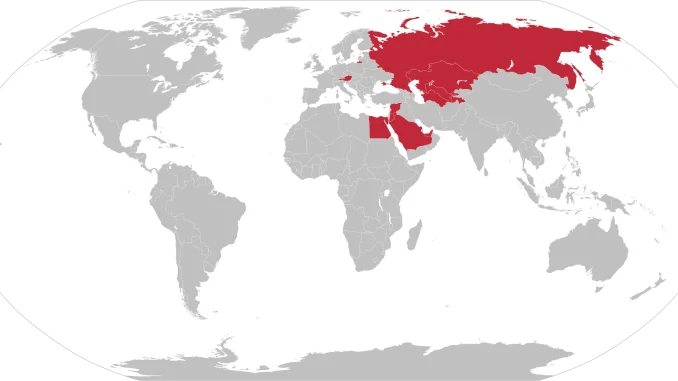 A map of countries that ban the Muslim Brotherhood, as of Aug. 6, 2021. Credit: BlankMap-World.svg via Wikimedia Commons.
The Muslim Brotherhood is viewed as a global network of terrorist jihadists, including U.S.-designated Foreign Terrorist Organization (FTO) Hamas.
By Executive Order dated Nov. 24, U.S. President Donald Trump initiated a process whereby various subdivisions of the Brotherhood are each to be designated as an FTO, as well as for specially designating persons as global terrorists.
Reining in the Brotherhood is a complex process. It is not organized like a U.S. public company with a formal corporate structure, including legal subsidiaries and affiliates, as disclosed in public filings and subject to regulation.
Instead, it is loosely organized to mask its malign activities and frustrate the taking of appropriate criminal and civil enforcement action under U.S. law, including seizing assets.
Activists, with a common purpose and some form of common funding, are bound together through coordination and collaboration, often by means of players associated with an FTO, like Hamas, Hezbollah, the Popular Front for the Liberation of Palestine or otherwise supporting any of them or their nefarious agendas. The web of deceit also includes various types of so-called splinter groups, which nevertheless benefit from material and financial support that can be traced back to the Brotherhood or linked organizations or individuals.
As was proven in the prosecution of the Holy Land Foundation case, the roots of the Brotherhood run deep, and the Holy Land Foundation, using some of the techniques described above, was effectively the umbrella organization for many acting in material support of Hamas in the United States. Indeed, it is reported that the Council on American-Islamic Relations (CAIR) and other U.S.-based Islamist organizations, including Students for Justice in Palestine, Within Our Lifetime and American Muslims for Palestine, have similar links and collaborative ties. The common goals are support for Hamas, anti-Israel and anti-American activities, with coordination and collaboration employed to achieve these malign purposes.
The reality of how terrorist organizations and their agents, associates, affiliates and supporters function in practice speaks to the need for more than just the formal listing of the name of an organization, like the Muslim Brotherhood, as an FTO.
A good example of this linkage in practice is the symbiotic virtual uprising that occurred on many American college campuses in support of Hamas and its goals after the appalling atrocities committed by Hamas and Palestinian terrorists in southern Israel on Oct. 7, 2023.
The playbook followed was developed in coordination with Hamas—or its sponsors and its cohorts—including harassment of and assaults on Jews, abhorrent signs and rhythmic chants calling for the destruction of Israel, as well as the United States. Support was loudly expressed for Hamas’s goal of the elimination of Israel and Jews by any means possible. The horrendous atrocities of Oct. 7, including sadistic sexual assaults, were rebranded, celebrated and justified as acts of resistance.
There was a virtual epidemic of hate, harassment and even violent outbreaks targeting Jews in the guise of protests, tent encampments and the occupation of university buildings, often barring Jews from the use of campus facilities. Disruption of traffic on the streets of major cities was also common, as well as harassment, intimidation and violence.
The nexus to Hamas raises important national security concerns within the purview of the U.S. Anti-Terrorism Act. Under the act, it is prohibited to provide material support or resources to an FTO like Hamas.
To better understand the seriousness of the situation, it is important to understand some of the statutory legalese used in the act.
“Material support or resources” is one of a series of terms defined in the act and refined by the courts. Thus, “material support or services” includes financial, personnel, training, expert advice or assistance; “training” means instruction or teaching designed to impart a specific skill, as opposed to general knowledge; and “personnel” refers to one or more individuals working under the FTO’s direction or control, which is qualified to mean not entirely independently.
In essence, only those individuals who act “entirely independently” of the FTO to advance its goals or objectives are not considered to be working under the FTO’s direction and control.
To violate the act, the person does not have to be an actual terrorist employed by the FTO. He or she must merely have knowledge that the organization is labeled as such and provide it with any such “material support or resources.”
The Federal Court in US v. Jama noted that Congress plainly intended for courts to consider the nature of an individual’s actions broadly in relation to the overall goals of the terrorist organization in determining whether someone is to be deemed part of that organization. It is also intended to reach all persons who act on behalf of an FTO to further its goals and objectives in significant ways, not just those who are a part of the internal command and control structure of the FTO.
The only exception is for individuals who are truly acting entirely independently, which means the individual’s actions cannot be directed by or coordinated with others associated with the FTO or its representatives. Receiving any payment also vitiates independence. The nature and extent of the individual’s contacts with those acting on behalf of the FTO or the individual’s identification with the FTO may also impair independence.
In Holder v. Humanitarian Law Project, the U.S. Supreme Court upheld the constitutionality of the act and found that engaging in political advocacy on behalf of an FTO—or training members in how to use the law or engage in other activities to further the goals of the FTO—was prohibited. The court also noted terrorist groups systematically conceal their activities behind charitable, social and political fronts.
Material support in any form also includes straining U.S. relationships with its allies, like Israel, and undermining cooperative efforts between nations to prevent terrorist attacks.
The danger is real. It’s long past time to take appropriate legal action to enforce the act.


Leave a Reply
You must be logged in to post a comment.