
Geoffrey Clarfield | The TOI Blogs | Nov 18, 2025
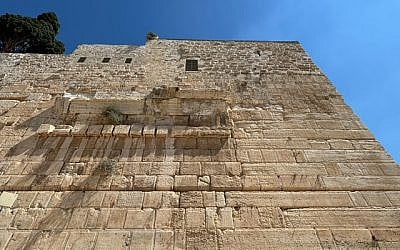 Newly excavated extension of the Western Wall with inscriptions. (Photo by Geoffrey Clarfield).
I first set foot in Jerusalem in 1971. I was an agricultural volunteer on a kibbutz and with my modest pay, took a bus to Jerusalem, stayed in a youth hostel, and toured the new city and the old city, mostly on foot. I walked for miles. I visited every above and below archaeological and historical site that I could, as well as all the museums. I was enthralled.
More than five decades later, I am back again. Much new material has been discovered as excavations have been ongoing for the last fifty years. For example, I have just recently toured the City of David and its ongoing excavations there that reveal, increasingly, the physical remains of the ancient and enduring Jewish presence in the land of Israel.
One of the most astounding finds has been an inscription on a building stone from the Temple of Herod commemorating the place on the Western Wall where the priests once blew the Shofar (sacred ram’s horn “trumpet”) to inaugurate the Sabbath. Archaeologists call it the “Trumpeting Stone.” To this day, Jews still blow the Shofar to usher in the Jewish New Year, a musical custom that is at least two thousand years old.
As I came out of the claustrophobia of the tunnels in this complex and ongoing excavation, I emerged to see a recently recovered part of the Western wall that is just near the Dung Gate (looking as if it had been sandblasted and washed last week). Here you can see a much less celebrated, but equally intriguing archaeological artifact: Hebrew inscriptions most likely dating from the reign of Roman Emperor Julian the Apostate, who ruled from 361-363 AD.
This is the most famous, although a few words are missing in the inscription:
(Isaiah 66:14): “You shall see, and your hearts shall rejoice and your bones shall flourish like the new grass.”
Some archaeologists have suggested that this inscription was a way for the local Jewish community to thank Emperor Julian the Apostate. He had announced that the Jews of Jerusalem and the land of Israel could now rebuild their Temple, as Julian had turned away from Christianity, returning to the polytheism of his recent ancestors without animus towards the Jews.
My guide explained that until these recent excavations, this inscription had lain buried for about 1,700 years since the Romans destroyed the Temple. Some of the large rocks that lie beside this excavated wall are pieces of the Temple that tumbled down when the Romans burnt the Temple. Flavius Josephus, a priest, and Jewish rebel who went over to the Romans at the time of the destruction of the Temple, wrote that you could hear the stones exploding for miles around. It is a place worth lingering.
It was a sunny day. I sat there and stared at the inscriptions. At the time they were made, that part of the wall was at ground level. It would have been easy for stone masons to carve that inscription, no doubt overseen by some Rabbi, for by that time the oral law (what became the Talmud) was supreme in the land of Israel, and was soon to be written out in the Mishna, for the “Pharisees” (Perushim in Hebrew), had long ago superseded the Temple priests for the loyalty of the Jewish people of the land of Israel.
I returned to my brother’s house in Jerusalem and read a biography of Julian the Apostate by British historian Adrian Murdoch. Julian the Apostate (as he was called by his heirs) was raised in a Christian household and was a close relative of Constantine the Great, who favored Christianity and made it the preferred religion of the Roman Empire in the early 300s.
However, Constantine only became a Christian during his deathbed baptism as he felt that he must do some horrible things before that, like murdering his eldest son. Then he could confess and go to heaven.
Julian had been raised in this milieu, and seeing that newly converted Christian rulers and power brokers still behaved like their pagan ancestors, turned against Christianity. He revisited the classical texts and became an intellectual, ascetic, warrior emperor who took justice and ruling very seriously. Although he tried to reinstitute the animal sacrifices to the Gods, he discovered that even among the remaining pagans, they were going out of style.
Scholars of this period (such as Robin Fox in his marvelous book Pagans and Christians) have written mountains of words about third and fourth-century Rome, suggesting its inhabitants were living in an “age of anxiety.”
Somehow, throughout the ages, many of Julian’s letters have survived. They are remarkable and seem almost contemporary.
Here he writes about state support for talented young musicians:
If there is anything that deserves our fostering care, it is the sacred art of music. Do you therefore select from the citizens of Alexandria, boys of good birth, and give orders that two artabae of corn are to be furnished every month to each of them, with olive oil also, and wine. The overseers of the Treasury will provide them with clothing.
And here he is channeling the radical skepticism of Socrates and Aristotle:
However, let us begin with “Know thyself,” since this precept is divinely inspired. It follows that he who knows himself will know not only about his soul but his body also. And it will not be enough to know that a man is a soul employing a body, but he will also investigate the essential nature of the soul and then trace out its faculties.
Julian also had much to say about Jewish and Christian theology and belief. He knew both the Old and the New Testaments very well. He found the mythological nature of Genesis and the belief in Jesus questionable. His criticisms of the mythological basis of the Judeo-Christian tradition presage in many ways Baruch Spinoza’s critique of the Bible more than a thousand years later, a man who provided the philosophical basis for the rise of liberalism and religious tolerance (as well as…Zionism).
Julian was not a fan of Judaism and less so of Christianity, but he was sufficiently enlightened to let the Jews practice their religion freely and rebuild their temple in Jerusalem if they wanted to.
Julian’s basic skepticism and hopeful belief in a multiplicity of Gods driven by some divine force, could have changed the nature of ancient history. Perhaps, had he lived to a ripe old age, he would not have, unlike his successors, forced Christianity on an ambivalent population and instead ushered in an era of tolerance and religious pluralism.
By then, the Temple would have been rebuilt, and who knows what that would have meant for the future of Judaism and the Jewish people. We will never know, for it is a corridor of history that was quickly closed.
Julian died young in battle fighting the Persians. Soon after, the dominant Christian elite of Constantinople, both religious and secular, reasserted Christianity and the Church as a social, cultural, and political force. Persecution of the Jews of this now Christian Roman empire increased leading to numerous Jewish revolts.
The Jews of the Land of Israel who inscribed those hopeful quotes from Isaiah on a wall of the destroyed temple were not likely aware of the complex ins and outs of Julian’s thought. For them, it was enough that Julian had temporarily stopped the persecution that the soon-to-be-called Byzantines waged against them in their native land.
But they did not take this change lying down. Recent research shows that Jews and Jewish/Samaritan alliances revolted against the Christian Roman empire in the land of Israel many, many times during the first six centuries AD, the last revolt being in 610, a few short years before the Muslim conquest.
For the latest in depth historical exploration of this topic see:
These numerous revolts against the Christian Roman empire in the land of Israel have yet to be incorporated into general histories of the Jewish people. They are important for many reasons.
One of them is that it counters the untrue Jewish historical stereotype that after the destruction of the Temple and the growth of the Talmud, Jews became quietist and pacifistic. This has always dovetailed nicely with early and medieval Christian theology that blames Jewish statelessness and conquest by Rome on the Jewish rejection of Christ. It is simply not true.
The Jews revolted against the Christian Roman Empire (later called the Byzantine Empire) again and again. It was only after Emperor “Justinian’s flea” (the plague) decimated the population of the Roman and Persian empires, thus allowing a small band of mounted Arabian adventurers to come north and join a long line of temporary conquerors of the land of Israel, and whom the Jews preferred to the Byzantines.
These few newly unearthed inscriptions cause us to look at our history in a different light. They are salutary. I recommend you go and see them.


Leave a Reply
You must be logged in to post a comment.