
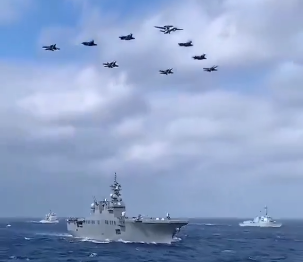
Peloni: So much hardware…Is it reasonable that Trump would put up a false offensive posture without the will to use ultimately use it? I believe that he would use it, and likely, he will have to use it, but most importantly, he should use it. The Iranians have been publicly shaming the US, threatening Trump personally, threatening military bases in the region, and threatening the US armada itself. Deterrence can never be established with those who seek the End of Times in our age, which is likely why Trump has thus far refrained from doing so. Still, the world is watching, and as the Iranians flaunt their disregard for American, US adversaries, particularly those adversaries in the Middle East, see this as weakness, rather than as restraint.
By Amil Imani |
 Screengrab via X
February 2, 2026 – The waters of the North Arabian Sea are no longer just a transit corridor; they have become the center stage for what military analysts describe as the most significant American force-generation event in over a decade. As of this week, the USS Abraham Lincoln (CVN-72) Carrier Strike Group has officially taken up station, marking the arrival of the “massive armada” promised by the Trump administration in response to escalating regional volatility.
This buildup is not merely a “show of flags.” It represents a multi-domain surge intended to signal both a defensive umbrella for regional allies and a “hammer-ready” posture for potential strikes against Iranian infrastructure.
?????? ????:?
????? ?? ??? ?????? ?????? ??? ?????? ?????!????? ?? ???? ?????? ?????? ???? ???? ?? ??? ?? ?? ???? ???? (Armada) ?? ??? ??? ?? ??? ?? ?? ???? ??? ???????? ?? ???? ?? ?????? ??? ??? ???? pic.twitter.com/OQsKzRwdiI
— Taza Halaat (@TazaHalaatNews) January 28, 2026
The arrival of the Lincoln marks the end of a rare “carrier gap” in the region. The strike group brings with it a lethal array of assets, including Arleigh Burke-class destroyers equipped with the Aegis combat system, capable of simultaneously tracking hundreds of aerial threats while maintaining the capacity to launch Tomahawk cruise missiles at targets deep within the Iranian mainland.
This is more than a display of hardware. It is a tactical answer to the IRGC’s “finger on the trigger” rhetoric. These units bring advanced electronic warfare and stealth capabilities, such as the F-35C Lightning II, which can bypass the regime’s aging air defenses with ease.
Beyond the naval surge, the Pentagon has quietly executed a massive logistics bridge. Open-source flight tracking data reveals over 80 C-17 Globemaster III transport flights in the last week alone, funneling equipment to “lily pad” bases across the Gulf. This includes the deployment of additional THAAD (Terminal High Altitude Area Defense) batteries and Patriot missile systems to Jordan, Kuwait, and Saudi Arabia – a move designed to preempt the “swarm” tactics of Iranian-aligned proxies.
The THAAD system operates on a “hit-to-kill” principle, meaning it carries no explosive warhead and instead relies on pure kinetic energy – colliding with the target at speeds exceeding Mach 8.2 (approximately 2,800 meters per second). Each battery is a complex mobile unit consisting of six truck-mounted launchers, 48 interceptor missiles, and the AN/TPY-2 X-band radar. This radar is one of the world’s most powerful mobile systems, capable of detecting and tracking threats at ranges between 870 km and 3,000 km. The interceptors themselves have an operational range of 200 km and can reach a flight ceiling of 150 km, effectively creating a high-altitude “shield” that protects entire metropolitan areas or large military hubs like Al Udeid Air Base.
The deployment comes on the heels of Operation Midnight Hammer, a series of strikes in 2025 that the administration claims “obliterated” Iran’s nuclear program. However, as noted by the Council on Foreign Relations, the current posture is a reaction to Tehran’s attempts to reconstitute its conventional forces and its brutal crackdown on domestic protesters in early 2026.
President Trump has been characteristically blunt, framing the deployment as a “big flotilla” that he hopes he “won’t have to use,” but is “ready, willing, and able” to deploy with “speed and violence.” This strategy of maximum pressure is further detailed in the newly released 2026 National Defense Strategy, which shifts the burden of regional defense toward Gulf partners while maintaining the US as the “strategic backstop” for high-end kinetic operations.
The military pressure from the outside is mirrored by a total collapse of authority from within. The January uprising – triggered by the collapse of the Rial and fueled by forty-seven years of mismanagement – has stripped the regime of its “aura of power.”
Furthermore, satellite imagery provided by Global Times highlights a significant increase in US tactical airpower at bases like Muwaffaq Salti in Jordan, where dozens of F-15E Strike Eagles are now “neatly parked” and ready for rapid sortie generation.
Independent estimates now place the death toll from the recent crackdown in the tens of thousands, a figure that the Council on Foreign Relations warns meets the “gravity test” for crimes against humanity. For those in the diaspora who have spent years advocating for international accountability, the massive US deployment is seen not as a threat to the Iranian people, but as a “rescue” force to prevent the regime from committing further atrocities in its final days.
The US is conducting multi-day readiness exercises to demonstrate “speed and violence” if the regime proceeds with further executions of pro-democracy activists.
The regime’s response has been one of predictable defiance, threatening “all-out war.” Even their traditionally neutral neighbors are beginning to distance themselves, with several Gulf nations refusing to let their territories be used for anything other than the defensive “containment” of Tehran’s aggression.
The sights of carrier-based jets and high-altitude defense systems are not symbols of war, but symbols of an ending. The “Massive Armada” represents a global consensus that the status quo is no longer sustainable. As the US military cements its presence, the shadow cast by these ships serves as a beacon of hope for a future Iran – one that is a prosperous member of the international community, free from the shackles of the current theocracy.
The world has chosen its side. The question now is not if the tide will turn, but how fast.


Leave a Reply
You must be logged in to post a comment.