
Peloni: In reading this essay, consider the words of Gen. Amir Avivi from two days ago:
Gen. Amir Avivi: I attended the Herzliya Conference at Reichman University yesterday and was horrified to discover that most of the speakers are still captive to the Oslo conception, unlike 80% of the people. Even after October 7, it seems that some refuse to part with the perceptions that led us to disaster.
There is no longer an option for separations, for withdrawals, for concessions. There will be no Palestinian state here, and it’s advisable that those who haven’t understood that yet start internalizing it. Peace will come only through strength.
There can and will be no second Palestinian state. Jordan is all they will ever have.
Peloni
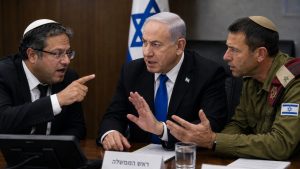 Left to Right: National Security Minister Itamar Ben-Gvir, PM Benjamin Netanyahu, Maj. Gen. Avi Bluth. Image via AI
A series of overlapping incidents in Judea and Samaria has intensified a widening dispute involving military enforcement operations, settlement farm communities, and senior political leadership, with growing tension over how Israeli security resources are deployed and how settlement activity is defined and regulated.
Across multiple locations – including Sha’agat Yehuda farm in northern Samaria, Tzafnat Farm near Tapuah, and the Shirat Tzion homestead near Kedumim – residents report repeated demolitions, confiscations, livestock-related violence, and large-scale enforcement operations carried out by Border Police, Civil Administration inspectors, and IDF forces. These incidents have become part of a broader debate over enforcement priorities and the status of small agricultural outposts.
On-the-Ground Enforcement and Clashes in Samaria
At Sha’agat Yehuda farm, residents described repeated enforcement operations in which structures were demolished and equipment confiscated under the authority of the Menashe Brigade. The report indicates that the operation took place shortly before Shabbat and was followed by continued enforcement activity in the surrounding area.
The same report cites claims by residents that extensive unauthorized Arab construction exists within a short radius of the farm, including structures allegedly subject to demolition orders that have not been enforced at the same pace or intensity. The report further notes that some of this construction is located on the site of a former IDF base, which residents say has been encroached upon without enforcement action.
At Tzafnat Farm near Tapuah, tensions escalated after the reported theft of a flock of sheep by individuals from Huwara. According to the farm’s account, residents and volunteers pursued the stolen livestock and encountered violent clashes involving stone-throwing, clubs, and alleged use of a knife and vehicle ramming. The IDF stated that forces were deployed to prevent escalation, that investigations were opened, and that incidents involving alleged misconduct by soldiers are being reviewed.
Separately, at the Shirat Tzion homestead near Kedumim, Border Police and Civil Administration forces demolished homes belonging to two families in an overnight operation. Residents reported resistance, including one individual who tied himself to a rooftop structure to delay the demolition. Two residents were detained, and claims were made regarding damage to infrastructure such as solar equipment and water containers during the operation.
The residents described the homestead as a small agricultural community with symbolic significance, noting that it was established in memory of Second Lt. Shira Hajaj, who was killed in a 2017 terror attack in Jerusalem.
Bluth, Administrative Orders, and Expanding Institutional Disputes
Maj. Gen. Avi Bluth, commander of IDF Central Command, has become a central figure in the controversy surrounding these enforcement and administrative measures. According to reports, he has issued a series of administrative restriction orders against settlement activists, including house arrest conditions, mandatory reporting requirements, and movement restrictions.
These measures have continued despite Defense Minister Israel Katz’s reported directive to end administrative detention orders against settlers last year, with alternative administrative tools still being used at Bluth’s descretion.
Bluth has also been involved in broader discussions with Prime Minister Benjamin Netanyahu regarding unrest in Judea and Samaria. In earlier meetings, he presented examples of public messaging he said contributed to building tensions, including a video posted by MK Limor Son Har-Melech during an evacuation at a wildcat outpost. National Security Minister Itamar Ben-Gvir rejected this characterization, arguing that criticism of settlement policy should not be interpreted as support for violence.
Heated Cabinet Dispute: Ben Gvir, Netanyahu, and Bluth
The political dispute escalated further during a Diplomatic-Security Cabinet meeting, where tensions reportedly erupted between National Security Minister Itamar Ben Gvir, Prime Minister Benjamin Netanyahu, and Maj. Gen. Avi Bluth.
The discussion focused on settlement activity and the establishment of farms in Areas A and B of Judea and Samaria, alongside concerns about international diplomatic repercussions.
Under the Oslo Accords, Judea and Samaria are divided into three administrative zones: Area A under full Palestinian Authority control, Area B under mixed Palestinian civil control and Israeli security control, and Area C under full Israeli control. Jewish settlement activity is largely concentrated in Area C, while entry into Area A is restricted and considered highly dangerous.
During the meeting, Bluth presented photographs showing MK Limor Son Har-Melech and Heritage Minister Amichai Chikli visiting outposts, arguing that such visits provide legitimacy to unauthorized sites and complicate enforcement efforts.
Ben Gvir strongly rejected this framing, arguing that international sanctions and diplomatic pressure are not directly tied to specific settlement activity but reflect broader hostility toward Israel. He further explained that ministerial and MK visits to outposts are legitimate and not inherently harmful to state policy.
Prime Minister Netanyahu reportedly came to support the military’s position, stating that Israel faces diplomatic consequences for settlement activity in Areas A and B and questioning the expansion of settlement beyond Area C, even as Netanyahu has repeatedly voiced opposition to the creation of a second Palestinian state.
Competing Strategic Visions for Judea and Samaria
The enforcement actions and political disputes have unfolded alongside broader ideological disagreements over the future of Judea and Samaria.
Naftali Bennett has stated that Area C would ultimately be part of Israel, while Areas A and B would remain under Palestinian autonomy. He emphasized that legal construction in Area C is legitimate, while illegal construction or building outside Area C would not be permitted. Notably, Bennett remained silent on addressing illegal Arab settlements which were left untouched while voicing support for the policies of demolishing Jewish settlements.
These remarks drew sharp criticism from Finance Minister Bezalel Smotrich, who argued that such policies would lead to the evacuation of farms and the establishment of a Palestinian state in the heart of the country. Israel Ganz of the Yesha Council similarly warned that such frameworks pose significant security risks following the events of October 7. Local council leaders added that strengthening farm outposts is essential for maintaining Israeli control over strategic areas.
Statement by MK Limor Son Har-Melech
Deputy Speaker of the Knesset MK Limor Son Har-Melech issued a strong statement criticizing what she described as a misallocation of security resources and calling for an immediate halt to demolitions of settlement farms and outposts:
“In days when the State of Israel is dealing with security challenges from all sides – terrorism, infiltration attempts, illegal takeover of state lands, and increasing threats to settlement—it is appropriate to ask where the resources of the security system are being directed. Again and again, repeatedly, they are directed precisely against the pioneers. Farms and settlement outposts are evacuated frequently, as if this is the most urgent mission of the State of Israel.
This morning we saw it again at the Kochav Yehuda farm in Gush Etzion. Dozens of Border Police officers operating under Central Command chief Avi Blot arrived at the site, demolished the family home, the boys’ residential structure, and the water tank, and arrested residents. Just last night, large forces also operated at the Shirat Zion outpost in Samaria.
The policy led by the regional commander has turned the pioneers who are on the front line of settlement into a target. Instead of concentrating all forces on fighting terrorism, on taking control of state lands, and on protecting the citizens of Israel, hundreds of soldiers, Border Police officers, and demolition equipment are being directed against Zionist families who are realizing the vision of settlement.
It is not possible to speak about strengthening settlement while at the same time destroying more and more settlement outposts. It is not possible to speak about sovereignty, and in practice to conduct a policy that harms precisely those who are on the front line of safeguarding national lands.
I demand that this destructive policy be stopped immediately. The role of the IDF is to protect the citizens of Israel, strengthen our hold on the land, and fight our enemies. It is time for the resources, forces, and determination to be directed toward those who threaten the security of the state, and not toward the pioneers who strengthen settlement.”
Conclusion
Across enforcement operations, violent clashes, administrative restrictions, and escalating political disputes, a broader structural tension has emerged between military command, government ministers, and settlement communities over the scope and direction of policies in Judea and Samaria. The incidents described by residents and officials alike reflect not only localized confrontations but also a wider disagreement over how authority, security priorities, and settlement activity should be balanced in a highly contested environment.
A fundamental question arises as to whether the restrictions set in place to support the failed ambitions of creating a second Palestinian state in the Oslo Accords should be maintained or a new reality should be supported, one which respects Jewish settlement activity. At a minimum, if enforcement is to be applied to rising illegal Jewish communities, what possible explanation could be offered in support of foregoing the same enforcement policies against rising illegal Arab communities. As PM Netanyahu argues that settlement activity in Area A and B should not be supported due to diplomatic controversies, it seems that there is some overlap between himself and former PM Bennett’s decision to prevent establishing effects on the ground from conflicting with the ambitions of foreign interests of ultimately moving forward with another rendition of the Two State Solution. This is an unfortunate meeting of the minds of these two figures who actually agree on so little. Is there so little support for recognizing the need to support the settler movement taking place in Judea and Samaria, even beyond the Oslo tripwires in what was once foolishly allotted to be used in the formation of a second Palestinian state in Areas A and B?
Israel needs to change the paradigm which secures any possibility for the creation of a second Palestinian state. As PM Netanyahu has stated, there will never be a second Palestinian state, so why not make any possibility of such a reality irreversible? That is what MK Har-Melech has called for. That is what Maj. Gen. Bluth is acting to prevent. So why is Netanyahu on the wrong side of this argument alongside his nemesis, Bennett?
This issue is not likely to disappear as the political season moves forward and the various political parties in the Right Bloc will try to distinguish themselves from one another and as it seems this is a topic on which there are distinct differences of opinion on how enforcement mechanisms for illegal settlements should proceed. Indeed, this topic is likely to become ever more topical in the coming months, even as there is currently scant reporting taking place on what is a vital aspect of how the future of Judea and Samaria will unfold.
Sources:
https://www.israelnationalnews.com/news/426712
https://www.c14news.com/article/1466042
https://www.c14news.com/article/1465571
https://www.israelnationalnews.com/news/429406
https://www.ynetnews.com/article/r1xgblewbl
https://www.c14news.com/article/1469625
https://www.c14news.com/article/1470472
https://www.israelnationalnews.com/news/429042
Guardians of the Mountains-Shomrei HeHarim


Rahm Emanuel Should Shut the Hell Up
https://open.substack.com/pub/lel817/p/rahm-emanuel-should-shut-the-hell?r=1q2uiq&utm_campaign=post&utm_medium=web&showWelcomeOnShare=true
I agree with the commentors below.
There has been an air of permissiveness with regard to the IDF, which is in charge in Judea and Samaria, and the activities of the so-called Palestinians and their most common helper, the EU. This should have been stopped long ago, but I quite understand the IDF not wanting to cause international issues that the government doesn’t want. It is up to the government to insist on clearing up this mess, but they have to solve the political, international debate first. Just throwing this problem over the fence and leaving it to someone else to do something about it is dereliction of duty, mostly at the political level.
In case this is not quite clear to some readers, when an EU country decides, for whatever reason, to help the Arabs grab land or steal water or build roads where they are forbidden or whatever other crimes they commit, they must be addressed on the political level. If the IDF simply marches in and arrests them or even delivers them to the airport to be deported, there will be a great hullabaloo and the soldiers involved will be punished for doing their jobs. This is unfair to the soldiers and doesn’t achieve the target.
The next step would be to assign a lawyer to deal with the DoJ part of the problem, but they probably don’t have the time or interest. They have plenty of time and interest making sure that terrorists are not bombed in Lebanon or Gaza, why not here? I guess , if they were to do their job, it might impact their careers if they were to go abroad after their period of service.
Trump Empowers Terrorist Regime in Turkey
https://open.substack.com/pub/lel817/p/trump-empowers-terrorist-regime-in?r=1q2uiq&utm_campaign=post&utm_medium=web&showWelcomeOnShare=true
Peloni is 100% correct.. There must never be treason by any Israeli against the ancestral Jewish homeland throughout Judea and Samaria. Oslo was horribly wrong and any Palestinian state exists only in Jordan.
In reading this essay, consider the words of Gen. Amir Avivi from two days ago:
There can and will be no second Palestinian state. Jordan is all they will ever have.