
By Victor Sharpe | August 22, 2025
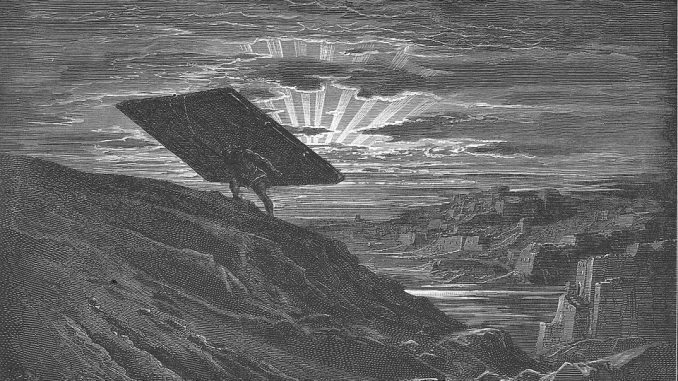 Samson Carries away the Gates of Gaza (Jud. 16:1-13). Painting by Gustave Doré – Doré’s English Bible, Public Domain, Wikipedia
The nearly four-thousand-year-old association of Jewish life in Gaza is little remembered or known in today’s world. Of course, those who have read the Hebrew Bible know of the Biblical story of Samson being blinded by the now extinct Philistines and how he brought down the temple to their gods in Gaza. But very few others have any idea of the deep Jewish history in the following millennia. In the Second millennium BCE, Gaza served as an administrative city and residence of the Egyptian governor of Canaan. The Bible tells us that the Jewish patriarch, Isaac, dug wells in Gerar, an ancient site between Beer Sheba and Gaza, and in the 13th century BCE the Philistines or Caphorites (Cretans) annihilated the Avite inhabitants of Gaza and made the city the largest of their five centers.
After the Israelite Exodus from Egypt and entry into the Promised Land, the tribe of Judah was given Gaza as a possession but did not include it fully in its territory. The Bible reports in Joshua 15.47 and Judges 1:18 how the city of Gaza, and those of Ekron, Ashkelon, Ashdod and Gat became a possession of Israel, but how some of them were among those places ‘lying in the remaining country,’ i.e., not fully possessed by the Israelites.
Down the centuries, Gaza was captured by Assyrians, Egyptians, Babylonians, Persians and later still by Alexander the Great who incorporated it into his growing empire in the 5th century BCE. The strategic territory, lying as it does at the crossroads of two continents, Africa and Asia, has repeatedly fallen since earliest times to invading armies.
In 167 BCE, Judah Maccabee led his Jewish warriors to victory over the Syrian Greek pagan king, Antiochus Epiphanies who had occupied the Jewish homeland. Jerusalem was liberated and the Jewish Temple cleansed of its pagan defilement. The miracle of this event is now celebrated by Jewish believers during the festival of Hanukah. But it was the Hasmonean king, Yochanan, who also liberated Gaza in 145 BCE. He was the brother of Judah the Maccabee, and it was their other brother, Simon, who sent Jewish forces and civilians to repopulate Gaza and its environs.
In the Book of Maccabees: 1:15, it says:
“Not a strange land have we conquered, and not over the possessions of strangers have we ruled, but of the inheritance of our Fathers that was in the hands of the enemy and conquered by them unlawfully. And as for us, when we had the chance, we returned to ourselves the inheritance of our Fathers.”
The Roman general, Pompey, conquered Judea in the First century BC and made Gaza a free “polis” but in 61 CE the Roman Governor, Gavinius, evicted the Jews from Gaza. In the subsequent war against Roman pagan occupation of Judea, between 67 and 70 CE, Jewish forces again liberated Gaza and the homeland before suffering defeat at the hands of Rome’s legions.
Continuing Roman excesses against the Jews led to the Second Jewish Revolt under the command of the charismatic Bar Kochba, known in Aramaic as the Son of a Star. The Emperor Hadrian’s legions destroyed the Jewish state in 135 CE, decimating the Jewish population in an enormous slaughter, and sending thousands into slavery and exile from the Roman slave markets of Gaza.
Under the subsequent harsh Byzantine rule, Gaza’s restored Jewish community nevertheless managed to flourish and during the 4th century Gaza served as the primary port of commerce for the Jews of the Holy Land.
It is interesting to note that in 1967, archaeologists discovered the beautiful mosaic floor of a 6th century synagogue situated on the Gaza seashore, attesting to the size and prominence of the Jewish community of the time.
The great medieval kabbalist Rabbi Avraham Azoulai lived in Gaza where he authored his famed work, Hesed L’Avraham, along with a commentary on the Torah (the first five books of the Bible). The Jewish inhabitants made Gaza a great center of study and towns and villages from Rafah to Yavne sprung up as centers of Talmudic learning.
Many Jews fled to Gaza from Spain at the end of the 15th century where they joined the Jewish community by working in various trades after escaping from the ravages of the Catholic Inquisition.
The great scholar, Rabbi Yaakov Emden, ruled centuries ago that Gaza is an intrinsic part of the Jewish people’s national heritage. “Gaza and its environs are absolutely considered part of the Land of Israel,” he wrote in his work, Mor U’ketziyah, adding, “there is no doubt that it is a mitzvah (commandment and blessing) to live there, as in any other part of the Land of Israel.”
Over the millennia Jews have been expelled from Gaza by many different conquerors but have always managed to return. The Crusaders killed many of Gaza’s Jews, leaving few survivors. Ottoman Turks ruled a vast empire from 1517 to 1917, including the geographical and non-state backwater known as Palestine. They also frequently expelled the Jewish residents but then allowed them to return. This pattern continued for centuries.
Napoleon, marching through Gaza from Egypt in 1799 failed to restrain many of his French soldiers who were joined by local Arabs in abusing the Jewish residents. As a result of Arab persecution, the ancient Jewish presence in Gaza and the nearby villages died out in the first years of the 19th century only to return yet again in the 1870s.
In August 1929, when Arab rioters threatened to slaughter Gaza’s Jews – as they had in a horrific massacre in Hebron – the British army under the Palestine Mandate forced the community to evacuate their homes. In October 1946, on the night following Yom Kippur, the Gaza Jewish community of Kfar Darom was established on land corresponding to the Biblical Jewish village of Darom. It lasted just a year and a half until the outbreak of Israel’s War of Independence in 1948, when Egypt overran the Gaza Strip and illegally occupied it.
In the June 1967 Six Day War, a war of Jewish self-defense, Israel liberated Gaza from Egyptian occupation, making it possible once again for Jews to reside there. In 2001, during Palestinian Authority control under arch terrorist, Yasser Arafat and his Fatah organization, Kassam rocket attacks began to pound the restored Jewish villages in Gaza.
After Arafat’s death, rocket fire continued under his Fatah successor and Holocaust denier, Mahmoud Abbas. But in 2005, Israel’s Prime Minister Ariel Sharon forcefully evicted from their homes the nearly 10,000 Jewish villagers and farmers from Gaza as part of the ill-fated and treasonous Disengagement Plan. At the time, Sharon disastrously attempted to explain the purpose of the Israeli pull-out. He said:
“These steps will increase security for the residents of Israel and relieve the pressure on the Israel Defense Forces (IDF) and security forces in fulfilling the difficult tasks they are faced with. The Disengagement Plan is meant to grant maximum security and minimize friction between Israelis and Palestinian Arabs.”
Sharon had foolishly believed that by removing the flourishing Jewish villages and farms from Gaza, the Arab residents would build a civilized and peaceful society, thus proving to both Israel and the world that they could live in peace with the Jewish state. It was not to be, and Sharon’s hopes now lay shattered.In an election pushed by Secretary of State, Condoleezza Rice, the Palestinian Arabs in Gaza voted eagerly for Hamas and against Fatah knowing full well that Hamas fundamentalist ideology called for the destruction of Israel or any non-Muslim state existing in territory previously conquered in the name of Allah. Hamas will never live in peace with Israel, the Jewish state, even though the Jews are the indigenous and native people of the region and predate Islam by millennia.
Will the pattern that has existed for thousands of years continue; a sequence of Jewish exile from Gaza, followed by inevitable restoration? Those Jews who were disastrously driven out by the Israeli government of Ariel Sharon now wait for the opportunity to again return.
One such Israeli refugee from Gaza, Rachel Saperstein, spoke at a Jerusalem Conference held in Israel in 2009. At the time, she lived with her husband, a disabled terror victim, in a rundown camp along with five hundred other Jewish families driven from their homes located throughout the Gaza Strip.
In her speech, she lamented that not a thing now grows in the village she was forced to abandon during the Disengagement Plan. The greenhouses that were given freely to the Palestinian Arabs were trashed by them. She added the following:
“We know the reason why. Only when the Jews return to their land will the land bring forth its bounty. No Israeli government is to give away any of our land ever again … This is my message.”
Victor Sharpe is a prolific writer and published author of the acclaimed four volume work titled, Politicide: The attempted murder of the Jewish state.


An excellent summary of the history of Jewish residence in Gaza. A Christian pilgrim to the Holy Land in the late seventeenth century and wrote a book describing his observations when he returned to Europe. He discovered a thriving Jewish community in Gaza, and wrote that Jews were 20 per cent of the population of an area largely coterminous with the Gaza strip of today. Christians, he wrote, were 20 percent of Gaza’s population, and Muslims 60 percent. He reported similar population statistics in nearly every other area and region of Palestine. In fact he estimated the Jewish population of the Holy Lan das a whole at about tweny percent of the entire population of Palestine. He also claimed that the country as a whole was thriving, with a considerable amount of commerce and agriculture.
Unfortunately, increasingly harsh and corrupt Turkish rule caused a massive exodus of Gaza’s prosperous educated inhabitants from the Holy Land in the eighteenth and the first half of the nineteenth century. Those Arabs who remained were primitive, mainly illiterate and devoted to robbing travelers and pilgrims on the dirt roads (little more than trails.) Villages constantly feuded with each other and even fought war s with each other, murdering their neighbors and caarying off plunder. Nomadic Bedouin tribes raided all permanent settlements and murdered many of their residents and carried off whatever property, such as sheep, that remained in the towns and villages. Even Turkish officials were afraid to travel in the country with armed escorts. This was the sad reality that Jews encountered when they began to return to the Land of Israel, beginning around 1840. But much of the country remained underpopulated, lawless and barren right up to the time of the British conquest of 1917-18. These are the conditions that the Zionist pioneers of the first five aliyot had to contend with.
Those that do not learn history are doomed to repeat history.