
Peloni: Historical memory provides an important context for a nation’s identity. Indeed, while many might prefer to pretend our history out of existence because of this truth, the historical, archaeological and Biblical record stands nonetheless. We are the heirs to the land of our forefathers, and this fact has been recognized by the modern age in the passage of international agreements and the victories of repeated battles which were each raised to obscure our ownership of the lands which are rightfully documented as our own, Eretz Yisrael.
Hadrian rebranded Judea to annihilate Jewish identity; modern pan-Arabists rebranded themselves to appropriate that identity.
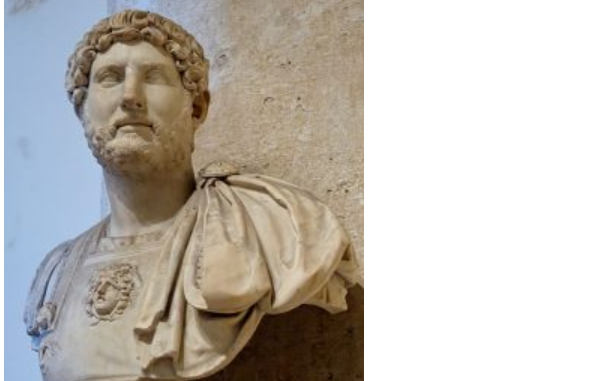 Hadrian. Photo by Marie-Lan Nguyen – Own work, Public Domain, Wikipedia
Almost two millennia ago, the Roman Empire learned that it could not extinguish the Jewish people by sword alone. After the Bar Kochba revolt (132-135 CE), Emperor Hadrian razed Judean towns, rebuilt Jerusalem as a pagan outpost, and reached for a different weapon: he renamed the land “Syria Palaestina,” transplanting the memory of the long-vanished Philistines to sever Jews from their homeland.
The Jewish nation, however, absorbed the trauma, clung to its prayers, and eventually returned in strength. Yet Hadrian’s final twist of the knife never fully left the battlefield. Today it reappears in diplomatic salons, media talking points, and campus chants that insist “Palestine” is ancient and Israel is an imposter (“Free, Free Palestine from the River to the Sea”).
The modern war for Israel’s legitimacy is still being fought with Hadrian’s curse.
On November 17, 2025, the United Nations Security Council adopted Resolution 2803, which explicitly endorses “a pathway to Palestinian statehood” as part of a comprehensive peace plan. Thirteen nations voted in favor, effectively rubber-stamping the fiction that a “Palestinian” people require its own sovereign state. The resolution passed despite the fact that in 1977, Zahir Muhsein, a senior leader of the PLO’s al-Sa’iqa faction, told the Dutch newspaper Trouw, “The Palestinian people does not exist. The creation of a Palestinian state is only a means for continuing our struggle against the state of Israel.” Every major Arab leader who promoted the Palestinian Myth – from Muhsein to Arafat to Shukairy – admitted it was a tactical invention. These leaders knew that there was never a so-called “Palestinian Arab nation” with its own history, language, or culture distinct from other Arab peoples.
Nonetheless, the USA believes, in spite of the counter evidence supplied by Hamas terrorists since 2007, that supporting the creation of a Palestinian Arab state will lead to a peaceful and prosperous middle east. The USA seeks to legitimize a path leading to a two-state solution on land unanimously set aside, by the League of Nations in 1922 in the Mandate for Palestine, as the Jewish National Home.
Note that the Mandate only refers to local residents. No reference even to Arabs! The Palestinians back then were the Jewish inhabitants of the land which had been carved out of the failed Ottoman empire and set aside as the Jewish National Home.
The Security Council in its wisdom, at the behest of the United Sates, just chose to legitimize at the highest level of international diplomacy, Hadrian’s curse transforming a Roman punishment into a modern diplomatic imperative. When the world’s most powerful nations vote to recognize a people, whose own founders declared it nonexistent, the propaganda war has achieved its ultimate victory.
Long before Muhsein spoke, other Arab leaders left a paper trail that exposes the decades-long masquerade:
– In 1956, Ahmed Shukairy told the United Nations, “Such a creature as Palestine does not exist at all. This land is nothing but the southern portion of Greater Syria.” In 1964, Egypt’s Gamal Abdel Nasser hired him to chair the new Palestine Liberation Organization (“Liberation” of pre-1967 Israel).
-Former Syrian dictator Hafez al-Assad repeatedly described Palestine as “an inseparable part of Southern Syria.”
-Jordan’s King Hussein, whose Hashemite family was imported by the British from Arabia to rule over the local Arab population east of the Jodan River, was almost overthrown in “Black September 1970” by Yasser Arafat, claiming to be the leader of a fictitious Palestinian nation.
-But Arafat himself told Oriana Fallaci in 1970, that “Palestine is nothing but a drop in an enormous ocean. Our nation is the Arabic nation that stretches from the Atlantic Ocean to the Red Sea and beyond.”
-Professor Juhan Hazam said that before the 1917 Balfour Declaration “there was no Palestine as a political or geographic unit.”
-The local Arab notable Abd al-Mahdi testified to the Peel Commission in 1937: “There is no such land. Palestine is a term invented by the Zionists.”
Hadrian rebranded Judea to annihilate Jewish identity; modern pan-Arabists rebranded themselves to appropriate that identity.
In 2007, standing at Annapolis, President George W. Bush extolled “two states for two peoples.” But only one people, the Jewish nation, has an uninterrupted historical, religious, and legal pedigree tying it to the Land of Israel. The other, by its own founders’ admission, is a construct designed for diplomatic leverage. Yet Western diplomats repeat the mantra so often that it feels axiomatic.
World leaders talk of a two-state “solution”. Many of them are well meaning if not grossly misinformed. Even people totally committed to Israel’s security have fallen for the myth that prosperity and overnight reform will lead to a utopian existence between Israel and a peace-loving Arab nation in the former west bank of the Hashemite Kingdom of Transjordan. Nothing could be further from the truth.
The so-called path to a peaceful state west of the Jordan River inside historical Judea/Israel is nonexistent.
Arab strategists learned after the Six Day War that they could not defeat Israel with tanks, so they adopted a victimhood imagery. International media outlets were inundated with narratives of a dispossessed “Palestinian people” rebelling against “Israeli occupation,” flipping the reality that a tiny Jewish state was fending off a vast Arab bloc.
When Lord Balfour’s declaration guaranteed a “national home for the Jewish people in Palestine,” he thought he was using a geographic shorthand. In fact, he resurrected Hadrian’s curse and planted the seeds of today’s confusion. British officials themselves admitted the term had no national substance; a 1938 report to the League of Nations stated bluntly, “The name ‘Palestine’ is not a country but a geographic region.” Yet the cartographers of Sykes-Picot had already inked “Palestine” onto their partition maps, and propagandists seized on the label. If the land could be rebranded, so could ownership.
If Israel’s leaders cede the premise that the land is “Palestinian”, that concession transforms every Israeli community across the Green Line and even within pre-1967 boundaries into an “occupation.” Once the biblical heartland is renamed, Jews become historical trespassers, no matter how many archaeological shards bear Hebrew inscriptions.
The Arabs understood this high ground decades ago. Their propaganda war is aimed at erasing the very name Eretz Yisrael, The Land of Israel, from global vocabulary, because once the name disappears, the claim collapses. Israel has been slow to realize that it is fighting an identity war in which surrender can be signed with words rather than bullets.
The Palestinian National Charter first invents a people; then it delegitimizes Israel as a colonial transplant; and finally, once Israel is weakened politically and demographically, it will be absorbed into the existing Arab order.
The Oslo Accords, hailed in Western capitals as a peace breakthrough, functioned as the Trojan horse Muhsein envisioned: Israel illegitimized and armed an authority that promises in its founding document to dissolve itself into a greater Arab nation the moment Israel falls.
When certain Israeli textbooks adopt the language of “Palestinian territories,” they smuggle Hadrian’s curse into the classroom. When some Israeli diplomats echo “two states for two peoples” without clarifying that one of those “peoples” is a political invention, they signal to allies and adversaries alike that Israel doubts its own exclusive claim to Eretz Yisrael. When Western journalists describe Tel Aviv as the Israeli capital while calling Jerusalem a “disputed city,” they reenact Hadrian’s attempt to sever the Jewish heart from its body.
The recent UN Security Council Resolution 2803, which endorses a pathway to Palestinian Arab statehood, represents the latest example of international institutions codifying a historical falsehood into diplomatic reality.
Israeli diplomats must challenge every Security Council member that voted for this resolution with the documented admissions of Arab leaders who created the Palestinian Arab “identity”. Press secretaries should be confronted with the quotes from Muhsein, Arafat, and Shukairy that admit the deception. Educational exchange programs should require Palestinian Authority participants to acknowledge the content of their own charter. International media outlets should be challenged every time they refer to “occupied Palestinian land” without acknowledging that the name itself was an imposed fiction.
By pushing for this rigor, Israel isn’t engaging in semantics; it is defending the prerequisite for any durable peace-the recognition that the Jewish people are indigenous to their own homeland.
Hadrian is long gone, but his heirs march under new banners. They do not need legions when diplomats, journalists, and even some Israelis will speak his curse for them. Breaking that spell requires courage, clarity, and a refusal to outsource Jewish history to those who wish to rewrite it.
The land is not Palestine. It never was. It is Eretz Yisrael, the Land of Israel-the only homeland the Jewish people have ever known, the jewel for which they prayed across millennia, and the inheritance they must never again allow anyone, emperor or propagandist, to rename out of existence.
(Ed. note: The Talmudic Sages cursed Hadrian, saying, “may his bones be crushed” because of Hadrian’s brutal suppression of the Bar Kokhba revolt (132-136 CE) and his subsequent harsh decrees aimed at eradicating Jewish nationalism and religious practice.)
Dr. Michael Wise is a founder and investor in numerous technology companies. He is a graduate of YU and holds a PhD in Theoretical Physics from Brandeis U., is the co-author of Israel demography study (BESA).and has published numerous articles about Israel sovereignty and demographics in Judea and Samaria. mlwise@gmail.com


Thisis all a bit sardonic given Hadrian was ahomosexual without children. This one is of surprisiing longevity.
Part of the problem is that when the modern geography books: G. Adams and D. Baly were written in the first half of the late century “Palestine” was a geographical expression for both sides of the Jordan watershed/basin and avoided “The Holy Land” and Ottoman sanjak and vilayet borders. Further “Philistia” is the coastal strip of the country from Carmel to Rafah and onto the “shfelah” the upper plain short of the central hills of Judea and Samaria.
Perhaps instead of constantly using the name “Palestine” we (for a start) should start to use the name “Hadrian’s Palestine” or alternatively “Syria Palaestina”.
It seems we’ve built a “Palestine Rut” and are using it constantly.
A very bad habit… Time to shake it off…
?! Don’t refer to Arab/Muslims as Palestinians but Fakestinians!
Well… using the word PALAESTRINA gives it a nice Latin edge, and (I believe) gets you out of the “Palestine Rut”.
People might start asking questions about this sudden change of name.