
By | Nov 27, 2025
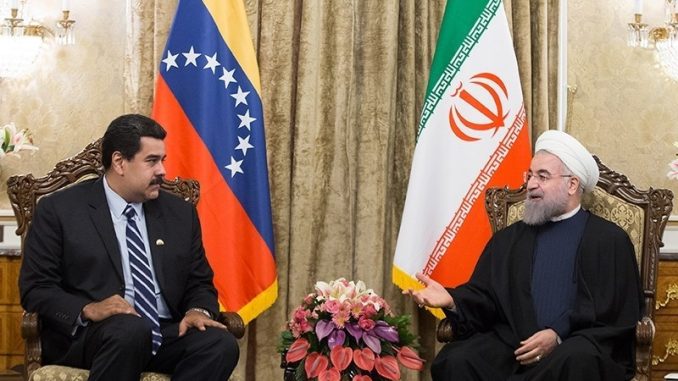 Iranian President meeting with Venezuelan President Nicolás Maduro in Saadabad Palace. Photo by Tasnim News Agency, CC BY 4.0, Wikipedia
Despots like each other’s company: Hitler and Mussolini, Stalin and Chairman Mao, Franco and Salazar, and now, Maduro and Ayatollah Khamenei. In fact the Iran-Venezuela alliance goes back several decades, but only now has it fully blossomed in all areas. More on their many-sided partnership can be found here: “The Cross-Continental Threat: Iran and Venezuela’s US-Defying Partnership,” by Ray Palumbo and Yoni Tobin, Algemeiner, November 25, 2025:
Bad actors stick together. Few relationships prove that more clearly than Iran and Venezuela’s. The regimes’ close ties are on full display with Iran’s foreign ministry on November 15, threatening the United States with “dangerous consequences” over the US military buildup near Venezuela’s shores.
It’s not just talk: the Iran-Venezuela strategic partnership has matured into a robust, multi-dimensional alliance, impacting both regional security and US foreign policy calculations. Iran and Venezuela’s cooperation spans the social, political, diplomatic, economic, and military domains — and is directly influencing the US posture toward Venezuela, including the recent military buildup near its shores and targeted strikes on drug trafficking operations.
The Iran-Venezuela partnership began in the 1950s and has deepened substantially, especially after former Venezuelan President Hugo Chávez declared the countries “brothers” in 2005….
Economically, the alliance is built on mutual circumvention of Western sanctions. Iran and Venezuela have exchanged oil, gold, and infrastructure assistance, often using Iran’s Islamic Revolutionary Guard Corps (IRGC) and Hezbollah-linked front companies for money laundering and sanctions evasion. This economic cooperation enables the Maduro regime to survive by generating hard currency and illicit financial streams, while also facilitating transnational criminal activity including drug trafficking, with groups such as Cartel de los Soles and Tren de Aragua working with Hezbollah proxies to move drugs into US territory. The proceeds fuel both regimes and deepen their partnership and resilience to international pressure.
Simultaneously, Iran and Venezuela collaborate on energy trade that is inimical to US interests and enriches Russia. Iran not only exports refined crude oil to Venezuela to enrich itself, but also helps Venezuela build and fix energy infrastructure, increasing Venezuelan storage and refining capacity. In turn, that boosts Caracas’s appetite for Russian naphtha, a petroleum product that further enables Venezuela to dilute and export its oil, giving Russia a new and growing energy market for its exports to replace Europe and undermining Western sanctions.
As the US presence in the region grows, Venezuela and Iran have enhanced their military coordination. Recently, Venezuela requested additional Iranian drones, military electronics, and asymmetric warfare technologies. Iran provides technical personnel and expertise, optimizing Venezuela’s capacity for electronic warfare and irregular tactics, thereby enhancing deterrence and complicating US intervention plans.
Against this backdrop, the United States has deployed significant naval assets and possibly special operations elements off the coast of Venezuela, amounting to the largest regional buildup since the Cuban Missile Crisis. Officially, the United States has justified this surge to counter escalating drug trafficking, with at least 20 recent kinetic strikes on alleged narco-trafficking vessels departing Venezuelan ports. Many of these drug networks are tied to Venezuelan state actors and Iran-linked proxies. It would not be a stretch to assume that the Maduro regime is leveraging its Iranian connection as strategic insurance….
Iran — along with its proxy Hezbollah — and Venezuela are force multipliers. All three work in concert to enrich the Iranian regime, strengthen Venezuela’s military and imperil regional stability, and facilitate transnational crime that threatens the US homeland. Washington should not allow this Venn diagram of threats to continue converging.
The US has now shown that it will no longer tolerate Venezuela’s narco-trafficking, by destroying the boats carrying drugs from that country to the Caribbean, from where they are then sent on to the United States and to Europe. This cuts down on Venezuela’s revenues, and also damages Hezbollah, whose operatives in Venezuela are deeply embedded in the drug trade, including some who may be aboard those narco-boats that the Americans have been blowing to smithereens. For Hezbollah, Venezuela has served as its gateway to South America. If Trump decides to send troops into the country to destroy drug labs and other facilities, it is likely that Maduro will be toppled. And his successor will want to boot out Hezbollah, that has been so helpful in sustaining the regime. And then the Venezuelans, freed at last from the Chavez-Maduro dictatorship, will renew ties with the U.S. and at the same time, at America’s behest, cut all those economic and military ties with the Islamic Republic that had been so carefully constructed over several decades.


Leave a Reply
You must be logged in to post a comment.