
Peloni: This is a must read article. Walter and Jacob hit it right on every point.
By Jacob Kohn and Walter E. Block
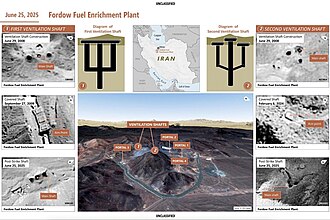 A graphic shared at the press conference today with additional details about the employment of MOPs on Fordow during Operation Midnight Hammer. Photo by United States Department of Defense – https://www.twz.com/air/gbu-57-massive-ordnance-penetrator-strikes-on-iran-everything-we-just-learned, Public Domain, Wikipedia
On June 20, 2025, President Donald Trump authorized the most consequential military action of his second presidency: U.S. B-2 stealth bombers dropped massive bunker-buster bombs on Iran’s nuclear facilities, including the heavily fortified Fordo site buried 300 feet beneath a mountain. This action, while controversial, was both necessary and overdue.
Why America Had to Strike
The strike came after Israel launched its own comprehensive military campaign against Iran on June 13, targeting nuclear facilities and eliminating key military commanders and nuclear scientists. For nine days, Israel fought largely alone against a nation ten times its size in population. When Israeli capabilities proved insufficient to neutralize the underground Fordo facility (requiring 30,000-pound bunker-busters and B-2 bombers that only the U.S. possesses), American intervention became essential.
Critics will argue that Trump violated his promise to avoid foreign entanglements. Yet this misses the larger picture: preventing a nuclear-armed Iran supersedes campaign rhetoric. As Trump himself acknowledged, the situation in June 2025 was unforeseeable when he made those promises. More importantly, his commitment that Iran would never obtain nuclear weapons demanded action when diplomacy had clearly failed.
Israel’s Right to Defend Itself
Israel’s initial strike on June 13 was legitimate self-defense, not unprovoked aggression. Iran has spent decades explicitly calling for Israel’s destruction:
• Ayatollah Khomeini denounced Israel as a “cancerous tumor” that must be removed
• Supreme Leader Khamenei threatened that Israel would cease to exist by 2040
• Former President Ahmadinejad declared Israel “has no roots in the Middle East and would be eliminated”
These weren’t idle threats. Iran has consistently backed its rhetoric with action through its proxy network of Hamas, Hezbollah, and the Houthis, who have terrorized Israeli civilians for years. When a nation repeatedly threatens genocide and actively works toward that goal, preemptive action becomes both justified and morally imperative.
What Allies Do for Each Other
The U.S.-Israel relationship, though asymmetric in power, represents a genuine alliance between democratic nations. When Israel, despite its remarkable military capabilities and world-leading technology sector, faced a threat beyond its capacity to handle alone, American support fulfilled basic alliance obligations. Partners support each other, especially when facing existential threats.
Yes, Trump bypassed Congress, violating constitutional provisions requiring legislative approval for acts of war. But this constitutional requirement has been a dead letter since 1941, with numerous military actions undertaken without formal declarations. Obama dropped 26,171 bombs in 2016 alone across seven countries without congressional approval, authorizing 542 drone strikes during his presidency that killed an estimated 3,797 people. Biden similarly launched strikes in Yemen, Syria, and Iraq without seeking congressional authorization. The precedent, while troubling, is well-established across administrations of both parties.
The Dangerous Peace
Here’s where the current situation becomes concerning. Despite Trump’s June 23 declaration of a ceasefire and claims of “UNCONDITIONAL SURRENDER,” the reality is far more complex. Initial intelligence assessments suggest the strikes may have only set Iran’s nuclear program back by months, not years. The underground facilities at Fordo, while damaged, may not be completely destroyed.
More troublingly, Trump’s rush to declare victory and push for peace contradicts his own stated goal of unconditional surrender. Iran remains under the control of the same regime that has terrorized the region for decades. Its leadership, while wounded, remains intact. Its nuclear ambitions, while delayed, remain unchanged.
The ceasefire, brokered after 12 days of intense conflict that killed 610 Iranians and 28 Israelis, appears fragile at best. Both sides immediately accused the other of violations. Iran’s Foreign Minister Abbas Araghchi declared that Tehran is now “more determined” to pursue its nuclear program. This resembles a tactical pause, not surrender.
Finishing What We Started
The Israeli military’s focus may now return to Gaza and Hamas, but the Iranian threat remains. As IDF Chief of Staff Eyal Zamir acknowledged, while a “significant chapter” has concluded, the campaign against Iran continues. This half-measure approach risks repeating history’s mistakes.
True victory requires regime change in Tehran. The Iranian people, who have repeatedly demonstrated against their oppressive government, deserve liberation from leaders who prioritize nuclear weapons and regional domination over their welfare. The precision of Israeli and American strikes, which targeted military and nuclear facilities while minimizing civilian casualties, shows this is a war against the regime, not the Iranian people.
Trump’s call for peace is premature. Iran has not surrendered, conditionally or otherwise. Its nuclear program, while damaged, survives. Its leadership, while bloodied, remains in power. Its ambitions, while temporarily checked, persist.
The Hard Truth
The June 2025 strikes were necessary but insufficient. Destroying Iran’s nuclear capability was the minimum requirement; ending the regime that pursues such weapons should be the goal. Until Iran’s leadership genuinely abandons its nuclear ambitions and stops threatening its neighbors, the job remains unfinished.
Peace through strength requires actual strength, consistently applied. Half-measures and premature ceasefires only guarantee future conflicts. If we truly seek lasting peace in the Middle East, we must see this through to its logical conclusion: the end of the Iranian regime’s threat to regional stability and global security.
The mouse may have roared, and the eagle may have struck, but the serpent still coils in Tehran. Until that changes, talk of peace remains both premature and dangerous.
Consider this: In the days following the ceasefire, oil prices plunged and global markets rallied, reflecting relief that Middle Eastern oil supplies remained secure. But market relief should not be confused with strategic success. A wounded but intact Iranian regime, nursing grievances and maintaining nuclear ambitions, poses a greater long-term threat than short-term market volatility.
History teaches us that leaving totalitarian regimes in power after military defeats rarely produces lasting peace. Germany after World War I, Iraq after the Gulf War, and countless other examples demonstrate that half-victories often lead to worse conflicts later. We cannot afford to repeat these mistakes with a potentially nuclear-armed Iran.
The Iranian people deserve better than their current leaders. The American people deserve better than endless cycles of Middle Eastern conflict. The Israeli people deserve better than living under constant existential threat. Only decisive action can break this cycle.
Note: The facts cited in this piece have been updated to reflect the actual events of June 2025. The claims about “unconditional surrender” appear to be aspirational rather than factual, as no formal surrender has been announced by Iran, and the conflict ended with a negotiated ceasefire rather than capitulation.


I agree 100 percent with Kohn and Block’s main point–that the United States had a moral obligation to bomb Iran’s “nuclear facilities,” and Israel had an obligation to its own people to destroy Iran’s nuclear facilities. They are also right that this should have been done years ago. In my opinion, back in 2003, when U.S. and American military intelligence both learned that Iran had begun work on a nuclear weapons program. In other words, the bombing missions of 2025 were twenty-two yeas late, Let us hope and pray, not too late.
I disagree, though with Kohn and Block’s claim that the U.S. constitution makes it illigal for the President to use military force in any and all situations where the U.S. faces a serious threat to its sovereignty or national security. Alexander Hamilton, in the Federalist papers, wrote that the President had the authority to use military force to respond an immediate serious threat to its sovereignty or national security. Some years later, while he was president, at the time of Aaron Burr’s conspiracy, expanded on this interpretation of the constitution. The threat of anyone, even an American citizen as Burr was, to seize American territory obligated the president to order the U.S. military to take action to eliminate this threat. Jefferson did just that, ordering the U.S. military to arrest Burr and his co-conspirators. Abraham Lincoln cited the same doctrine when he called up the state militias of the Northern and Western states, to suppress the Confederate secession, even before Congress, then not in session, could convene to authorize this action.
In my opinion. Iran does represent a clear and present danger to America’s national security. Its leaders have repeatedly called for the destruction of the American “Great Satan.” They are either on the verge of developing nuclear weapons, or may even already have them. They are on the verge of developing intercontinental ballistic missiles that could hit the United States with nuclear warheads. They already possess missiles that could strike our European allies. In my opinion, all this means it is well within President Trump’s constitutional authority to attack Iranian nuclear weapons manufacturing sites and intercontinental rocket launchers that could deliver nuclear bombs to our European NATO allies. He should launch a much bigger attack than the one he authorized earlier this year.