
Peloni: As Iraqi Shia militia’s move to support Iran in the current war, the political crisis at home remains. The choice of a new leadership continues to stand as a political contest between America and Iran, with Iraq’s future weighing in the balance. Will the political deadlock be maintained or will a political coalition finally come to be formed. Both the political and military stability of Iraq stand in the shadow of Iran’s power projection, making the outcome of the current war significantly relevant to the Iraq’s ability to choose its own government. So, while Iran is still able to assemble its military arms in Yemen, Lebanon and Iraq, the coming vote will show us if Iran still maintains its leverage over the political process in Iraq, or if there has been a shift due to current events, making the April 11 vote a litmus test of Iranian power in Iraq.
Jafaj | April 1, 2026
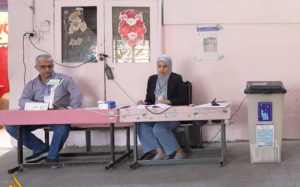 Iraqi polling stations in the 2025 election. Screengrab via Youtube
EXECUTIVE SNAPSHOT
The Iraqi Council of Representatives is set to convene on April 11 to elect a president, marking the most credible attempt in months to break Iraq’s political deadlock.
This session is not a resolution—it is a test of whether the system can function.
At stake is not simply the presidency, but the ability to form a government and restore executive authority.
CORE INSIGHT
Iraq does not select winners—it prevents losers.
The presidential process is not an election in the conventional sense. It is a negotiated allocation, shaped by coalition acceptability, veto power, and quorum control.
HOW THE SYSTEM ACTUALLY WORKS
Two thresholds define the outcome:
- 220 votes ? quorum (controls whether a vote happens)
- 165 votes ? majority (determines who wins)
This creates a system where:
- Coalitions must first enable the vote
- Only then can they attempt to win it
Implication:
Actors who cannot win can still block the process entirely.
LIKELY OUTCOME
The most viable coalition remains:
- Coordination Framework (~130)
- Sunni blocs (~60)
- PUK (~18)
? ~208 votes (above 165, near quorum)
This positions Abdul Latif Rashid as the most likely outcome, provided quorum is secured through limited additional support.
Alternative pathways (KDP-led) lack the numbers to win and rely primarily on boycott leverage.
WHAT THIS MEANS STRATEGICALLY
This election does not change Iraq’s alignment—it reveals it.
- United States: retains access, loses leverage
- Iran: maintains structural advantage through embedded influence
- Europe: prioritizes stability over outcome
- China: benefits from continuity and economic access
Bottom Line:
A Coordination Framework–aligned outcome reinforces a stable but Iran-tolerant equilibrium.
WHAT TO WATCH (NEXT 7–14 DAYS)
- Quorum formation (220 threshold) ? decisive indicator
- PUK–KDP positioning ? determines Kurdish alignment
- Sunni bloc participation ? stabilizes or disrupts coalition
- Independent attendance ? determines whether vote occurs
ACTIONABLE TAKEAWAYS
FOR GOVERNMENTS
- Engage across all blocs—not just preferred partners
- Prioritize system functionality over candidate preference
- Prepare for delay—deadlock is structural
FOR BUSINESS
- Track who controls execution—not titles
- Maintain presence in both Baghdad and Erbil
- Expect continuity, but slower decision cycles
FINAL BOTTOM LINE
The key question is not:
Who will win?
It is:
Who can assemble enough alignment to allow the vote to happen?
Until that threshold is crossed, outcomes remain suspended—not because of failure, but because of design.


Leave a Reply
You must be logged in to post a comment.