
Peloni: Herein lies the consequences of the failed US Turkey policy which has come to embolden an already too emboldened Erdogan as he looks to fulfill his nation’s long held hopes of rebuilding the long lost empire of the Ottomans.
By
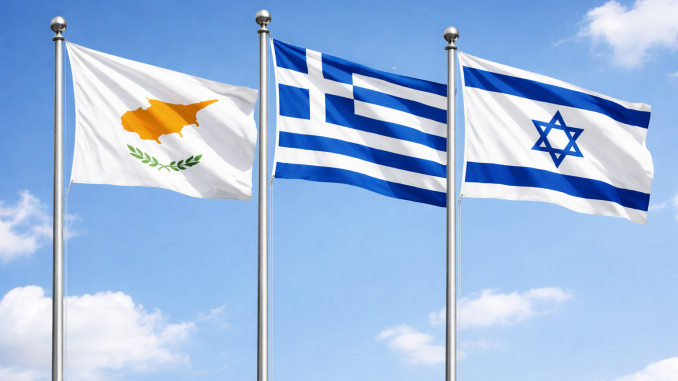 Flags of Israel, Greece and Cyprus. Image via AI
Israel, Greece, and Cyprus share a common enemy, Turkey, that has been projecting its power in the eastern Mediterranean by establishing military outposts in Syria. Turkey has also made large claims about the extent of its own territorial waters, no doubt hoping there is oil and gas under them.
Now Israel, which Turkish President Recep Tayyip Erdogan has repeatedly threatened to destroy, and has even suggested that a pan-Islamic army be created to destroy the Jewish state, has been looking for allies in the region to oppose an aggressive Turkey, and has found both Greece and Cyprus fit the bill. Greece’s Prime Minister, Kyriakos Mitsotakis, is known for his support of Israel, though he has also warned Israel, “as a friend,” that by opposing the “two-state solution,” it risks losing more international support. The president of Cyprus, Nikos Christodoulides, maintains an even stronger pro-Israel stance. He has deepened energy, defense, and economic ties with Israel, viewing it as a key strategic partner holding an aggressive Turkey in check.
Now the three countries have come together to discuss establishing a rapid-response force consisting of troops from all three, in the hope that Turkish aggression may thereby be deterred. More on this rapid-response force can be found here: “In move to deter Turkey, Israel explores creation of rapid-response force with Greece, Cyprus,” by Amichai Stein and Yonah Jeremy Bob, Jerusalem Post, December
Senior officials from Israel, Greece, and Cyprus are discussing the possibility of establishing a rapid-response force composed of units from the armed forces of the three countries, three people familiar with the matter told The Jerusalem Post.
The initiative is part of a broader effort to deter Turkey’s military and strategic activities in the Eastern Mediterranean, they said….
On Monday, Defense Minister Israel Katz met with his Cypriot counterpart in Israel.
The concept they discussed envisions a unit of about 2,500 personnel, some 1,000 soldiers each from Greece and Israel, and 500 from Cyprus, Greek news site Tanea reported.
Discussions on the proposal are ongoing, two sources told the Post.
The establishment of such a force, and even discussions about its establishment, is intended to send a message to Turkish President Recep Tayyip Erdogan.
“If you take this and you add it to the deepened military cooperation of the last 15 years, to me this could be a natural extension of this cooperation,” Angelos Athanasopoulos, a Greek geopolitics and security expert, told the Post. “And the main country from which it will receive a backlash will be Turkey. Following recent comments in both Greek and Israeli press, this really raises some eyebrows in Turkey.”
Erdogan can dish it out but he can’t take it. He can call for a pan-Islamic force to destroy Israel, clearly envisioning himself as its natural leader, he can promote a maritime policy that refuses to recognize the territorial waters and exclusive economic zones granted to Greece and Cyprus under international law, he can send his ships deep into the Aegean to enter the territorial waters of both Greece and Cyprus, but should Israel, Greece and Cyprus appear to be making plans for deepening military cooperation in the form of a rapid-response force, the Padishah in his 1,150-room Ak Saray, or White Palace, is enraged. His sock- puppets in the Turkish media have become just as agitated.
Ankara is seeking to turn Syria into a Turkish satellite state, including the deployment of air-defense systems aimed at aircraft and missiles in Syrian territory.
At the same time, Turkey is pursuing involvement in the multinational force in the Gaza Strip and is holding talks with both rival governments in Libya in an attempt to negotiate a new maritime agreement. Such a move could allow it to become a dominant player in the maritime space of the Northern and Eastern Mediterranean….
Turkey will not be permitted to send its troops into Gaza, period. The Israelis have made that clear. But in Libya, Turkey is talking to the rival governments based in Tripoli and Tobruk, in the hope that it may be able to negotiate a new maritime agreement that will provide Turkey with recognition of its expansive claims to territorial waters in the eastern and southern Mediterranean.
Greece has just signed a $3.5 billion dollar deal with Israel to buy weapons, including the LORA long range ballistic missile developed by Israel Aerospace Industries (IAI) and the PULS (Precise and Universal Launching System) from Elbit.
This triple entente, beginning with this rapid-response force, is a good first step in what could turn into a formal defense pact, a mini-NATO in the eastern Mediterranean, that has only one aim — to hold Erdogan, and his military, in check. In time, this anti-Turkey alliance could attract other riparian states, possibly including France, Italy, and Egypt, all three of which have serious disagreements with Erdogan.


Leave a Reply
You must be logged in to post a comment.