
Peloni: A truly joyous reckoning is taking shape, and this is only the beginning.
By | Feb 14, 2026
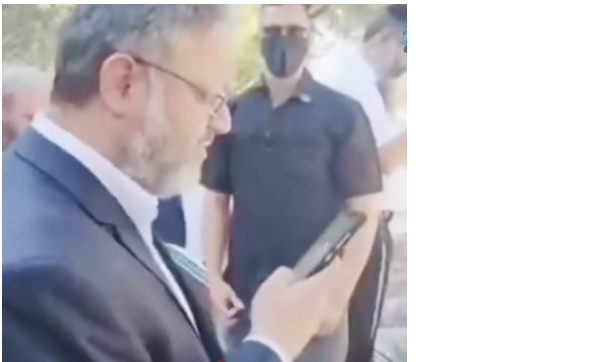 Min. Ben Gvir and others praying at the Temple Mount. Screengrab via Youtube
In 1967, Israel took back by force of arms from Jordan the Old City of Jerusalem, including the Temple Mount that is the holiest site in Judaism. For the first time since the 1948 war, Jews could now visit the Temple Mount. However, Defense Minister Moshe Dayan made a fateful decision, intended to lessen tensions and prevent a violent outburst from the Arabs, already smarting from their defeat in the Six-Day War. He prohibited Jews from praying, or bringing with them prayerbooks, or from wearing tefillin, when visiting the Mount. In fact, Jews were not even allowed to silently mouth prayers. Israeli police monitored the Mount and stopped any Jews who were. violating those rules.
Now that prohibition on Jewish prayer at the holiest site in Judaism has finally been lifted by the government of Israel. More on this decision can be found here: “Jews pray on Jerusalem’s Temple Mount as decades-old status quo begins to shift,” by Linda Gradstein, Jerusalem Post, February 13, 2026:
Escorted by police, a group of about 25 people walked across the Temple Mount esplanade to the steps leading up to the Dome of the Rock, the site where the First and Second Temples once stood.
They climbed a few steps toward the mosque, singing “Yedid Nefesh” (“soulmate”), usually sung on Friday nights.
“Are you with us?” a policeman asked this reporter.
When I said no, he told me to stop filming as participants in the group continued to video themselves walking on the large courtyard of the mount.
The men did not want to be interviewed, but Ilana, one of the few women in the group – who asked that only her first name be used – agreed to speak.
Wearing a white kerchief covering her hair, Ilana said she had immigrated to Israel from the Ukraine.
“I used to go to pray at the Kotel,” she said, referring to the Western Wall, just below the Temple Mount. “But then I started coming here whenever I had the opportunity. It feels very special to pray here.”
A few Muslims sitting on a nearby stone wall watched the group silently.
Ali, who said he goes to pray every day at Al-Aqsa (so called because it was “the farthest” mosque from Mecca when the Quran was revealed), said Jewish groups visiting and even praying there doesn’t bother him.
“It does disturb some people, but it doesn’t bother me,” he said. “If they do it quietly, it’s okay. People should worship God in the way they want to.”
But other Palestinians disagreed. A group of three women from the Galilee, who said they come about once a week to pray at the mosque for their families and for those who were killed in Gaza, frowned as they watched the Jewish group.
“This place is for Islam, and Jews are supposed to pray at the Wall,” Samira said….
Not a hint from this Muslimah that on the Temple Mount, where the First and Second Temples stood, the place Jews regard as holier than all others, Jews too should have a right, like Muslims — for whom the Temple Mount is only the third holiest site after Mecca and Medina — to pray there. Empathy for the Infidels is not a Muslim trait.
Note that the Temple Mount is holy to Jews because of a historical fact: the First and Second Temples were built on it. But it is holy to Muslims not because of any verifiable fact, but because of a belief in the supernatural: Muhammad traveling to the “farthest mosque” — which the Muslims then identified, in an act of religious appropriation, as being located right on the Temple Mount, the place holiest to the Jews.
Israeli officials deny that there has been a major change to the status quo….
The Israelis try to downplay this because they don’t want to stir up the Arabs or attract the ire of the UN, or the assorted Tlaibs, Omars, and Albaneses always ready to pounce. One can well imagine a UN Resolution demanding that “there be no change in religious observances on the Haram al-Sharif.”
“Four years ago, someone would utter a prayer under his breath or say a quick ‘Kaddish,’” said Yisrael Medad, who has been up to the Temple Mount hundreds of times, beginning in 1970. “Now people can prostrate themselves and the police let them pray, sometimes for up to five minutes.”
Jews are now allowed to pray for “five whole minutes” on the Temple Mount. My, the Jewish people really do want but little here below. And remember, too, they are only allowed to visit the Temple Mount for four hours a day, and only during five days of the week — Sunday through Thursday. Meanwhile, the Muslims can pray on the Temple Mount, at all hours, for as long as they want, every day of the week.
When the Jordanians held the Old City, from 1949 to 1967, not a single Jew could visit the Temple Mount or the Western Wall. When Israel took possession of the Old City, Muslims continued to have full rights to pray at any time on the Temple Mount while the Israeli police enforced a ban on Jews praying. This preferential treatment of the Muslims by the Israeli government ought to be continually brought up, as Israel makes it case before the world. It is too seldom brought up.
Now there has been a change in the status quo. Jews will now at long last be able to pray openly on the Temple Mount. However, they will be limited to saying the prayer prepared by the Temple Mount Yeshiva that will be printed on a single page, and handed to visitors as they go through the Mughrabi Gate, the only one open to Jewish visitors, from where they ascend to the Mount. But they will still have to limit the length of those prayers to five minutes. And they are still going to be restricted to visiting the Temple Mount for four hours, five days a week in winter and four and a half hours in summer, five days a week.
But allowing Jewish prayer on the Temple Mount is a big step in undoing the mistakes made by Moshe Dayan in the summer of 1967. The damage he did then, in order to placate the Arabs, by prohibiting Jews from praying on the Mount, has now been reversed. The next order of business is to let Jews choose their own prayers to recite on the Mount, instead of limiting them to saying whatever prayer is printed on a single page by the Temple Mount Yeshiva, and handed them as they enter. Jews should not be limited to five minutes of prayer, but allowed to pray — just as the Muslims do — for as long as they want. Finally, Jewish visiting hours should not be limited. They should be allowed “to pray just as Muslims have always been allowed to pray,” at all hours, and on seven days of the week.
And what seemed just a few years an impossibility — Jews being allowed to pray on the Temple Mount — is going to be followed by other changes to Jewish access to the Temple Mount. Little by little, the Jews will reclaim their right to pray, for as long and as often as Muslims do, on the Temple Mount. A welcome development for Jews, a maddening one for Muslims.


Leave a Reply
You must be logged in to post a comment.