
This is not the stalwart American ally and statesman everyone takes him for.
Am Thinker | November 10, 2026
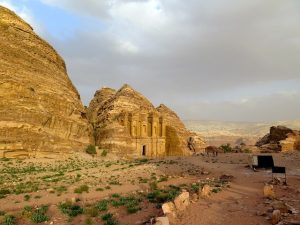 Image via Picryl.
In the mainstream media in Washington and Jerusalem, Jordan’s king is portrayed as a knight in shining armor — a secular ruler who fights terrorism and keeps his majority under control.
In the following paragraphs, I will explain why these arguments are at best naïve and at worst a cover for who he really is.
From the United Nations podium, he called Israel a “regional threat.” Then, in a speech to Jordan’s parliament, he described Israel’s expansionist ambitions as the “biggest threat” to the region’s future.
Some of his American friends may insist he is merely appeasing his population. Others argue that he is “helping America,” even claiming he is fighting both the Muslim Brotherhood and Iran. One passionate writer recently went as far as to suggest that the United States should take notes from Jordan’s king.
For a starter, Jordan is not stable. An example of this is an October 23 attack that targeted a Greek Orthodox church in Karak, southern Jordan. Three related terrorists from East Bank tribal backgrounds killed nine people and injured dozens. The mastermind and principal perpetrator, Hazza al-Dhneibat, was a convicted ISIS-linked terrorist who had been released by the king from a seven-year prison sentence earlier in 2026.
On November 6, an East Banker from a northern tribe, used a knife to kill a police officer guarding the Sri Lankan Embassy in Amman. The perpetrator had been released by the king just two days earlier. He had been serving a nine-year sentence.
Compare their treatment with that of Ali al-Sarsour, a peaceful Jordanian activist from Palestinian heritage. Convicted terrorists were released, just to carry out terrorist attacks, while Sarsour remains behind bars, denied bail despite having done nothing wrong.
Further, in 2025, the Jordanian government announced that it had shut down the Muslim Brotherhood, and many naïve Western journalists began praising the king. In reality, he closed a defunct Muslim Brotherhood “association” that had originally been shut down in 2021. Meanwhile, the Muslim Brotherhood “society” remained open. Its political party, the Islamic Action Front, remained untouched, with members serving in Jordan’s parliament. The Islamic Center Society also remained open. This charitable organization, described by the Jordanian government itself as being worth $3 billion, supports Muslim Brotherhood members and their families and serves as the movement’s financial arm.
He allowed the Brotherhood to expand its political operation, rename the Islamic Action Front the Nation’s Party, and celebrate its government approval across the media. That celebration included a gathering at which participants pledged to continue jihad. The king is openly empowering the M.B. despite American pressure and President Trump’s terrorist designation.
I have spent years documenting the marriage between the Jordanian monarchy and the Muslim Brotherhood.
Some defend this decision by arguing that the king fears his Palestinian majority. Yet the results of recent internal Brotherhood elections showed that the elected leaders were almost all East Bank Jordanians, not Palestinians. Palestinians in Jordan seem less interested in “liberating Palestine” and more in securing their civil and political rights in Jordan. A U.S. Embassy Amman cable released by WikiLeaks discusses this under the heading “A Grand Bargain?” It describes Palestinian-origin contacts willing to give up their aspirations to return to their ancestral homes in Israel in exchange for full political integration in Jordan. In my view, granting equal rights to the Palestinian majority means less authority for the king — and this is what he fears most.
Some argue that Jordan helped the United States during the war with Iran by allowing American forces to operate from its bases. Nonetheless, the value of the Jordanian help is questionable. Recall President Trump’s response after an Iranian attack killed three American soldiers at a base operated through Jordan.
That day, Iran’s Revolutionary Guard issued a statement thanking Jordanians for providing information that facilitated the attack. At first, it appeared to be an Iranian propaganda stunt. But in an interview the following day, President Trump said that “they did slip something through in Jordan.” He placed the blame on the operator; “different operators could have prevented it.”
Worth noting, renowned Israeli academic and writer Edy Cohen documented this relationship in a Jerusalem Post article under the headline “It’s official: Jordan is now allies with Iran.”
Today, Jordan opens the floodgates for the Muslim Brotherhood to dominate the streets while cracking down on people for doing as little as liking a secular opposition post on Facebook or X. Meanwhile, the Brotherhood can hold parades in Amman and publish videos of them on YouTube, Facebook, and its own channels.
Its newspaper, Al-Sabeel, still operates online. The king claims to have shut it down, but its print edition was already barely functioning. Like many prominent global newspapers, its readership is primarily online. Closing the print edition accomplished little.
Meanwhile, Jordan’s king is presenting himself to the West as a secular leader. Fortunately, some senior decision-makers in Washington and Jerusalem are not buying it. They understand that the king is playing with fire to buy time as his population grows increasingly disgruntled and hostile toward him.
The king is playing a dangerous game. It could blow up in the faces of both the United States and Israel, further compromise Israel’s borders, and damage Jordan beyond repair.
The United States must attach clear conditions to its aid to Jordan.
He must provide greater transparency about how American taxpayer dollars are spent and where that money goes. He must recognize Jordan’s demographic reality: Palestinian. He must ban the Muslim Brotherhood completely, including all its branches.
The king must ease the pressure building inside his country by ending incitement against the United States and Israel throughout his media apparatus, including state media. And he must sever ties with Iran instead of speaking out of both sides of his mouth.
An Israeli friend, an army general and rabbi, told everyone at a European workshop we attended last year that Israel considers its Jordanian border its most dangerous current threat. President Trump must stop the king’s games before he burns the whole house down, with everyone still inside.
Israpundit is entirely dependent on readers support. Please help me continue educating people with the truth about what is going on in Israel and around the world.

Leave a Reply
You must be logged in to post a comment.