
Peloni: In the hearing discussed below with Prof. Eugene Kontorovich, ZOA President Morton Klein made these additional and pivotal remarks:
Jude and Samaria, moreover, is legally Jewish land. A series of binding international agreements -the San Remo Resolution, League of Nations Covenant, British Mandate, Lodge Fish, UN Chartered Article 80 – recognize the Jewish people’s connection to the land and guarantee the land of Israel under international law, including Judea and Samaria, to the Jewish people. UN resolutions that contradict the UN charter are absolutely legally void.
| All Israel News | December 19, 2025
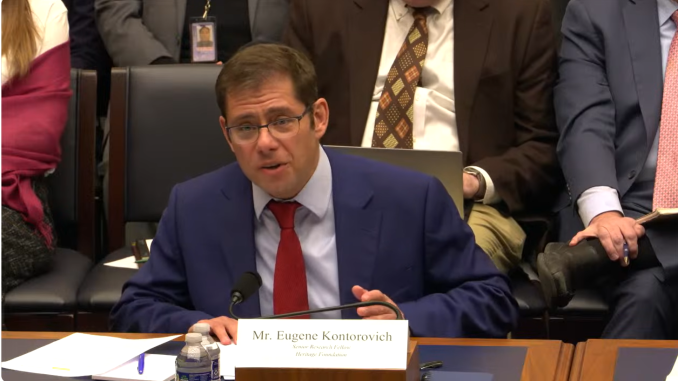
A summary of Professor Eugene Kontorovich’s testimony during the House Foreign Affairs Subcommittee hearing on “Understanding Judea and Samaria”: Dec 10, 2025.
Core Argument: Legal Sovereignty Under International Law
Professor Kontorovich, a Senior Research Fellow at the Heritage Foundation, presented a legal argument centered on the principle of uti possidetis juris. His core thesis is that, according to this standard rule of international law, Israel has a strong sovereign claim to Judea and Samaria (the West Bank), and the territory is not under “belligerent occupation.”
Key Points of His Testimony:
1. The Uti Possidetis Juris Principle:
- He explained this as a “textbook” rule where a new state automatically inherits the borders of the preceding administrative unit upon independence. This rule prioritizes clear, pre-existing boundaries over competing historical or demographic claims to avoid ambiguity.
- Examples Cited: He used several analogies to illustrate the consistent global application of this rule:
- Crimea/Ukraine: Despite Crimea’s long history with Russia and Russian-speaking majority, the world considers it Ukrainian because it was within the internal borders of the Ukrainian Soviet Republic when the USSR collapsed.
- Karabakh/Azerbaijan: The Armenian-majority region is universally recognized as part of Azerbaijan because it was within the borders of the Azeri Soviet Socialist Republic.
- Arab States: Lebanon, Syria, Iraq, and Jordan all retained the borders of their League of Nations mandates upon independence, despite containing discontented minority groups.
2. Application to Israel’s Creation:
- The preceding geopolitical entity before Israel’s independence in 1948 was Mandatory Palestine, which included Judea and Samaria.
- Therefore, under uti possidetis, Israel’s sovereign borders at birth extended to all of the Mandate territory, including Judea and Samaria.
3. The 1948 and 1967 Wars in This Legal Framework:
- Jordan’s conquest and annexation of Judea and Samaria in 1948-49 was an act of illegal aggression, not a lawful transfer of sovereignty.
- When Israel took control of the area in the 1967 war, it was not occupying foreign territory. Instead, it was “taking territory to which it had sovereign title since 1948.” He compared this to Ukraine liberating Crimea from Russia—it would not be considered an occupation.
4. Addressing the “West Bank” Terminology:
- He noted that “West Bank” is a term coined by Jordan after its 1948 conquest (as it lies west of the Jordan River). “Judea and Samaria” is the historical name used, for example, by the UN in 1947.
5. Implications for Peace and Policy:
- Not a Barrier to Peace: Kontorovich argued that recognizing Israel’s sovereign rights does not prevent a two-state solution. Israel, as the sovereign, would have the right to cede parts of the territory to create a Palestinian state.
- No Special Status for 1949 Lines: His legal analysis concludes that the 1949 armistice lines (often called the “1967 borders”) have no special legal status and should not be the presumptive starting point for negotiations.
- Current Reality: He stated that under the Oslo Accords, Palestinians already exercise self-government in Areas A and B, which is where the vast majority of them live. Israel’s primary role in Area C (over 60% of the land) is one of security.
6. Responses to Specific Questions:
- On Annexation: He clarified that Israeli discussions are about extending Israeli civil law to Jewish communities in Area C, not annexing the entire West Bank. He suggested President Trump’s 2020 peace plan, which envisioned this, is consistent with that approach.
- On Palestinian Authority (PA) Reforms: He was deeply skeptical, stating that the PA’s “pay-for-slay” program stems from a “deeply held belief” system. Real reform requires a fundamental ideological change, not just superficial adjustments to satisfy U.S. legislation.
- On the U.S. Peace Plan: He emphasized that the success of the “20-point plan” hinges on the demilitarization of Hamas and the deradicalization of Gaza, which are its fundamental, non-negotiable elements.
Overall Message:
Professor Kontorovich sought to reframe the debate from one about “occupation” to one about sovereignty. He argued that international law, applied neutrally, supports Israel’s claim to the land. He positioned this not as an obstacle to diplomacy, but as a factual legal starting point that should inform U.S. policy, strengthen the U.S.-Israel relationship, and lead to a more “fact-based” discussion about future solutions.
Aurthur A. Flowers is a technical journalist, SEO content writer, marketing strategist and freelance web developer. He holds a MBA from the University of Management and Technology in Arlington, VA.


Excellent presentation by Professor Kontorovich and 100% spot on!!!