
Peloni: The change of rhetoric in Lebanon can not be mistaken for a change in capabilities. Even if we take Aoun at his word, which could only be done by foolishly ignoring the long history of Lebanese commitments regarding disarming Hezbollah in the past, it doesn’t change the reality of Lebanon’s demographics, which is also represented in the Lebanese Armed Forces, in which the Lebanese Shiite community has a large representation. Notably, amid reports that even the Shiite commuity in Lebanon has turned against Hezbollah, this has yet to be demonstrated in any way material beyond verbal assertions. Israel can not afford to be forced from Lebanon under the hollow promises of “peace once more”. Israel should maintain its presence in Lebanon, and Aoun should demonstrate his authority by disarming Hezbollah in what remains of Lebanon presumably under his control. Of course, he might first start by demonstrating that he has the ability to even evict the Ambassador of Iran, whose remaining presence in Lebanon is all that is needed to demonstrate the lack of capabilities of the Lebanon president to enforce the will of the Lebanese rather than that of the Iranian regime.
We Want To Live In Peace And Not Die In Iran’s Wars
By: Steven Stalinsky, Ph.D. | MEMRI | June 11, 2026
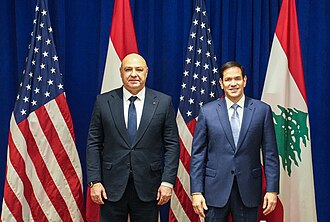 Secretary Marco Rubio meets with Lebanese President Joseph Aoun in New York City, New York, September 22, 2025. Photo by U.S. Department of State – Flickr, Public Domain, Wikipedia
“The only flag of the Lebanese people is the flag of Lebanon”[1]; “[Iran is] using Lebanon and Hizbullah mainly as a bargaining chip”; “It’s not the country [of Iran’s Revolutionary Guards], it’s our country”[2]; “A traitor is someone who takes his country to war in pursuit of external interests”[3]—These are some of the strong statements made by Lebanese President Joseph Aoun in recent months against Hizbullah and its patron Iran, reflecting a significant hardening of his position.
These statements reflect the efforts of President Aoun and the Lebanese government to establish the sovereignty of the Lebanese state while detaching it from Iran and from the latter’s conflict with Israel and the U.S. in the region. As part of this, the government opposed Hizbullah’s joining the fighting alongside Iran and seeks to consolidate the state’s monopoly on the use of weapons and to delegitimize any military activity outside its official frameworks.
This sharp rhetoric, which followed months-long attempts at dialogue with Hizbullah that yielded no results, was accompanied by a series of active political measures against Hizbullah and Iran. Chief among these was Prime Minister Nawaf Salam’s declaration of a ban on Hizbullah’s military and security activity[4] and his insistence on the government’s demand to restrict weapons to the state’s security forces. At the same time, steps are being taken to reduce Iran’s presence in Lebanon, including the designation of Iran’s appointed ambassador, Mohammad Reza Sheibani, as a persona non grata; a ban on the presence of Iran’s Islamic Revolutionary Guards Corps (IRGC) operatives in Lebanon, and the promotion of an independent and direct negotiation track with Israel, in stark opposition to the position of Hizbullah and its patron Iran.
These moves have led to unprecedented and mounting tension between Hizbullah and Lebanon’s government and president, which came to a point of rupture and mutual threats. President Aoun and the Lebanese government—which includes representatives of Hizbullah—are facing a harsh political and media campaign from this organization and Iran, including accusations of treason and even explicit threats to topple the government and ignite civil war. For example, in a May 25, 2026 speech, Hizbullah Secretary-General Na’im Qassem threatened: “We will confront anyone who stands against us just as we confront Israel… It is the people’s right to take to the streets and bring down the government.”[5] Mahmoud Qamati, a member of Hizbullah’s Political Council, clarified that the organization would not surrender its weapons and threatened to “take the life” of anyone who attempted to seize them.[6]
In order to justify their defiance of the state, Hizbullah and its supporters are working to undermine the legitimacy of the Lebanese authorities, calling them a “protectorate regime” that fails to defend Lebanon and does not enjoy the people’s trust.[7] A clear expression of Hizbullah’s non-recognition of the state’s authority was its decision to join the fighting alongside Iran on March 2, 2026, in opposition to the state’s position, as well as its continued refusal to relinquish its weapons. [8] This is alongside Iran’s refusal to accept Lebanon’s decision to expel its ambassador.[9]
At present, it appears that President Aoun and his government are maintaining this line despite the pressures. However, given Hizbullah’s military and political power, the Lebanese state is struggling to realize its policy in practice.[10]
This report reviews prominent statements made by President Aoun against Hizbullah and Iran in recent months, reflecting his efforts to establish a sovereign Lebanon despite Hizbullah’s and Iran’s threats.
President Aoun Promoting A State Monopoly On Weapons And Acting To Limit Hizbullah’s Power
Hizbullah’s March 2026 decision to join the war alongside Iran and drag Lebanon once again into a confrontation with Israel caused a further decline in the already strained relations between Hizbullah and Lebanon’s president and government. In this context, President Aoun intensified his rhetoric toward the organization and its patron Iran, emphasizing that the state holds the exclusive authority to possess weapons and to decide on matters of war and peace.
Aoun: Hizbullah Is A Traitor Loyal To Iran; It Has Once Again Dragged Lebanon Into A War Not Its Own
Aoun sharply criticized Hizbullah’s decision to join the war alongside Iran by launching six rockets at Israel on March 2, 2026, describing this as yet another “‘support war’ that has nothing to do with us” and which endangers Lebanon.[11] Calling Hizbullah “an armed group [operating] outside [the framework of] the Lebanese state that gives no weight to Lebanon’s interests or to the lives of its people,”[12] Aoun added that the rocket attack on Israel was “an ambush against Lebanon, intended to bring it down,” even at the cost of many lives, “based on considerations of the Iranian regime.”[13]
In a meeting with dignitaries from the Hasbaya and Arqoub regions in South Lebanon, he said: “How much longer will the people of the South continue to pay the price of other people’s wars on our land, the latest of which are the war in support of Gaza and the war in support of Iran? Had the war been for Lebanon, we would have supported it. But when its purpose is to serve others, we reject it completely.” At the same event, the president described Hizbullah’s conduct as treason, saying: “A traitor is someone who takes his country to war in pursuit of external interests… The loyalty of the Lebanese should be to Lebanon alone… The only flag of the Lebanese people is the flag of Lebanon. Whoever wishes to carry another flag should go to the country whose flag he carries.” He added: “Those who dragged us into war in Lebanon [now] accuse us of entering negotiations without a national consensus. My question is: when you decided to go to war, did you first obtain a national consensus?”[14]
Aoun: The Lebanese People Want to Live in Peace; It Is I Who Represent Them, Not Hizbullah Secretary-General Na’im Qassem
In an interview with CNN, Aoun sharply criticized Hizbullah, arguing that it does not represent the Lebanese people and is acting against their wishes. He said: “We are fed up and we want to live in peace… I met many people from the South… [and they say] they are fed up… And they deserve to live in peace and in dignity, they deserve not seeing their homes being destroyed every five to ten years… This is my obligation towards my people. They are Lebanese people. They are not Naim Qassem’s people…”[15]
Aoun To Iran: Do Not Interfere; This Is Not Your Country; No One Will Negotiate On Our Behalf
The president also criticized Hizbullah’s patron Iran, accusing it of interfering in Lebanon’s affairs and of using Lebanon as a bargaining chip in its negotiations with the U.S. He stressed that Lebanon “refuses to be a bargaining chip in regional conflicts”[16] and called for Lebanon’s political course to be kept separate from the regional developments.
To that end, President Aoun has been promoting a separate track of direct negotiations with Israel under U.S. auspices, parallel to the contacts between Iran and the U.S., in opposition to the stance of Hizbullah and its ally, Parliament Speaker and leader of the Shi’ite Amal Movement Nabih Berri. According to Aoun, “We are a state with its own identity and existence. It is the state that conducts negotiations, and we will not allow anyone else to negotiate on our behalf.”[17]
In his interview with CNN, Aoun departed from the usual diplomatic tone and declared, in response to a statement by Iran’s IRGC rejecting the understandings taking shape between Israel and Lebanon under U.S. auspices:[18] “This is not your country; it is our country… It is not your job to interfere… It is our people being killed and our houses being destroyed. They are using Lebanon as a bargaining chip in their negotiations with the United States. This is unacceptable…”[19]
It should nevertheless be emphasized that, despite the tough rhetoric and the measures taken against Iran—including the withdrawal of recognition for the ambassador-designate and restrictions imposed on the activities of the IRGC—Lebanon’s ability to enforce this policy remains limited.
[1] Mtv.com.lb, April 27, 2026.
[2] Edition.cnn.com, June 5, 2026.
[3] Al-Nahar (Lebanon), April 27, 2026.
[4] Al-Nahar (Lebanon), March 2, 2026.
[5] Alahednews.news, May 24, 2026.
[7] Alahednews.news, June 10, 2026.
[10] A prominent example of this is Lebanon’s failure to complete the first phase of the plan to restrict weapons to the possession of the state, which includes the removal of Hizbullah’s weapons and infrastructure south of the Litani River. This was clearly demonstrated by Hizbullah’s renewal of its hostilities against Israel in this area following the organization’s decision to join the war alongside Iran. See MEMRI reports: Inquiry & Analysis No. 1931 – Following Hizbullah’s Entry Into War Alongside Iran, Lebanese Furious At Their Government: Its Claims Of Controlling The South Are A Lie – March 26, 2026.
[11] The term “support war” was first used by Hizbullah to describe the campaign it launched against Israel on October 8, 2023 in support of Hamas following the latter’s October 7 massacre in Israeli communities.
[12] Al-Jumhouriyya (Lebanon), March 10, 2026.
[13] Nida Al-Watan (Lebanon), March 2, 2026.
[14] Mtv.com.lb, April 27, 2026,
[15] Edition.cnn.com, June 5, 2026.
[16] Al-Jumhouriyya (Lebanon), April 24, 2026.
[17] Al-Nahar (Lebanon), April 9, 2026.
[18] Telegram.me/Tasnimnews, June 4, 2026.
[19] Edition.cnn.com, June 5, 2026.

Leave a Reply
You must be logged in to post a comment.