
By Oded Faran and Walter E. Block
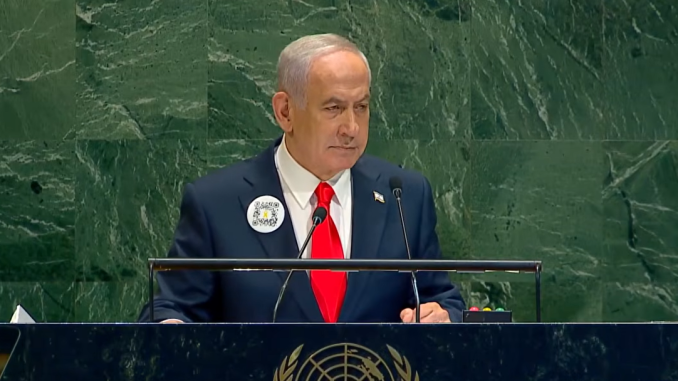 Netanyahu speaks before UN General Assembly. Image via Wikipedia
In an April 2024 New York Times column, Bret Stephens articulated what many consider the correct approach to Israel’s existential war:
“Israel must destroy Hamas as a military and political force in the territory while minimizing harm to civilians… It must, by diplomacy or force, push Hezbollah back from Lebanon’s southern border, so that 60,000 Israelis can return safely to their homes in the north. It must take the battle directly… to Hamas’s and Hezbollah’s patrons, whether in Syria, Qatar or Iran.”
This is precisely correct. As two self-described members of the Israel Defense Force Publicity Department (armed with laptops rather than rifles), we enthusiastically concur with this strategic framework.
But Stephens concludes: “And for all of that to happen effectively, Benjamin Netanyahu must go.”
This conclusion requires scrutiny. Stephens conflates legitimate questions about intelligence failures with policy disagreements, demanding leadership change based on hindsight judgments about decisions made under uncertainty. His case against Netanyahu reveals more about the dangers of midstream leadership changes during existential conflicts than about the Prime Minister’s fitness for office.
The Qatar Funding Decision: Strategic Logic vs. Hindsight
Stephens asks why Netanyahu supported Qatari funding to Hamas “just weeks before the massacre.” He frames this as near-treasonous incompetence, as though Netanyahu invited the October 7 butchery.
The reality is more complex. According to multiple Israeli security officials, the policy aimed to prevent the emergence of a unified Palestinian political entity by maintaining the Hamas-PLO split. Netanyahu and his security advisors assessed that a PLO-governed Palestinian state posed a greater long-term threat to Israeli security than a contained Hamas in Gaza. This was not an irrational judgment. Even critics like Stephens would not accept Hamas participation in a Palestinian government, yet they persistently advocate for Palestinian statehood under “reformed” PLO leadership. Netanyahu’s strategy sought to make that dangerous scenario impossible.
Was this assessment correct? We face an imponderable comparison: the actual toll of October 7 (approximately 1,200 Israeli deaths) against a counterfactual scenario in which a Palestinian state, armed and internationally recognized, posed continuous existential threats. Israeli security professionals made this judgment based on decades of experience with PLO terrorism and diplomatic warfare against Israel’s legitimacy.
Even if Netanyahu’s strategic calculus ultimately proved wrong, strategic errors under uncertainty differ fundamentally from incompetence or malfeasance. Stephens provides no evidence that alternative leadership would have chosen differently given the same intelligence and constraints. Demanding leadership removal for retrospectively questionable (but rationally defensible) strategic decisions sets a dangerous precedent. Should Franklin Roosevelt have been removed after Pearl Harbor? Should Winston Churchill have been dismissed after Singapore fell in 1942?
Intelligence Failure and Distributed Responsibility
Stephens asks why “the bulk of the Israeli military was nowhere near Gaza in the first hours of the attack.” This implies Netanyahu personally orchestrated the IDF’s deployment failures. The reality involves distributed responsibility across multiple institutions.
In the months preceding October 7, Israel faced unprecedented domestic turmoil over judicial reform. Military reservists, including senior officers, publicly threatened to refuse service. This created divisions within the IDF command structure during a period requiring maximum cohesion. Simultaneously, Israel confronted threats from Hezbollah in the north, Iranian proxies throughout the region, and mounting tensions in the West Bank.
Intelligence failures involved multiple echelons: field intelligence officers, Southern Command, Military Intelligence Directorate, and the Shin Bet. According to emerging accounts from Israeli investigative journalism, specific warnings about unusual Hamas activity were assessed and deemed non-critical by intelligence professionals. This represents a systemic failure, not a single point of incompetence.
Stephens employs a logical fallacy: because catastrophe occurred under Netanyahu’s watch, he must go. This confuses leadership accountability (which Netanyahu accepts) with sole responsibility (which no reasonable analysis supports). The principle of specialization and division of labor applies to government. Military intelligence chiefs bear direct responsibility for threat assessment; field commanders bear responsibility for tactical readiness; the Prime Minister bears ultimate political accountability. But political accountability in a democracy means answering to voters, not to columnists demanding resignation based on complex intelligence failures still under investigation.
The Laws of War and Operational Dilemmas
Stephens criticizes Israeli forces for “destroying the enemy but ignoring civilian needs for security and basic necessities.” He simultaneously condemns the IDF for having to “recapture the same places, like Gaza City’s Al Shifa hospital, that were supposed to have been cleared of terrorists months ago.”
These criticisms contradict each other. The IDF withdrew from Al-Shifa Hospital precisely to allow it to resume medical operations, thereby “minimizing harm to civilians” as Stephens demands. Hamas immediately re-militarized the facility, exploiting civilian infrastructure for military purposes. This pattern, repeated throughout Gaza, reflects Hamas’s systematic strategy of using protected sites as shields, a tactic unprecedented even in World War II.
Stephens cannot demand both maximum consideration for civilian welfare and uninterrupted military control of civilian infrastructure. International humanitarian law requires distinction between combatants and civilians, not provision of services to enemy populations during active combat operations. No army in history has been expected to maintain governance and humanitarian services in enemy territory while simultaneously conducting intensive combat operations. The Allies did not concern themselves with “civilian needs” of German and Japanese populations until after achieving military victory.
The fundamental question Stephens elides: Who bears responsibility for Gaza civilian suffering? An army fighting a defensive war after the worst massacre of Jews since the Holocaust, or a terrorist organization that systematically positions military assets in hospitals, schools, and residential buildings while rejecting every ceasefire proposal?
Democratic Legitimacy and Coalition Politics
Stephens criticizes Netanyahu for “bringing far right rabble rousers to his government,” presumably referring to Finance Minister Bezalel Smotrich and National Security Minister Itamar Ben-Gvir. This reveals a telling bias: ministers representing significant constituencies within Israeli democracy are dismissed as illegitimate based on their political views rather than their performance.
These ministers, commanding 14 Knesset seats between their parties, represent hundreds of thousands of Israeli voters. They have consistently opposed premature ceasefire agreements that would leave Hamas in power, a position vindicated by Hamas’s repeated rejection of hostage deals. Whether one agrees with their politics, they hold democratic legitimacy that opinion columnists lack.
More fundamentally, Stephens dismisses Netanyahu’s judicial reform initiative as “unnecessary.” This characterization inverts reality. Israel’s Supreme Court operates through a self-perpetuating mechanism: sitting justices select their successors, effectively cutting elected representatives out of the process. This system, unchanged since 1948, has maintained a consistent ideological orientation regardless of electoral outcomes.
Netanyahu’s reform would have introduced democratic accountability into judicial selection, allowing the Knesset to influence the Court’s composition. Critics called this a “lethal blow to Israel’s democratic character.” Yet what is democratic about fifteen unelected judges, accountable to no electorate, wielding unchecked power over legislation? Netanyahu’s reform would have democratized Israel’s judiciary by making it responsive to the people’s elected representatives. The principle “no taxation without representation” applies to judicial systems as much as to parliaments.
The Question of Alternatives
Underlying Stephens’s argument is an unstated assumption: someone else would perform better. Who? What would this hypothetical alternative leader do differently?
A different Prime Minister might have chosen different strategies regarding Hamas funding, judicial reform, or coalition partners. But Stephens provides no evidence that alternative strategies would have prevented October 7 or prosecuted the current war more effectively. He simply assumes that because disaster occurred, different leadership would have avoided it. This represents the classic logical fallacy of post hoc ergo propter hoc.
Leadership changes during existential wars carry enormous risks. New leaders face learning curves while enemies probe for weakness. Coalition realignments create political instability precisely when national cohesion matters most. The historical record suggests that democracies rarely benefit from changing leaders mid-conflict, particularly when the conflict’s outcome remains uncertain.
Democratic Accountability vs. Pundit Demands
Netanyahu has made decisions that merit legitimate debate. The Qatar funding policy, whether ultimately wise or not, involved complex tradeoffs that reasonable security professionals might assess differently. The October 7 intelligence failure reflects systemic problems across Israeli security institutions that demand comprehensive investigation and reform. The judicial reform initiative and coalition composition reflect democratic choices about governance philosophy.
None of this justifies the conclusion that “Netanyahu must go.” Stephens confuses policy disagreement with incompetence, hindsight judgment with foresight failure, and distributed institutional failure with individual culpability. His argument, if accepted, would establish that any major security failure requires leadership removal regardless of broader context or alternative leadership capabilities.
Israel remains the only representative democracy in the Middle East. Democratic accountability means leaders answer to voters through elections, not to columnists through resignation demands. If Israeli voters judge Netanyahu harshly for October 7 and its aftermath, they possess the constitutional mechanism to replace him. Until then, removing democratically elected leadership during an existential war based on policy disagreements dressed as incompetence charges undermines the very democratic principles Stephens claims to defend.
We enthusiastically support Stephens’s strategic vision for the war. We part ways with his conclusion that achieving this vision requires new leadership. The case for Netanyahu’s removal remains unproven.
Sources:
Stephens, Bret. “Netanyahu Must Go.” New York Times, April 9, 2024. https://www.nytimes.com/2024/04/09/opinion/netanyahu-israel.html
Qatar Funding Policy:
Bergman, Ronen, and Mazzetti, Mark. “Documents show Israel sought, valued Qatari aid for Gaza in years leading to Oct. 7.” The Times of Israel, October 3, 2024. (Link requires subscription)
Cohen, Nir (Shoko). “Top Secret: In a 2018 letter, Netanyahu asks Qatar to fund Hamas.” Ynet News, May 5, 2024. https://www.ynetnews.com/article/bk8mgcefr
Mazzetti, Mark, Bergman, Ronen, and Abi-Habib, Maria. “Qatar sent millions to Gaza for years with Israel’s backing. Here’s what we know about the controversial deal.” CNN, December 12, 2023. https://www.cnn.com/2023/12/11/middleeast/qatar-hamas-funds-israel-backing-intl/
Raz, Adam. “The not-so-secret history of Netanyahu’s support for Hamas.” +972 Magazine, November 19, 2024. https://www.972mag.com/netanyahu-hamas-october-7-adam-raz/
Harkov, Lahav. “Netanyahu: Money to Hamas part of strategy to keep Palestinians divided.” The Jerusalem Post, March 12, 2019. https://www.jpost.com/arab-israeli-conflict/netanyahu-money-to-hamas-part-of-strategy-to-keep-palestinians-divided-583082
“Israeli support for Hamas.” Wikipedia, November 7, 2025. https://en.wikipedia.org/wiki/Israeli_support_for_Hamas
October 7 Intelligence Failures:
Kubovich, Yaniv. “Years of Israeli Misconceptions, Intelligence Blunders Led to October 7 Attack, Probe Finds.” Haaretz, February 27, 2025. https://www.haaretz.com/israel-news/2025-02-28/ty-article/.premium/idf-probe-military-intelligence-misread-hamas-intentions-failed-to-manage-conflict/00000195-48e8-d562-afff-cff892740000
ToI Staff. “Former IDF intel chief: Oct. 7 was ‘much deeper’ than an intelligence failure.” The Times of Israel, August 16, 2025. https://www.timesofisrael.com/former-idf-intel-chief-oct-7-was-much-deeper-than-an-intelligence-failure/
Barnea, Avner. “Israeli Intelligence Was Caught Off Guard: The Hamas Attack on 7 October 2023—A Preliminary Analysis.” International Journal of Intelligence and CounterIntelligence, Vol. 37, No. 3, 2024. https://www.tandfonline.com/doi/abs/10.1080/08850607.2024.2315546
Wyss, Michel. “The October 7 Attack: An Assessment of the Intelligence Failings.” CTC Sentinel, Combating Terrorism Center at West Point, October 2024, Vol. 17, Issue 9. https://ctc.westpoint.edu/the-october-7-attack-an-assessment-of-the-intelligence-failings/
Melman, Yossi. “Not Enough Spies in Gaza: The Israeli Intelligence Failures That Led to October 7.” Haaretz, March 5, 2025. https://www.haaretz.com/israel-news/2025-03-05/ty-article/.premium/not-enough-spies-or-human-intelligence-the-israeli-security-failures-that-led-to-oct-7/00000195-6681-d7b0-af95-e6bbd8500000
Jones, Clive, and Geist Pinfold, Robert. “Israel and the Politics of Intelligence Failure on 7 October.” RUSI Journal, Vol. 170, No. 3, 2025. https://www.tandfonline.com/doi/full/10.1080/03071847.2025.2487510
Israeli Supreme Court and Judicial Reform:
Levush, Ruth. “Israel: Knesset Adopts Controversial Reform on Appointing Judges.” Library of Congress Global Legal Monitor, April 16, 2025. https://www.loc.gov/item/global-legal-monitor/2025-04-16/israel-knesset-adopts-controversial-reform-on-appointing-judges/
“2023 Israeli judicial reform.” Wikipedia, December 2024. https://en.wikipedia.org/wiki/2023_Israeli_judicial_reform
“Judicial Selection Committee (Israel).” Wikipedia, September 15, 2025. https://en.wikipedia.org/wiki/Judicial_Selection_Committee_(Israel)
“Supreme Court of Israel.” Wikipedia, December 2024. https://en.wikipedia.org/wiki/Supreme_Court_of_Israel
Amir-Arjomand, Saïd. “The Israeli Government’s Proposed Judicial Reforms: An Attack on Israeli Democracy.” ConstitutionNet, January 2023. https://constitutionnet.org/news/israeli-governments-proposed-judicial-reforms-attack-israeli-democracy
“About the Supreme Court of Israel.” Cardozo Israeli Supreme Court Project, Yeshiva University. https://versa.cardozo.yu.edu/about-supreme-court-israel
Bogoch, Bryna. “Judicial Selection in Israel in the Aftermath of the Judicial Overhaul.” Israel Democracy Institute, August 14, 2024. https://en.idi.org.il/articles/55609
Levush, Ruth. “Israel: Legislation Abolishes Reasonableness as a Standard for Judicial Review of Government’s Decisions.” Library of Congress Global Legal Monitor, October 25, 2023. https://www.loc.gov/item/global-legal-monitor/2023-10-24/israel-legislation-abolishes-reasonableness-as-a-standard-for-judicial-review-of-governments-decisions/
International Humanitarian Law:
“Geneva Convention relative to the Protection of Civilian Persons in Time of War” (Fourth Geneva Convention), August 12, 1949, Articles 18-19. https://www.ohchr.org/en/instruments-mechanisms/instruments/geneva-convention-relative-protection-civilian-persons-time-war
Schmitt, Michael N. “The Legal Protection of Hospitals during Armed Conflict.” Lieber Institute West Point, September 6, 2024. https://lieber.westpoint.edu/legal-protection-hospitals-during-armed-conflict/
“Geneva Conventions and the law.” International Committee of the Red Cross, March 11, 2025. https://www.icrc.org/en/geneva-conventions-and-law
“Protocol Additional to the Geneva Conventions of 12 August 1949, and relating to the Protection of Victims of International Armed Conflicts” (Protocol I), Article 12, June 8, 1977. https://www.ohchr.org/en/instruments-mechanisms/instruments/protocol-additional-geneva-conventions-12-august-1949-and
“Geneva Conventions and their additional protocols.” Legal Information Institute, Cornell Law School. https://www.law.cornell.edu/wex/geneva_conventions_and_their_additional_protocols
Democratic Leadership During Wartime:
Hamby, Alonzo L. “Democracy’s Champions: Churchill and Roosevelt.” International Churchill Society, May 11, 2021. https://winstonchurchill.org/publications/finest-hour/finest-hour-172/democracys-champions-churchill-and-roosevelt/
Prior, Robin. “Churchill and Roosevelt as war leaders.” In The Routledge History of the Second World War. Taylor & Francis, 2021. https://www.taylorfrancis.com/chapters/edit/10.4324/9780429455353-17/churchill-roosevelt-war-leaders-robin-prior
“Churchill and the Presidents: Franklin Roosevelt.” The Churchill Project, Hillsdale College, September 28, 2024. https://winstonchurchill.hillsdale.edu/churchill-presidents-franklin-roosevelt/


Who is/was really in charge of the country?
The PM or the SC, UN-elected judges and never responsible for their decisions!
What a shame that it’s so easy to pile up on the PM of Israel with this amazingly researched article that misses all the points.
While we still haven’t heard the latest on what, how, why, when and who messed up or even if it was by accident, lack of attention or on purpose, the truth will probably remain hidden forever, much like the true facts about the Yom Kippur war in 1973.
Without going into too many details, the missed judicial reform of the months leading up to 10/7 is, more likely than not, the triggering event that made 10/7 possible. The coalition Bibi set up was unable to get any part of the reform passed, the most important factor being that the AG, yes, that “lady” who was supposed to represent the government but was politically 100% opposed to any bill put forward by the coalition, did her best to sabotage every move.
The opposition produced this obstacle before being ousted at the last elections. Since she has successfully torpedoed any attempt to remove her, she can only be described as a 5th columnist (speaking politely).
The opposition has a number of members who are absolutely unwilling to coalesce, even for the benefit of the country in wartime. They were not willing to join the government for a temporary period. I guess that Bibi is to blame for that. His opponents claimed that he cheated them in previous coalitions, but they did a lot worse when they were in the saddle. We are left with the option to pray…
Netanyahu did all that except for finishing the job in Gaza, and that was Trump’s doing. Now, it’s back to mowing the lawn.
Stephens used to make sense. So did Tucker Carlson.
Stephens is not a wise commenter anymore – just another political hack
Carlson is just plain evil.
I saw Stephens speak at a Toronto shul around 2015- 2016. I found him to be a snot-nosed elitist who thinks he’s smarter than everyone else. Everything about him smells from the rarified air found at the NYT and WSJ.