
Peloni: Is Netanyahu moving his meeting with Trump forward simply to take a pulse of America’s negotiation? I would argue it is likely related to the fact that those negotiations have little (read as none) chance of success and the meeting is instead regarding more sensitive matters related to the failure of the talks and what comes next rather than the scope of the undergoing negotiations.
Iranian FM Araghchi resists any compromises, says ballistic missile program ‘non-negotiable’
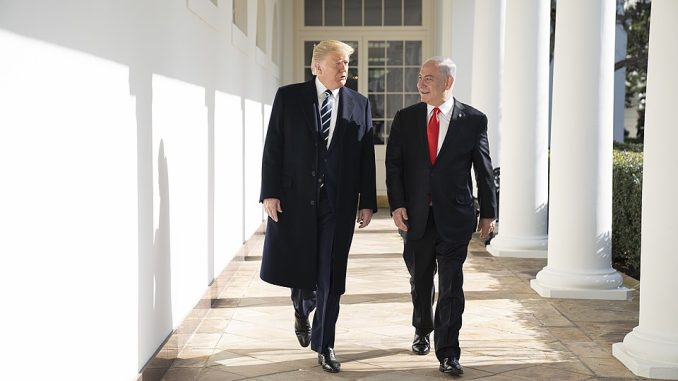 President Donald J. Trump walks with Israeli Prime Minister Benjamin Netanyahu Monday, Jan. 27, 2020, along the Colonnade of the White House. Photo by The White House from Washington, DC – President Trump Meets with Israeli Prime Minister Benjamin Netanyahu, Public Domain, Wikipedia
Israeli Prime Minister Benjamin Netanyahu will travel to Washington to meet with U.S. President Donald Trump this week, the prime minister’s office announced in a statement Saturday evening.
Netanyahu had originally planned to meet with Trump later this month, Feb. 18-22, but as negotiations between the U.S. and Iran have resumed, reports indicate that the Israeli premier hopes to secure support for Israeli concerns.
The trip comes just weeks after his previous visit to the U.S. in December 2025. Protests in Iran started at the end of that visit, and led President Trump to promise to intervene on behalf of the Iranian people if the regime started shooting protesters. Trump repeated that promise several days later, before backing down after claiming he was informed the Iranian regime was not going to execute protesters.
“The Prime Minister believes any negotiations must include limitations on ballistic missiles and a halting of the support for the Iranian axis,” the statement said.
The announcement came one day after U.S. special envoy Steve Witkoff and Trump adviser Jared Kushner engaged in negotiations with Iranian Foreign Minister Abbas Araghchi in Oman. Following those discussions, President Trump claimed that the two sides had “good talks.”
“We likewise had very good talks on Iran,” Trump told reporters aboard Air Force One on Friday. “Iran looks like it wants to make a deal very badly. We have to see what that deal is.”
“But I think Iran looks like they want to make a deal very badly, as they should,” the president continued. “Last time, they decided maybe not to do it, but I think they probably feel differently. We’ll see what the deal is. It’ll be different than last time. And we have a big armada. We have a big fleet heading in that direction. It’ll be there pretty soon. So we’ll see how that works out.”
Prime Minister's Office announcement:
Prime Minister Benjamin Netanyahu is expected to meet with US President Donald Trump this Wednesday in Washington, and will discuss with him the negotiations with Iran.
— Prime Minister of Israel (@IsraeliPM) February 7, 2026
Reports in international media indicate that Iran is unwilling to compromise on its initial positions, and remains committed to its right to enrich uranium, which the U.S. has demanded Tehran give up.
In an interview with Al-Jazeera, Araghchi said that Iran views enrichment as “an undeniable right,” and is unwilling to compromise.
“As for zero enrichment, that is outside the scope of the negotiations for us. Enrichment is an undeniable right for us, and it must continue. Even through bombing us, they could not destroy it because technology cannot be destroyed by bombing,” Araghchi said.
He also opposed transferring the approximately 400 kilograms (nearly 882 pounds) of highly enriched uranium the country already has stockpiled.
“Iran’s sovereign position is opposition to transferring uranium abroad,” he stated.
In previous negotiations, Iran demanded that talks focus only on the issue of the Islamic Republic’s nuclear program, and reports indicate that Tehran hopes to do the same in this round of talks.
Araghchi told Al-Jazeera that the Iran’s ballistic missile program is non-negotiable because it relates to a “defense issue.”
However, he repeated previous warnings from the Iranian regime, that if attacked, the country will respond with attacks of their own.
“It would not be possible to attack American soil, but we will target their bases in the region,” Araghchi told Al-Jazeera regarding a possible U.S. strike. “We will not attack neighboring countries; rather, we will target U.S. bases stationed in them. There is a big difference between the two.”
On Sunday, speaking in Teheran, Araghchi said the Islamic Republic is not concerned about the U.S. military buildup in the region.
“Their military deployment in the region does not scare us,” Araghchi said, according to Iranian media.
Following talks in Oman on Friday, Witkoff and Kushner visited the USS Abraham Lincoln aircraft carrier in the Arabian Sea, along with U.S. Central Command head Adm. Brad Cooper. Witkoff posted about the visit to his official special envoy account to ?, writing, “Today, Adm. Brad Cooper, Commander of U.S. Naval Forces Central Command, Jared Kushner, and I met with the brave sailors and Marines aboard the USS Abraham Lincoln, her strike group, and Carrier Air Wing 9 who are keeping us safe and upholding President Trump’s message of peace through strength.”
The move appears to be a signal to Iran that the U.S. is prepared to use military force if negotiations fail.


Leave a Reply
You must be logged in to post a comment.