
Once such stealth technology leaves American control, the strategic danger is nearly irreversible.
Moshe Phillips
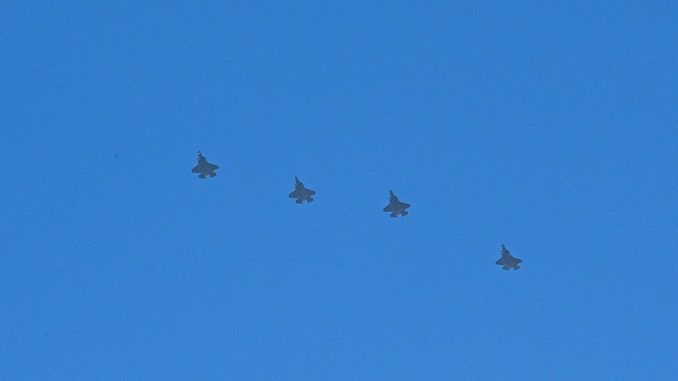 Photo by Air Force Senior Airman Alexander Cook – https://media.defense.gov/2019/Sep/25/2002186916/-1/-1/0/190921-F-BQ566-1004A.JPG, Public Domain, Wikipedia
“We’re going to have a deal. They’re going to purchase F-35s. They’re buying them from Lockheed, and it’s a great plane,” stated U.S. President Donald Trump in the Oval Office last week during the visit from Saudi Crown Prince Mohammed bin Salman. This news should alarm every American and all friends of Israel.
For all of Saudi Arabia’s perceived importance to the United States, it remains an authoritarian, repressive monarchy whose internal politics are far from stable. Arming such a regime with the most advanced stealth fighter jets carries risks that are just too high for today’s Middle East. Friendly-to-America strongmen rulers can be toppled, policies can shift overnight, and weapons placed in their hands can quickly be beyond U.S. influence or control.
This is not a routine arms sale. Granting Riyadh access to the F-35 means placing America’s most advanced stealth and sensor technology into the hands of a regime that has no democratic checks and balances, and zero long-term certainty of political continuity.
There is no guarantee that future Saudi rulers will align with American interests in the way current leadership claims to. The critical question is not whether the Saudis are friendly now, but whether the United States can trust any autocracy with such sophisticated systems when future use cannot be foreseen or constrained. The Arab world is legendary for its revolutions and violent coups.
History offers a warning. Washington once sold F-14s to the Shah of Iran, only for those jets to become assets of a radically anti-American regime after the 1979 Islamic revolution. Before this summer, Iran’s air force posed a threat not only to the United States but also to Israel—a threat that stemmed in part from a shortsighted arms transfer made under the pretense that an autocratic regime would remain stable. That lesson should loom large as Congress considers whether to greenlight even more advanced aircraft to another authoritarian state.
F-35 stealth fighter jets can reach Israel in mere minutes from Saudi Arabia—a country that still has no formal relations with Israel and a royal government that continues to boycott Israeli products.
The case for urgent congressional scrutiny is clearer than ever. Legislators cannot treat this as just another diplomatic favor; they must insist that any sale exclude stealth-sensitive technologies.
Moreover, national security officials are alarmed by the possibility that China could gain access to U.S. stealth technology through Riyadh. That is not a theoretical concern; reports suggest some in the administration worry the F-35 tech could be compromised given the strength of Saudi-China ties.
We must also remember that the Saudis could, for whatever reason, decide to transfer some of these high-tech supersonic stealth strike fighter/bombers to another country. In 1982, during Israel’s war against the Palestinian Liberation Organization in Lebanon, it was widely reported that among the weapons Israel seized were American-made M-16 army rifles that had been originally sold to Saudi Arabia.
Congress must act before contracts are signed and before jets are delivered. Once the stealth F-35s leave American control, the strategic danger is nearly irreversible. The United States must not let short-term geopolitical convenience or financial incentives cloud its long-term judgment. Promises from Riyadh, even on Abraham Accords-style normalization, are not worth surrendering America’s technological edge or undermining Israel’s security.
Allowing a deeply authoritarian monarchy to obtain the most sophisticated aircraft ever built is a historic risk. This could haunt both American and Israeli security for decades unless Congress steps in and places strict limits on F-35 sales to anti-democratic regimes.


One of the vital special parts of the F-35 is the helmet the pilot, which is Israeli manufactured. To my knowledge the plane does not function with it. This is a standard part and not an upgrade as with some of the other features that Israel has put into its Adir (Israeli F-35).
These are just some of the features of the helmet.
More or less what I expected ….F -35s denuded of ALL the Israeli added goodies ….or none at all.
@Edgar
Yes, there will be none at all. But while this is an important distinction to be made, the upgrade of the Saudi airforce to now include the F35s is an exponential change, limiting the advantages which Israel has over the Saudis, which is also being granted serious consideration by the Trump administration for the Turks. A very unfortunate development, IMO.
Pel
If fthere will be none at all, how can the SA air force be upgraged by adding F-35s
@Edgar,
Because, even without the Israeli designed upgrades, the Saudis have nothing closely resembling the F35 in its fleet of airframes. It is a stealth plane. While the Israeli F35 Adir has greater fuel capacity, greater munition choices, greater independence of operations, and the ability to be modified independently, but they both have advanced intelligence gather capabilities, and act as an intelligence node in flight which can share battle data with other aspects of the Saudi armed forces. While the US still has a kill switch on the Saudi planes, it won’t keep the Saudis from using their plane to advance Saudi intelligence interests exponentially beyond its current capabilities.
So, Trump wants to sell F35’s to Saudi Arabia which is not a member of the Abraham Accords and is in a proxy war with the UAE which is.
“ Wars within wars: Yemen’s battlefield reveals deeper power struggle between Saudi Arabia, UAE
BEHIND THE LINES: In Yemen, Saudi forces reclaim key territories from UAE-backed STC, showcasing the growing rift between Gulf powers over regional influence and governance.”
https://www.jpost.com/middle-east/article-882804
Though the UAE and SA appear to be allied in Sudan and both sides are suppressing civilians.
https://pomeps.org/the-great-game-of-the-uae-and-saudi-arabia-in-sudan
So, if I am reading this correctly, the UAE-backed RSF is committing genocide against black but opposing the Muslim Brotherhood backed forces. Both sides promote military rule and massacre civilians.
So, this is where U.S. advanced weaponry is going?
AI Overview
“ Multiple sources indicate that both the Rapid Support Forces (RSF) paramilitary group and the Sudanese Armed Forces (SAF) have been accused of committing atrocities and war crimes in Sudan’s civil war. However, an official genocide determination has so far been applied only to the RSF and its allied militias.
The Rapid Support Forces (RSF)
The U.S. government officially determined in January 2025 that members of the RSF and their allied militias have committed genocide, crimes against humanity, and ethnic cleansing in the Darfur region.
Specific accusations against the RSF include:
Targeted ethnic killings of non-Arab communities, particularly the Masalit people, in areas like West Darfur and El Fasher.
Widespread sexual violence, including mass rapes, often with ethnic slurs, used as a tool of terror and a weapon of war.
Systematic murder of men, boys, and even infants on an ethnic basis.
Mass displacement and the creation of a massive humanitarian crisis.
Looting of homes, hospitals, and humanitarian aid warehouses.
The RSF evolved from the notorious Janjaweed militia, which was responsible for the Darfur genocide in the early 2000s, leading many observers to note that history is repeating itself with similar patterns of violence and ethnic targeting.
The Sudanese Armed Forces (SAF)
The U.S. has accused the SAF and its allied militias of committing war crimes and has imposed sanctions on its leader, General Abdel Fattah al-Burhan.
Specific accusations against the SAF include:
Indiscriminate shelling and airstrikes on populated residential neighborhoods and civilian infrastructure, including hospitals and markets, causing high civilian casualties.
Lethal attacks against civilians.
Blocking humanitarian aid access, which has contributed to widespread famine and disease.
Targeting activists and journalists.
International Response and Investigations
While international bodies like the U.N. and human rights organizations have broadly accused both sides of committing war crimes and crimes against humanity, the specific legal determination of “genocide” has been leveled against the RSF.
The International Criminal Court (ICC) prosecutor has stated there are “grounds to believe” that war crimes and crimes against humanity are being committed in Darfur and that its investigation is ongoing. “
I presume the ICC is more objective here where there are no Jews involved. Or, no, actually they didn’t say anything specific did they? This is a U.S. determination.
… and MBS still insists on a terrorist Pal state!!!
How dare you!
Sebastian, you’ve proven your point. Ther is no trust amongst thieves. We’re grown up now and realize that things change. Promises too.
And Pollard was railroaded by the Reagan Administration! For giving Israel crucial intelligence the U.S. was illegally withholding from Israel. Back when it was Israel that relied on superior U.S. intelligence unlike now when it’s the other way around.
And even after, recall the “Iran Contra Affair” when the Reagan administration sold missiles under the table to that self-same anti-American regime, one that had recently taken the American Embassy staff hostage! (though that was during the Carter administration so I guess that doesn’t count) – in order to get funding for the Nicaraguan contras that had been banned by Congress.
Reagan also armed and trained the Taliban and Al Queda in Afghanistan. He was so obsessed with fighting Communists, he enabled the Islamists who are today allied with the Communists.
OK, I stand corrected but it’s a distinction without a difference:
“ AI Overview
+5
No, the Reagan administration did not arm al-Qaeda or the Taliban; the Taliban did not exist during his presidency. However, Reagan armed the Mujahideen, an anti-Soviet resistance movement, to counter the Soviet invasion of Afghanistan. Some leaders and fighters from this movement later joined or formed the Taliban, and al-Qaeda emerged in the 1990s and found a haven with the Taliban.
Reagan’s support for the Mujahideen
The U.S. policy of supporting Afghan resistance groups began under the Carter administration and was escalated under Reagan.
The Reagan administration provided significant funding and weaponry to the Mujahideen to weaken the Soviet Union.
Reagan famously referred to the Mujahideen fighters as “freedom fighters”.
The rise of the Taliban and al-Qaeda
The Taliban emerged in the 1990s, after the Soviet withdrawal from Afghanistan.
Al-Qaeda was founded in the late 1980s, and its leaders later sought and received a safe haven from the Taliban in the 1990s.
The U.S. did not arm the Taliban or al-Qaeda; rather, the U.S. armed a group that was later partially succeeded by the Taliban and fought against the Taliban and al-Qaeda in the post-9/11 war. ”