
Avi Abelow
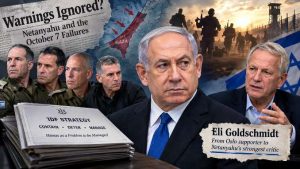 Image created via AI
It’s insane.
Nearly three years after October 7, suddenly, more and more headlines are appearing about alleged warnings Netanyahu supposedly received before the Hamas massacre, accusing him of ignoring them.
As Israel approaches another election, the political left has decided to focus its election campaign on spreading unsubstantiated allegations (all either crazy or literally denied by those who reportedly passed on the information – Egypt and the UAE) blaming prime minister Netanyahu for Oct. 7, while fundamental questions about the military and intelligence failures remain unresolved.
Think about it.
Israeli intelligence detected suspicious Hamas activity in Gaza hours before the massacre. Senior security officials held consultations, yet Netanyahu was not awakened. The Nova music festival wasn’t evacuated. Troops along the Gaza border weren’t placed on the level of alert necessary to confront the invasion.
These are absolute failures by the heads of the IDF and the intelligence services, that are central to understanding October 7.
And what about the strategic policies that preceded the massacre?
For decades, Israel’s political and security establishments pursued policies intended to strengthen the terror supporting Palestinian Authority, through territorial concessions, security cooperation, economic incentives and constant appeasement. The Oslo Accords, the 2005 Gaza disengagement and the subsequent approach towards an enemy population that literally educates its children to murder Jews and destroy Israel.
Netanyahu bears responsibility for decisions made during his governments. But any serious national reckoning must also examine the impact of the Oslo accords, the 2005 Gaza disengagement, and the years of “professional” recommendations from the IDF/intelligence officials including Eisenkot, Halevi, Haliva, Bar and their peers, recommendations regarding Gaza that treated Hamas as a problem to be managed, not an enemy preparing a massacre.
October 7 cannot be reduced to a political campaign against one man.
And now comes an extraordinary political development.
One of the most unexpected voices challenging his former political leftist camp is Eli Goldschmidt, a former senior Labor Party leader who supported the Oslo Accords and Israel’s disengagement from Gaza.
Yes, a former leader of the very political movement that championed recognizing the PLO as a peace partner, transferring territory and arming Palestinian security forces.
Goldschmidt has publicly acknowledged that his former political worldview was totally wrong. He has criticized the 2005 Gaza disengagement and recognized that Netanyahu warned about the dangers associated with the Oslo “peace” process decades ago.
And he hasn’t stopped there.
In a remarkable September 26 television interview, Goldschmidt described Netanyahu’s leadership as being at its peak, credited him with changing history and compared him to Israel’s Iron Dome. He even acknowledged that he had previously been consumed by hostility toward Netanyahu.
This is particularly striking because Goldschmidt himself previously blamed Netanyahu for strengthening Hamas and releasing Hamas leader Yahya Sinwar. His current position represents a substantial political reversal.
He has also warned that a future center-left government under Eizenkot could return Israel to the disastrous diplomatic framework associated with Oslo.
What changed his mind about Oslo? Why does he now recognize the dangers he believes Netanyahu identified decades ago? And what lessons does his transformation offer about the assumptions that shaped Israeli security policy before October 7?
Goldschmidt’s journey is a reminder that Israel’s reckoning with October 7 cannot be reduced to the campaign Eisenkot and the political left are running: dump the greatest massacre of Jews since the Holocaust on Netanyahu, and treat the military and intelligence failures, including those of Eisenkot’s own era and his protégés, as an inconvenient afterthought.
The victims of October 7 and their families deserve a comprehensive accounting of all those failures, without political exceptions.
There is another dimension to this debate that the Eisenkot camp would prefer the country never examine: Gadi Eisenkot’s own military legacy, and the professional advice he and his protégés spent years feeding Netanyahu.
Eisenkot was IDF chief of staff from 2015 to 2019. He did not merely “serve.” He published the IDF’s first public strategy document. That doctrine treated Hamas as a problem to be managed in “emergency” campaigns designed to restore quiet without seeking a strategic change. In plain language: contain, deter, hit when necessary, leave Hamas standing. That was not a stray remark. It was the institutional concept.
Herzi Halevi and Aharon Haliva were not random officers who appeared on October 7. They held senior positions under Eisenkot. Haliva was his head of operations. The two of them appeared together before the Knesset Foreign Affairs and Defense Committee in 2018. Halevi, Haliva and Shin Bet director Ronen Bar later headed three of Israel’s most important security institutions on the morning of the massacre. All three eventually left, even after months that the legal establishment and mainstream media fought against their removal. Those were Eisenkot’s people, executing Eisenkot-era military conclusions.
The current political campaign that dumps the entire catastrophe on Netanyahu treats this as an inconvenient footnote. It is the opposite. For years the professional military and intelligence establishment told successive governments, including Netanyahu’s, that Hamas was contained, that the arrangement in Gaza was sustainable, that the barrier would hold, that the concept was sound. Netanyahu listened to that advice. That is what a prime minister is supposed to do with the chiefs of staff, the heads of operations, Military Intelligence and the Shin Bet. The absurdity is pretending he invented the doctrine in a vacuum while the men who built it now pose as its judges.
After October 7, the Netanyahu government finally was able to overcome the “professional military/intelligence” advice and adopted a radically different strategy toward our jihadi enemy in Gaza. That fact alone should end the cartoon version of events. And they continued to try to stop the new government war strategy. Netanyahu’s government ordered for a military takeover of Gaza, the military said no. Even the destruction of Gaza buildings to save soldiers lives did not come from the military senior staff, who placed more emphasis on saving the lives of the non-combatant enemy population.
Fact after fact places the finger at the senior IDF and intelligence figures, including Eizenkot himself.
And today, the political left led by Eisenkot, together with mainstream media, decided the only name that belongs on the indictment for Oct. 7 is Netanyahu’s.
Israel needs a commission that examines the political leadership, the general staff, the intelligence services and the shared strategic assumptions they all signed. Anything that puts Eisenkot’s military legacy and the records of Halevi, Haliva and Bar off-limits is not an inquiry. It is a political protection racket. Netanyahu must answer. So must the men who told him, year after year, that this was the professional way to handle our jihadi enemies.
Some Israelis who live on the mainstream media’s diet will swallow the campaign line that October 7 was Netanyahu and Netanyahu alone. Many will not. They remember who built the concept, who briefed it, and who now pretends the professional advice of those years never existed.
That gap is part of a wake-up process. Israel will have to face both the political left’s attempt to rewrite the record and the external enemies who still want us gone. We will do both
Our future is bright. Strengthen your faith in God. Stick with me at the pulse of Israel for all the truth the mainstream media would rather bury.
Am Yisrael Chai!!!


But, who, unlike Netanyahu, have not learned anything from its failure, and if elected, will go back to it.
This is how the old Conceptzia can be preserved. It is vital for the Left and the globalists that this be the case.
cont:
What if they are terrorists sworn to the extermination of my people.
Google: If a nation invites a group sworn to the extermination of its people inside its borders, the scenario shifts from a traditional military rebellion to an existential war for survival. From a strategic and geopolitical perspective, this completely changes how a state must respond.When facing an adversary motivated by total destruction rather than political leverage or wealth, conventional negotiations fail because their goal is not a compromise.Immediate Strategic AdjustmentsUnleash Overwhelming Force: Since your domestic army is significantly more powerful, you must immediately pivot from containment to a total counter-offensive. State survival requires using your military superiority to neutralize the threat rapidly and completely.Declare an Emergency and Evacuate: Martial law must be declared immediately to protect civilians. The primary objective of your superior army should be securing and evacuating towns currently being targeted by the rogue faction.Cut Off External Support: Groups dedicated to total extermination often rely on covert foreign sponsors for funding, weapons, or propaganda. A powerful country must use its intelligence agencies and military dominance to block these supply lines entirely.Historical and Comparative PrecedentsHistorically, when states have underestimated the ideological fanaticism of a group they tried to appease, use, or control, it has resulted in severe national catastrophes:The Rise of Extremist Proxies: During various 20th-century conflicts, governments have occasionally tolerated or funded radical factions to fight domestic political rivals, only for those factions to turn around and attempt to completely dismantle the host state once they gained a foothold.The “Tiger Rider” Dilemma: This scenario perfectly mirrors the ancient political proverb of “riding a tiger”—it is impossible to dismount safely, and the beast cannot be tamed. The only viable strategic option for the rider’s survival is to slay the beast before it consumes them.Because your nation possesses the more powerful army, you have the hard power necessary to correct this catastrophic strategic error, but it requires an immediate, absolute military response rather than half-measures.To develop this scenario further, let me know: What kind of terrain does this conflict take place in (e.g., dense cities, rugged mountains)? I can help you map out how your superior army can best utilize its tactical advantages.
—
Musical interlude: “Tiger Rag” Django Reingardt (guitar) and Stephane Grapelli ( violin) Hot Club Quintet du France”
https://youtu.be/mdKWJ5KSdns?is=i6__VBCoNnvXBiTH
Query: tiger rag words (not in this recording which is just instrumental)
Google: The classic jazz standard and fight song “Tiger Rag” primarily features the iconic shouted refrain rather than standard verses.Standard Vocal ChorusHold that tiger!Hold that tiger!Hold that tiger!Hold that tiger!Hold that tiger!Hold that tiger!Hold that tiger!Where’s that tiger?Where’s that tiger?Where’s that tiger?Where’s that tiger?Where’s that tiger?Where’s that tiger?Where’s that tiger?Popular Variations (like The Mills Brothers Version)Where’s that tiger! Where’s that tiger! Where’s that tiger! Where’s that tiger!Hold that tiger! Hold that tiger! Hold that tiger!Choke him, poke him, kick him and soak him!Where’s that tiger? Where’s that tiger? Where oh where can he be?Low or highbrow, they all cry now”Please play that Tiger Rag for me”
Query: Praise the Lord and pass the ammunition
Google:
https://youtu.be/rj8hCT7-ADg?is=Lp1fTx15T01KkORR