
Peloni: The false conception which infiltrated the October 6 mindset was a devastating and debilitating blow to Israel, but it was not the first time this took place, and it was in fact intended that such a false mindset would never cripple the nation again, as it also did back in 1973. Unfortunately, faith with this commitment failed the nation on October 7. There must be a vigilance which maintains faith with the future commitment that such a false perception will never again be manipulate against the good of the nation.
There is an unmistakable sense that lessons so painfully earned in the past must be heeded with humility now.
Sarah N. Stern | Aug 18, 2025
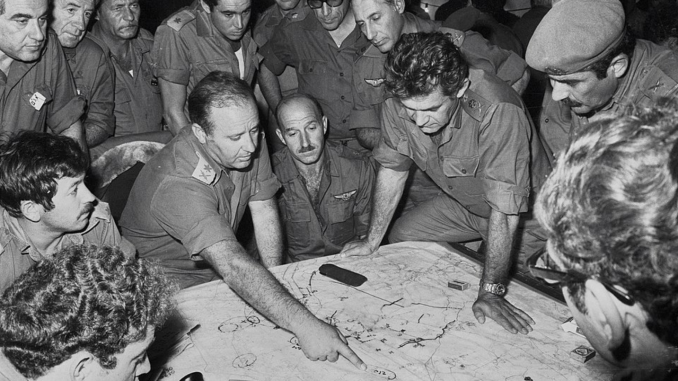 Israeli chief of staff in a meeting in Northern Command, during Yom Kippur War. By IDF Spokesperson’s Unit, CC BY-SA 3.0, Wikipedia
It’s time to acknowledge that in its 77-year history, Israel has made some critically painful mistakes.
After the 1973 Yom Kippur War, during which as many as 2,800 Israeli soldiers had lost their lives, the Agranat Commission was established to investigate Israeli intelligence failures.
It was found that the military and intelligence community failed to establish the gravity of the Egyptian military build-up along the Chaim Bar-Lev Line. They also felt that they failed to establish that Syria would enter the war, assuming it would only follow Egypt’s lead.
This marked not only a turning point in Israeli military strategy but a profound moment of national introspection. The commission’s findings reverberated throughout the country, prompting widespread debate about leadership, accountability and the vulnerability of even the most resilient societies. Over the decades, Israel has faced similarly daunting crossroads, each underscoring the complexities of balancing security with the aspirations and rights of its people. As we reflect on these events, it becomes clear that acknowledging missteps is essential for growth and for forging a more just and secure future.
We have certainly reached such a moment. Prior to Oct. 7, 2023, female surveillance spotters, or tatzpitaniyot, had been consistently warning their commanding officer and superiors that they were observing suspicious, atypical military drills just across the Gaza border. They witnessed Hamas members practicing raids and hostage taking drills.
They reported these events to their superiors, saying “something big was about to happen.”
These reports were shrugged off with a dismissive attitude, many by their male superiors. It was part of the prevalent conceptia that Hamas, which had governed Gaza since June 7, 2007, was more interested in domestic governance than in attacking the State of Israel.
These women were totally vulnerable. They had no guns, no weapons. They sat in small, unprotected rooms along the border, such as in Kibbutz Nahal Oz. Their eyes focused on screens. Many of them were away from their homes for the first time. They bonded as sisters.
These warnings, so urgent and clear, were not echoes from the edge but rather the vigilant observations of young analysts charged with safeguarding the nation’s borders. Despite their crucial proximity to unfolding threats, their voices were stifled by ingrained biases and a pervasive overconfidence in the status quo. The cost of this disregard would soon become heartbreakingly apparent.
As a member of this unit described: “Our job is to protect all residents. We have a very hard job; you sit on shift, and you are not allowed to squint or move your eyes even a little. You must always be focused.”
The results were tragic. Twelve of these courageous female warriors were among the first to be brutally murdered or taken hostage during the Hamas-led terrorist attacks in southern Israel on Oct. 7.
This dangerous underestimation, rooted in entrenched perceptions and organizational inertia, echoes the very failures the Agranat Commission sought to address half a century earlier. The reliance on old paradigms and the dismissal of critical voices, especially those from the ranks of young, often overlooked soldiers, exacted a heavy price. The tragic events that unfolded only two autumns ago were not merely the result of external hostility; they were compounded by internal blind spots that history had already warned against.
In the aftermath, Israeli society once again finds itself grappling with uncomfortable truths. The urgent questions resurface: How do institutions incorporate dissent and warning into decision-making processes? What structures must be built to ensure that cautionary signals are not lost amid hierarchy and hubris? There is an unmistakable sense that lessons so painfully earned in the past must be heeded with humility now.
Unfortunately, so many of the dots trace back to the 2005 withdrawal, almost 20 years ago, to the day. As Maj. Gen. (res.) Dan Harel argued at the time, one of the many fatal flaws of the disengagement was not to obtain any commitments from the reigning Palestinian Authority. This perspective tended to embolden the authoritarian tendencies within Hamas and Palestinian Islamic Jihad.
The following year, Hamas won the Palestinian Parliamentary Elections, and the jihadist terrorist group has ruled with an iron fist ever since.
Beyond that, Israel lacked any sort of plan for “the day after” the Israeli residents of Gaza were forced to withdraw every remaining remnant of their Jewish life. The visage of Israeli residents of Gaza being forced to abandon their homes, their livelihoods and their very way of life only served to empower Hamas and Palestinian Islamic Jihad.
The Palestinian National Charter—incidentally, of the Palestinian Authority—openly speaks about “liberation through armed struggle.”
Yet many in the international community foolishly believe that the corrupt P.A. would be better at running Gaza “the day after the war” than Hamas.
As Israel stands at this inflection point, the imperative to listen— to truly listen— not only to all voices within Israeli society, but also to those of our enemies, has never been more vital.
The resilience of a nation is not only measured by its response to threats, but by its ability to learn from its history, and to adapt and value the insights of those willing to speak up. In this, there lies the hope for renewal, accountability and a more secure future for all its people.
Sarah N. Stern is the founder and president of the Endowment for Middle East Truth (EMET), a think tank that specializes in the Middle East. She is the author of Saudi Arabia and the Global Terrorist Network (2011).


See
(1979)
https://afsi.org/wp-content/uploads/2017/08/SadatsStrategy_Eidelberg1.pdf
This is where it started. Doesn’t all of this sound familiar?
“The People of the book”
What is the purpose of “HISTORY” if it is constantly ignored!
Chutzpah and Chutzpah! Superiority complex vs Audacity!
“Never Again”, the greatest illusion for it, ignores HISTORY!
Victims of “leftist” utopia!
Just a few “clichés” coming to my mind.
Many more in reserve.
But I do not live in Israel although I have family and friends who live there.
I considered Aliyha in the early 80ties, as an MD, but I was advised not to, in view of my specialty.