Jews and Judaism Posts
Jews, Communists and Democrats (57998)
Trump, Socialism, and the Jews (140752)
Jews who hate Trump (78495)
It Pays to Be Jewish (21754)
Christians, Jews and Muslims (97403)
Current Posts
- Paxton Owes Texas Voters an Audit
- The Fifth Wave of Terrorism Is Upon Us – Part 2: Governmental Support
- ISRAEL THROUGH MY EYES
- Thanksgiving Reaffirms 400-Year-Old Roots of the US-Israel Nexus
- From Mecca to Istanbul: Turkey Builds a Defense Network Without America
- Texas CAIR Launches Lawsuit Against Grand Prairie Over Canceled Muslim-Only Event at Water Park
- If No Party Will Represent Me…
- Eisenkot plans Knesset vote on minority government despite opposition from potential partners
- Trump, Xi, Putin conclude historic summit, but what did the talks actually achieve?
- Oman Is Getting Too Close to Iran | Ambassador Marc Sievers
- The Muslim Brotherhood as a Terrorist Organization: What Egypt’s Court Ruling Reveals About Europe
- This is why I love them.
- Letters By Pablo Nankin: Stop the increase in Antisemitism
- Qatar launches lobbying campaign to roll back legislation requiring Alabama universities to disclose Qatari funding
- What the Media Won’t Tell You About Judea and Samaria
- The Greatest Conspiracy in the History of the World: How October 7, 2023 Proves Global Activists Knew in Advance
August 5, 2019
Subscribe to Israpundit Daily
Digest for Free
August 4, 2019
The Candace Owens Show: Steve Bannon
Subscribe to Israpundit Daily
Digest for Free
Who’s winning the fight for Trump’s ear on Iran?
Sanctions on the Iranian foreign minister indicate that hawks are still calling the shots for “maximum pressure,” despite the influence of Sen. Rand Paul and Tucker Carlson.
by Jonathan S. Tobin, ISRAEL HAYOM
When the news broke that the United States would extend existing waivers on five different nuclear-related sanctions on Iran, the implications of the move seemed clear. The hawks inside the administration – led by Secretary of State Mike Pompeo and National Security Adviser John Bolton – seemed to be in retreat. But two days later, when another announcement was made indicating that Iranian Foreign Minister Mohammad Javad Zarif was being subjected to US sanctions for his role as the public spokesman of the rogue theocracy, that assessment no longer seemed to be accurate.
Pompeo and Bolton have been pushing for a policy of “maximum pressure” against Tehran, including the withdrawal from the 2015 nuclear deal and the unilateral implementation of economic sanctions that have crippled Iran’s economy. But while President Donald Trump is a bitter critic of the nuclear pact concluded by President Barack Obama and long intended to dump the deal, he isn’t necessarily in sync with every aspect of his foreign policy’s team’s aggressive approach to Iran.
Read more…
Subscribe to Israpundit Daily
Digest for Free
Diversity, Inclusion and Anti-Excellence
Anyone who has followed the news from college campuses over the past few years knows they are experiencing forms of unrest unseen since the late 1960s.
Now, as then, campuses have become an arena for political combat. Now, as then, race is a central issue. Now, as then, students rail against an unpopular president and an ostensibly rigged system. Now, as then, liberal professors are being bullied, denounced, demoted, threatened, sued and sometimes even assaulted by radical students.
But there are some important differences, too. None of today’s students risk being drafted into an unpopular, distant war. Unlike the campus rebels of the ’60s, today’s student activists don’t want more freedom to act, speak, and think as they please. Usually they want less.
Most strange: Today’s students are not chafing under some bow-tied patriarchal WASP dispensation. Instead, they are the beneficiaries of a system put in place by professors and administrators whose political views are almost uniformly left-wing and whose campus policies indulge nearly every progressive orthodoxy.
So why all the rage?
Read more…
Subscribe to Israpundit Daily
Digest for Free
Jordanian King Rejected Request by Netanyahu for Meeting, Report Says
Israeli official denies report by London-based newspaper Al-Quds al-Arabi, which said the refusal angered Netanyahu
Jack Khoury, Noa Landau, HAARETZ
A request by Prime Minister Benjamin Netanyahu to meet with Jordan’s king has been rejected, sources in Jordan reported over the weekend. A source in the prime minister’s bureau denies the claim.
London-based Al-Quds Al-Arabi newspaper reported that King Abdullah II said he has no intention to hold any meetings or conversations at this time, and that the rebuff irritated Netanyahu.
The report cited unofficial Jordanian sources as saying that the king expressed his reservations over U.S. President Donald Trump‘s initiative to convene a conference at Camp David with Arab leaders to promote his Middle East peace plan. According to the report, Abdullah said he has no intention to hold a meeting for the sake of a photo opportunity, as in the Bahrain conference in June. The report added that the king has not ruled out the possibility of talks with Trump or his staff, however.
Read more…
Subscribe to Israpundit Daily
Digest for Free
Danger ahead: A US-Iran ‘deal of the century’
I fear that Trump’s “maximum pressure” campaign will be cut short before Iran’s leaders truly have no choice but to capitulate to Western demands, and that the Iranians will bamboozle the West into another bad deal.
By David Weinberg, ISRAEL HAYOM
Until now, the Trump administration has acted with wisdom and tenaciousness against Iran, crashing the disastrous nuclear deal that President Obama signed with the ayatollahs in 2015 and forcefully sanctioning Iran’s terror apparatus and oil exports.
Alas, there are signs that President Trump is getting ready to ease the pressure and bargain for a new deal with Iran. My fear is twofold: That Trump’s “maximum pressure” campaign will be cut short before Iran’s leaders truly have no choice but to capitulate to Western demands, and that the Iranians will bamboozle the West into another bad deal.
As Iran expert Prof. Ze’ev Maghen has said, “The Iranians win the moment you enter the negotiating room with them.” Unlike the eager negotiators of the West, Iran’s resolute front men always know how to weasel their way into a sweet deal on their terms.
Read more…
Subscribe to Israpundit Daily
Digest for Free
16 Muslim Countries Endorse China Forcing Muslims to Eat Pork
By Daniel Greenfield, FPM
The war of letters began when 22 countries penned a letter to the United Nations Human Rights Council condemning China’s treatment of Uighurs and “other Muslim and minorities communities.”
The letter in defense of Muslim Uighurs in Xinjiang was signed by France, Germany, Canada, Sweden and 18 other, mostly Western and European, countries. The case of the missing Muslim signatories was solved when the People’s Republic of China fired back with its own letter signed by 37 countries.
This letter in defense of China’s crackdown on Islam was signed by 16 Muslim countries.
While some of the Muslim signatories were drawn from African countries, the letter was also signed by ambassadors for the leading Arab governments including Qatar, Egypt, Saudi Arabia, the United Arab Emirates, Syria, and Kuwait. Pakistan, the world’s second largest Muslim country, also signed on.
Read more…
Subscribe to Israpundit Daily
Digest for Free
The Antisemitism Monopoly
By Ilya Feoktistov, AMERICAN THINKER
Recently, while defending Democratic congresswoman Rashida Tlaib from charges of anti-Semitism over her Holocaust comments, Jeremy Burton, the head of Boston’s umbrella Jewish community organization, asserted a cartel monopoly for establishment Jewish leaders on the privilege “to determine what is, or is not, antisemitic.” “[W]e must insist,” he wrote, “that the mainstream of our own community gets to make that determination. Institutions and leaders who represent the sensibility of our community will call it as they see it, both on the left and the right.” As examples of sensible mainstream Jewish institutions and leaders who should be granted this exclusive call on anti-Semitism by the “responsible media,” Burton identified the Anti-Defamation League (ADL), as well as, by implication, himself and his Jewish Community Relations Council (JCRC) of Greater Boston.
Much has been written about the ADL’s recent calls on anti-Semitism, how thesecalls have differed between the left and the right, and why the ADL et al. mightdemand a monopoly over anti-Semitism accusations at this current stage in American political history. But, as a right-leaning Jewish lawyer and activist who has been on the receiving end of one of Mr. Burton’s anti-Semitism determinations, I have a certain personal perspective on how an anti-Semitism monopoly might be enjoyed by likes of Mr. Burton and the ADL if they ever get the power to enforce it.
Read more…
Subscribe to Israpundit Daily
Digest for Free
Arab housing in Area C
Subscribe to Israpundit Daily
Digest for Free
August 3, 2019
Mudar Zahran affirms that Trump’s peace plan “will be successful”
Mudar Zahrán, exiled in Great Britain, states anyway that “the reality in Jordan must first be changed”. Exclusive interview of Ynet Español.
By Leandro Fleischer, YNET ESPANOL
Mudar Zahrán (45) is a Jordanian-Palestinian writer who leads the Jordanian Opposition Coalition group. The persecutions he has suffered due to his strong criticism of King Abdullah II led him to exile in Britain. This Arab intellectual is also a firm detractor of the Palestinian leadership.
In exclusive statements for Ynet Español , Zahran affirms that Trump’s peace plan “will be successful,” since he says that “the Palestinians have changed” for the better and calls on Israelis not to trust what the press or leaders say. of the Palestinian Territories and Jordan. However, he points out that in order to make more progress, it is necessary to remove King Abdullah II.
Why do Palestinians reject Trump’s peace agreement?
Subscribe to Israpundit Daily
Digest for Free
Canada’s Health Care System is not what it’s cracked up to be.
By Valerie Sobel
The following events did not take place in the Soviet Union. Cuba and Venezuela are also in the clear. None of this inhumanity was a figment of my imagination. It all took place in front of me, and I’m narrating the details without the aid of even the slightest hyperbole.
Gather all your compassionate, equality-minded, social justice pals for a ride through one amazingly affordable health care system. The one Obama and other notable liberals paint as the “envy of the world”. See how quickly you can figure out where this envy of the world dwells.
Got your seat belt on? This liberal utopia is a bit bumpy.
Read more…
Subscribe to Israpundit Daily
Digest for Free
Trump Single-Handedly Changes the Political Calculus
The two greatest political controversies in the western world in the last several years—the attempt to delegitimize President Trump and the question of Britain’s relations with the European Union—have generated similar reflexes and tactics in the opponents of the president and of Brexit. In the one case as in the other, the initial response of the political establishments in the two countries has been disbelief followed by a tenacious determination to undo the verdict of the voters.
There is also an important difference.
In the U.K., the referendum three years ago generated a 52 to 48 percent vote to leave the European Union, contrary to the wishes of the incumbent government, which was so committed to the losing “remain” side that Prime Minister David Cameron had to be replaced by Theresa May.
Read more…
Subscribe to Israpundit Daily
Digest for Free
August 2, 2019
What’s Netanyahu Up To? His Supporters Would Like to Know
As the party lists were locked in place this week, and the right finally ‘united,’ Likudniks are asking, where is the leader guiding us?
[After discussing Bibi’s demeanor with the lack of 61 seats in his block, he continues. ]
However you look at the electoral picture, Netanyahu has little reason for excessive optimism. His circle is now turning its gaze to Labor leader Amir Peretz; maybe he will be the deus ex machina, the missing piece to complete the coalition puzzle. For those who have forgotten, Peretz, along with Hatnuah leader Tzipi Livni, joined the third Netanyahu government, after leaving Labor in anger with the excuse that the party’s elected head, Shelly Yacimovich, had refused to promise him, and publicly, that she would never hook up with Netanyahu.
If the Peretz of six years ago was ready to forsake his declarations and principles in return for a junior portfolio, the environmental protection ministry, I was told by a Likud minister, how will he respond when Netanyahu calls him on election night and dangles the Finance Ministry in front of him? In that case, the walls whose collapse the Labor chairman anticipates almost religiously really will come tumbling down.
Read more…
Subscribe to Israpundit Daily
Digest for Free
The Real Reason The Left Hates Israel
Five years ago, I was sitting in my office trying to figure out options for a desperate Palestinian woman. Her family had found her and her boyfriend together in his apartment in Queens, and they were threatening both of them with physical harm. I had been told that the young couple feared for their lives.
To help them, I reached out to an organization that was working to train the New York City police force about the difference between honor killings and murder (the former is often perpetrated by a close family member who would not be a suspect in a murder). While I was speaking to the liaison about the couple, I happened to notice an email update from a former classmate at Barnard with some news: A Columbia student organization formed to support victims of sexual assault, called “No Red Tape,” was aligning itself with Students for Justice in Palestine, a virulently anti-Israel, pro-Palestinian group.
Read more…
Subscribe to Israpundit Daily
Digest for Free
When Muslims Do Not Assimilate
Subscribe to Israpundit Daily
Digest for Free
The incendiary balloon of international law
By Melanie Phillips, jns
In the 20th century, Jewish lawyers, jurists and other activists sought to fashion international human-rights law into a defense mechanism to protect powerless minorities. The process through which it became a weapon to be used against the Jewish people is a tragic history.
(August 1, 2019 / JNS) For months now, Israel has been attacked by aerial incendiary weapons launched by Hamas during riots at the Gaza border fence.
These weapons—balloons or kites attached to flammable material—are driven by the winds off the sea towards southern Israel.
In just one week in June, they started nearly 100 fires in farmland and forests, in playgrounds and private yards. By last month, Hamas had burned more than 7,400 acres of Israeli land.
Read more…
Subscribe to Israpundit Daily
Digest for Free
Dr. Robert Epstein on Big Tech Censorship
PRAGER U
Subscribe to Israpundit Daily
Digest for Free
Dysfunctional UNRWA’s Latest Disgrace
It is time to pull the plug on UNRWA and move its functions to agencies that truly want to solve humanitarian problems effectively rather than to perpetuate them
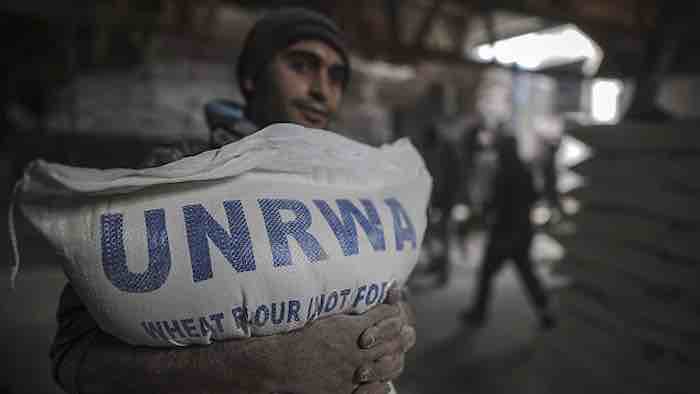
The Trump administration decided last year to cut off U.S. funding for the hopelessly dysfunctional United Nations Relief and Works Agency for Palestine Refugees in the Near East (UNRWA). It was a wise decision. A confidential internal report from UNRWA’s own ethics office has chronicled alleged rife mismanagement and corruption reaching the agency’s highest levels of leadership. The report was sent to UN Secretary General Antonio Guterres’s office last December. The UN Office of Internal Oversight Services (OIOS) has reportedly undertaken a probe into the report’s allegations, which has not yet been completed.
Members of an “inner circle” in UNRWA’s top management have engaged in “abuses of authority for personal gain.
Read more…
Subscribe to Israpundit Daily
Digest for Free
The Saudi-Palestinian Labyrinth
The pro-Palestinian Saudi talk has diminished, increasingly replaced by an adversarial Saudi walk
By Yoram Ettinger, CFP

The shift in the Saudi attitude has been reflected by a reduction of foreign aid to the Palestinians, partially due to the rift between the PA and Hamas, and in protest of PA corruption; a tighter control of monetary transfers by Palestinians residing in the kingdom; and the increase in the number of Palestinians arrested in – and denied access to – Saudi Arabia.
The transformation of the Saudi attitude toward the Palestinians has been triggered by Palestinian ties with entities which challenge and threaten the House of Saud. For example, the anti-Saudi Muslim Brotherhood (the largest Sunni Islamic terror organization), Iran’s Ayatollahs (the leading mortal enemy of the House of Saud), the anti-Saudi Erdogan’s Turkey (which supports the Muslim Brotherhood and opposes Saudi Arabia in Syria, Iraq, Qatar and Somalia), Hamas Palestinian terrorists (supported by Iran’s Ayatollahs and Turkey), Hezbollah terrorists (supported by the Ayatollahs), Qatar (which maintains close ties with Iran and Turkey, as well as with the USA), etc.
Read more…
Subscribe to Israpundit Daily
Digest for Free
August 1, 2019
Young Palestinians are leaving Gaza in droves
With few jobs and no hope, there is little reason for them to stay
ECONOMIST, Middle East and Africa, Aug 3rd 2019 | RAFAH
Yarub ikhdeh and his friends had been waiting half their lives to get on a bus. The six young men had never left Gaza, which has been blockaded by Israel and Egypt since 2007. They grew up in a territory where half the population is jobless and at least 70% rely on aid to survive. “We’re all recent graduates in business and it,” says Mr Ikhdeh. “And we’re all unemployed.”
Early on a recent morning the friends sat in a sun-baked car park in Rafah, on the border with Egypt. Each had crammed his life into a single suitcase. They would soon board a bus for Cairo, then a flight to Dubai in the United Arab Emirates (uae). None had a job waiting in the uae. Their tourist visas would be valid for only a month. But the mere prospect of work was enough to make them leave home.
Read more…
Subscribe to Israpundit Daily
Digest for Free