
PELONI: So what was described as Yalta 2 has come and gone. Now we have to live with the fallout of the grand compromise whose namesake, the original Yalta, was used to empower the Soviet menace over the world for half a century at the expense of the sovereign nations of Eastern Europe. Park MacDougald explained in his recent Tablet article, “There’s no anti-China strategy guiding the president’s foreign policy. Stop trying to find one.” So we will soon see if the consequences of this meeting are as great as the size of Xi’s table, but with Trump going to China for this meeting, allowing Xi to preside over this auspicious moment, and Xi characterizing the success of this meeting, it raises many questions for those of us who see China as a real danger to the free people of the world, and most certainly to the continuation of Western society. The lack of any press gaggle with the three leaders only exacerbates the questions raised about what was agreed upon and what sacrifices might have been made in this second attempt to literally stabilize tyranny on a global scale. Of course, we should not ignore the China Hawks that are present in Trump’s administration, but the simple truth is that Trump has such Hawks and Doves alike as his advisors, and the truth is that as Trump has often noted, Trump’s policy choices are ultimately guided by Trump himself. The silence on the topic of Iran and Taiwan was eerily piercing in this meeting, so we will see how this historic summit impacts these two trigger points on which the US and China lie on opposite sides. Perhaps the comparison to Yalta should not be used to draw significant conclusions, but the simple reality is that this summit has America lying down with Xi, and the consequences of any bargain with this ambitious totalitarian being less than compromising to the West does seem to be highly unlikely. So we shall see.
By SETH J. FRANTZMAN
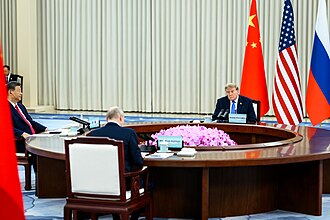 The White House, Public domain, via Wikimedia Commons
US President Donald Trump, Chinese President Xi Jinping, and Russian President Vladimir Putin concluded their historic trilateral summit in Shenzhen on Thursday, and issued a joint declaration emphasizing strategic stability, international security, and nuclear nonproliferation. The meeting, held on the sidelines of the Asia-Pacific Economic Cooperation (APEC) summit, brought together the leaders of three of the world’s most powerful countries for discussions about global security and the future of their relations.
One could argue that this meeting was important. After all, the three leaders were brought together in the same room – an act symbolic of global order. However, was there anything concrete that came out of this meeting? What might change, and what are the likely ramifications?
According to the BBC, the meeting lasted approximately 90 minutes. That’s not a lot of time when one considers that each comment had to be translated into multiple languages.
The three presidents departed without making statements to the press. Putin appeared pleased with the outcome, telling Xi as he departed: “Thank you for organizing this. I don’t think anyone even expected everything to go so well.”
China’s official Xinhua news agency reported that Xi described the summit as “positive, constructive, and fruitful.” Xi said that the three countries shared a commitment to safeguarding world peace and strengthening communication and cooperation.
What is the China-Russia-US Heads of State Declaration toward Peace?
The meeting produced a four-point declaration titled the China-Russia-US Heads of State Declaration toward Peace. The document addressed the reform of the United Nations, energy security, international judicial institutions, and nuclear weapons.
Interestingly, China, Russia, and the US all appear to be concerned with the ICC. US Secretary of State Marco Rubio recently slammed the ICC in a speech at the Federalist Society.
China said that the three countries were committed to maintaining strategic stability and international security. Its generalized language does not indicate any particular outcomes.
As permanent members of the UN Security Council, the three countries also agreed on the need to reform the organization so that it could respond more effectively to global challenges.
The leaders also agreed to increase the production and “supply of refined petroleum products,” and emphasized the importance of “stable energy flows.” This comes amid concerns about energy security, primarily related to the Iranian conflict. China and Russia want to see the conflict scaled back, and both have worked with Iran. Prior to the US-Israel strikes, China had a 25-year deal with Iran prior. Russia, for its part, helped Tehran secure the 2015 Iran deal.
The fourth provision concerned nuclear weapons. The three leaders reaffirmed that “a nuclear war cannot be won and must never be fought.” They also committed to dialogue on reducing nuclear risks and preventing nuclear proliferation.
The declaration did not announce specific nuclear arms reductions or establish a timetable for negotiations. However, it provided a framework for continued discussions among the three nuclear powers.
Xi outlines principles for relations between major powers
Xi called for a new approach to relations between major powers. The Chinese leader outlined four principles for relations between major powers: mutual respect, peaceful coexistence, cooperation, and dialogue. Xi also said that countries should respect each other’s sovereignty, territorial integrity, and political systems. He emphasized the importance of recognizing the core interests and major concerns of other countries.
One could read this as criticism of the US interfering in the Middle East by attacking China.
According to Xinhua, Xi warned against interference in “domestic affairs.” The report noted that Xi said, “On major sensitive issues concerning one another, it is important to communicate in advance, try to see things from one another’s perspective, act with caution, and in particular, not to challenge the red lines of one another.”
Xi argued that China, Russia, and the US should view one another as partners rather than adversaries. He warned against falling into the “Thucydides Trap,” a term used to describe the danger of conflict between established and rising powers.
In ancient Greece, the Athenians arrogantly challenged a Sparta-led alliance and, in the end, lost the war. The war was devastating for both sides, however, and led to a larger decline. If China and the US came into conflict, it would likely harm both countries immensely. This is the point that Xi appears to be making.
China’s leader linked this argument to the legacy of World War II, describing the three countries as major victors of the conflict with a responsibility to preserve the postwar international order. On nuclear weapons, Xi went further than the language of the joint declaration. He called for their eventual elimination, describing them as a “Sword of Damocles” hanging over humanity.
Xi also emphasized economic cooperation. He said that the three countries could combine their strengths in natural resources, manufacturing, and consumption to expand trade and economic opportunities. It is interesting how much the Chinese leader used Western terminology from the Classical era to discuss the modern world.
At the moment, China’s goal is to ease tensions and reduce the chances for escalation in the Middle East. It also wants to prepare for any future “misunderstandings.” For now, China seems to prefer diplomacy. However, it is keeping tabs on what will come next and whether the US will make any missteps
Israpundit is entirely dependent on readers support. Please help me continue educating people with the truth about what is going on in Israel and around the world.



Leave a Reply
You must be logged in to post a comment.