The Old Peace Treaties vs. the Abraham Accords
Dr. Frank Musmar, BESA September 12, 2021
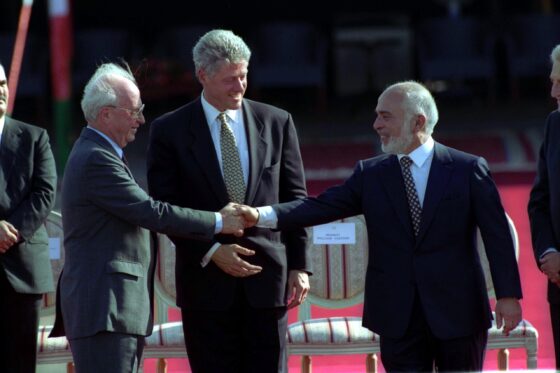
President Bill Clinton watches King Hussein and PM Yitzhak Rabin shaking hands, October 1994, image via Israel GPO
EXECUTIVE SUMMARY: Unlike Israel’s earlier peace agreements with Egypt and Jordan, the Abraham Accords involved Arab countries that do not border Israel, have never fought it on the battlefield, and are relatively unburdened by the Palestinian question. Accordingly, they were able to implement a “people to people” peace that eluded their predecessors.
The search for a peaceful settlement to the conflict between Israel and its neighbors reached a critical juncture in 1979 when Egyptian president Anwar Sadat and Israeli PM Menachem Begin signed the Egyptian-Israeli peace treaty. Fourteen years later, in September 1993, Israel and the PLO signed the Declaration of Principles on Interim Self-Government Agreements (DOP) after secret talks in Oslo, and in October 1994 a Jordanian-Israeli peace treaty was signed. In the subsequent two-and-a-half decades, no new Arab-Israeli agreements were signed until the conclusion in August 2020 of the Abraham Accords between Israel, the UAE, and Bahrain, followed a month later by normalization agreements between the Jewish state, Sudan, and Morocco.