
Update: US-Iran talks begin
Negotiations continue despite Iranian threats over Israeli strikes on Hezbollah
| Published: April 10, 2026
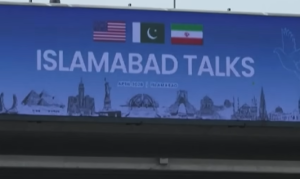 Screengrab via Youtube
The Pakistani government placed its capital, Islamabad, on lockdown Friday as U.S. and Iranian delegations prepared to arrive for the first round of negotiations over a final ceasefire agreement.
The U.S. delegation reportedly includes Vice President JD Vance, White House Special Envoy Steve Witkoff, and President Donald Trump’s advisor and son-in-law, Jared Kushner, with their arrival scheduled later in the day.
The Iranian delegation is set to be led by Parliament Speaker Mohammad-Bagher Ghalibaf, who has reportedly emerged as one of the regime’s most powerful figures.
?????? Islamabad is under lockdown ahead of U.S.-Iran talks this weekend.
Authorities have blocked roads with containers and barbed wire, deploying heavy security across the city.
A 3+ km radius around the Serena Hotel has been fully sealed off, with access restricted and even… https://t.co/G6TyARXpVj pic.twitter.com/Y14gwTvB1r
— Israel War Room (@IsraelWarRoom) April 10, 2026
Ahead of boarding a plane on Friday afternoon, Vance told reporters he thought the talks would be “positive.”
“As the president of the U.S. said, if the Iranians are willing to negotiate in good faith, we’re certainly willing to extend an open hand. If they’re going to try to play us, they’re going to find that the negotiating team is not that receptive… the president gave us a pretty clear guideline.”
The meeting is expected to mark the highest-level direct U.S.–Iran talks since 1979 Iranian Revolution, following a series of negotiations characterized by mutual suspicion, with the latest two rounds ending in U.S. airstrikes after Iran attempted to drag out the talks.
Breaking:
US Vice President JD Vance says he’s looking forward to talks in Islamabad as he departs for Pakistan pic.twitter.com/qd1cu1riP5
— The Balochistan Diaries (TBD) (@BalochDiaries) April 10, 2026
The Pakistani government declared a two-day public holiday on Thursday and Friday, placing Islamabad on a broad lockdown amid a heightened presence of security forces. Control of the government complex known as the Red Zone was handed over to the army, a senior Pakistani Interior Ministry official told The Media Line.
The news outlet also reported that a U.S. advanced security and tactical team landed in Pakistan on Thursday afternoon, with the Secret Service and CIA sending operatives to review security arrangements and secure the planned venue of the talks.
The negotiations will reportedly focus on several issues, most importantly, Iran’s nuclear program and the Strait of Hormuz. However, in the days leading up to the talks, attention shifted to the Lebanese front, after Iran and Pakistan claimed the ceasefire should also apply. Tehran signaled it could walk away from the talks if Israeli operations against Hezbollah continued.
How are the negotiations with #Iran's regime going? Confusion over the terms of the ceasefire, accusations of violations, and conflicting reports about the arrival of Iran's regime's delegation in Islamabad. Welcome to diplomacy with the Iranian regime. Not a good omen. pic.twitter.com/ZsM3IgOlDp
— Jason Brodsky (@JasonMBrodsky) April 10, 2026
Israel, in turn, declared that the intense IDF strikes against the Iranian proxy Hezbollah would continue, while announcing the start of direct negotiations with the Lebanese government. According to Trump, he asked Prime Minister Benjamin Netanyahu to scale back the strikes to avoid endangering negotiations with Iran.
An Israeli official told Ynet News that Iran seeks “to unify fronts, a vision of [slain Hamas leader] Yahya Sinwar that has collapsed, but Hezbollah entered the conflict on their behalf, and there is a code of honor between them.”
“In any case, it is important to accumulate as many achievements as possible. That is also why the heavy blow [in Lebanon] was delivered during the holiday,” the official added.
On the U.S. side, Trump expressed his dissatisfaction with the Iranian regime over its handling of the Strait of Hormuz in a series of posts on Truth Social in the night between Thursday and Friday.
The strategic waterway was supposed to fully reopen under the terms of the two-week truce.
“There are reports that Iran is charging fees to tankers going through the Hormuz Strait – They better not be and, if they are, they better stop now!” Trump wrote. According to Axios, this might have been a reference to a report in the Financial Times stating that Iran is seeking the right to demand $1 per barrel of oil from any ship passing through the strait.
Freedom of navigation is a right for all under international law — not a privilege Iran can grant or withhold. The UAE ?? will continue to engage in global efforts to ensure the Strait of Hormuz opens fully, unconditionally, and without restriction.https://t.co/WXS7jMclja
— UAE Mission to the UN (@UAEMissionToUN) April 9, 2026
Trump later added in a post: “Iran is doing a very poor job, dishonorable some would say, of allowing Oil to go through the Strait of Hormuz. That is not the agreement we have!”
A U.S. official told Axios that, while the strait is technically “wide open,” ships are scared of the regime, which has “threatened and coerced everybody,” and are hesitant to cross the strait.
According to The New York Times, hundreds of oil tankers and other ships are still waiting to transit the waterway.
In another written message attributed to new Supreme Leader Mojtaba Khamenei on Thursday, the Iranian leader said Iran wants to “bring the management of the Strait of Hormuz into a new stage,” apparently confirming reports that the regime wants to institutionalize its right to demand tolls for the passage through the Strait in any permanent ceasefire agreement.
Hard to see a scenario where Iran’s control of the Strait of Hormuz will be acceptable to Gulf countries.
Here’s the head of ADNOC, Dr Sultan Al Jaber, earlier today: pic.twitter.com/xe1oxDWavd
— Annmarie Hordern (@annmarie) April 9, 2026
Gulf states have strongly rejected the idea of paying a toll for passage. In addition, they have been attacked by the regime several times since the start of the ceasefire.
On Friday morning, Kuwait accused Iran and its proxies of launching drone attacks targeting “some vital Kuwaiti facilities Thursday night.”
The Revolutionary Guards later denied any connection to the attack, but the Saudi Al-Arabiya news channel reported that the drones were launched from Iraq, presumably by one of the Iranian proxies based there, highlighting the importance of the topic of its regional proxies.
Israel, the United States and the United Arab Emirates have demanded that the regime stop supporting its proxy militias as part of any future post-war agreement.
Meanwhile, the nuclear issue continues to loom over the talks, with hundreds of kilograms of enriched uranium believed to remain buried or otherwise inaccessible within damaged Iranian facilities at Natanz and Isfahan following earlier strikes.
On Wednesday, Trump wrote on Truth Social, “There will be no enrichment of uranium, and the United States will, working with Iran, dig up and remove all of the deeply buried (B-2 bombers) nuclear ‘dust.’”
However, Israel is reportedly preparing for a scenario where the uranium is not addressed through an agreement.
Army Radio reported that the IDF Intelligence Directorate is working to build a “warning system” for the uranium, with dedicated units tracking the material and immediately alerting decision-makers about any attempt by Iran to extract it.
A senior IDF official said that all of Israel’s intelligence would be invested in this effort, stressing that information-sharing and joint monitoring with the U.S. intelligence would “of course” continue as well.
Raz Zimmt, director of the Iran program at the Institute for National Security Studies in Tel Aviv, told Axios that Israel’s main concern is the extent to which the talks would address the nuclear issue.
“There are three minimum requirements that must be met: the removal of 60% enriched uranium from Iran, the dilution of 20% enriched material to a low level, and the suspension of uranium enrichment for as many years as possible,” he explained.
“If these demands – some of which Iran rejected before the war – are accepted, the war can end with at least one significant achievement. If the war ends with these nuclear capabilities still in Iran, it would constitute a major failure.”


Leave a Reply
You must be logged in to post a comment.