
Peloni: See also the dispute between Netanyahu and the IDF Chief Zamir: “IDF chief says Gaza ceasefire line is ‘new border’ – but PM Netanyahu says Phase 2 will begin ‘shortly’”
‘Phase 1 is almost there, one more deceased hostage to return,’ says Netanyahu
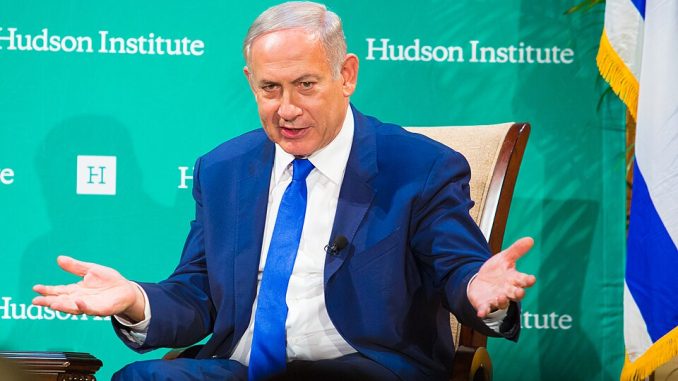 By Hudson Institute – Flickr, CC BY 2.0, Wikipedia
Prime Minister Benjamin Netanyahu spoke at a conference of Israeli ambassadors and diplomats from the Foreign Ministry in Jerusalem on Sunday evening, where he addressed contacts with Syria, the security situation in the Gaza Strip, and the rising tide of global antisemitism.
Netanyahu began his remarks by saying that, “Israel today is a country that is stronger than ever, it is certainly a regional power, in several areas it is a global power. And this is connected to several things that were done here over the years and even more so in the last two years.”
“The result is that we strengthened our security power, everyone understands that,” Netanyahu stated, “perhaps not everyone understands to what extent.”
“Our strength was expressed in this war in terms of the people and their steadfastness,” the prime minister continued. “In any other place where there are missiles, people flee out, but here everyone returned.”
Netanyahu also said that “A senior American official told me, ‘You are the only fighting allies we have.’”
“Now we need to strengthen this force,” Netanyahu continued, “we are making an effort to ‘strengthen independently.’”
He said that while Israel sees the “need to be as independent as possible,” especially regarding its defense capabilities, “this doesn’t mean we can’t form alliances.”
“We are inundated with requests” from countries would like to be security allies, Netanyahu claimed, saying, “Israel has never been so powerful.”
Regarding the situation in Syria, Netanyahu said that while Israel hopes to reach a demilitarization agreement regarding southwestern Syria, the country intends to protect the Druze population in the area.
“We very much hope that it is possible to reach an agreement on demilitarization, and also to take care of our Druze brothers,” Netanyahu said.
The prime minister also referred to the security situation in the Gaza Strip, claiming that since the IDF took over the Philadelphi Corridor, “there has been no buildup of Hamas.”
This claim appears to contradict reports in Cabinet meetings that Hamas is taking advantage of the ceasefire to rearm itself, both by producing its own weapons and by repurposing unexploded ordnance left behind by the IDF.
Regarding the move to the next phase of the peace plan proposed by U.S. President Donald Trump, Netanyahu admitted that the international stabilization force (ISF) may not be able to carry out its main mission, which is the demilitarization of the Gaza Strip.
“In the second stage, we move to disarmament and more accurately the removing of weapons and demilitarization,” Netanyahu told the Foreign Ministry’s conference of ambassadors and heads of missions, “Now there is a question here: our friends in America want to try to establish an international force that will do the work.”
“We know there are certain missions that this force can do,” Netanyahu said, “I don’t want to detail, not everything they can do, and perhaps the main thing they cannot do, but it looks, how did President Trump say? ‘It can be done the easy way, it can be done the hard way. But in the end it will be done.’”
Netanyahu referred to his upcoming trip to Washington, which he said is related to the next phase of the peace deal.
“And we are now at this stage, and you can be proud and confident that I will talk about it with President Trump at the end of the month,” Netanyahu told the diplomats.
Netanyahu said that “The greatest opportunity before us is also normalization and peace agreements,” noting that, “not everything is clear, or more accurately, not everything is clear in public discourse.”
He claimed there were many naysayers before the announcement of the Abraham Accords in 2020.
“There are many statements that always say: it can’t be, without this thing and without that thing and without another thing,” Netanyahu opined. “It’s more or less the same things that were said about the Abraham Accords. ‘It can’t go without us getting the PA’s agreement.’
“There is one problem with that,” he continued. “If we had waited for the PA’s agreement, they would never agree. Never.”
The prime minister also encouraged the diplomats to be clear about Israel’s mission and its fight for justice in the carrying out of their roles.
“I think the most important thing to understand when you talk to the public and leaders of your countries, and this is true, I always say, there is a difference, with leaders, interests, with public, justice, it’s true. But first of all, in truth, we are fighting the war of the civilized world, and we are fighting against barbarians,” Netanyahu stated. “Therefore our fight, not only ours, it is for the entire world, is in terms of justice.”
Netanyahu concluded, “We will continue together and as they say, ‘We will do this, and with God’s help we will continue to succeed.”


Leave a Reply
You must be logged in to post a comment.