
Oded J.K. Faran and Walter E. Block
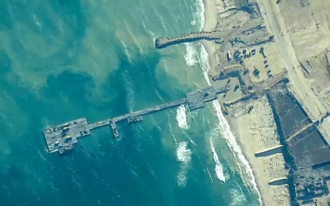 Overhead image of the connection of the Gaza Pier shortly after completion by US military forces on May 16, 2024. Photo by U.S. Central Command Public Affairs – dvidshub.net, Public Domain, Wikipedia
Former president Joe Biden is widely known as a staunch friend and ally of Israel’s. At least in some circles. For example, the AP claims of him that he is a Zionist “in his heart.” Reuters offers this quote of Mr. Biden: “I am a Zionist.” According to NBC News: “Israeli Prime Minister Benjamin Netanyahu and President Joe Biden, who have a long history together, have been plunged into a wartime partnership.” Al Jazeera features a picture of the two of them hugging each other and goes on to say: “’It’s the price of waging a war.’ Those were Joe Biden’s words in late October, when the United States president was asked about civilian casualties in war-stricken Gaza.” NPR maintains: “Biden faces pushback within his own party for his unwavering support of Israel.”
However, there is at least one instance upon which this consensus unravels: that floating pier.
A pier. Floating. American-built. Stretching from the Mediterranean to Gaza. Constructed at enormous expense by the Biden administration to deliver humanitarian aid to the very population whose elected government launched the October 7th massacre. The stated purpose: feeding supposedly starving Palestinians while Israel prosecuted a defensive war against Hamas.
The operation called for offloading 90 trucks of supplies initially, escalating to 150 daily, with the United Nations managing final distribution. The policy raised an uncomfortable question: Was America acting as Israel’s ally or its adversary?
Consider the historical precedent. Imagine that during World War II, a neutral power had constructed a floating pier from the Baltic Sea to Germany, delivering food to sustain the German war effort. Would the Allies have regarded such an actor as friend or foe? The answer requires no deliberation. That pier would have been reduced to debris within hours, and the sponsoring nation treated as an enemy combatant. The last strategic priority of any serious military coalition is ensuring the enemy population remains well-fed and capable of supporting continued hostilities.
This raises a foundational question about the laws of war: Since when does an army waging legitimate self-defense bear responsibility for feeding enemy civilians? No nation in history has faced such a demand. Not the United States in Iraq or Afghanistan. Not NATO in Yugoslavia. Not any combatant in any conflict. The unique standard applied to Israel invites an obvious hypothesis: antisemitism provides the most parsimonious explanation.
Actions clarify intentions better than rhetoric. The construction of that pier, coupled with plans to sustain Israel’s adversary, revealed the Biden administration’s true posture toward the only liberal democracy in the Middle East. The policy constituted material support for Hamas’s strategic interests, regardless of humanitarian pretenses.
Biden’s verbal pronouncements matched his policy. When Israel responded to barbaric atrocities with measured military operations, the President deemed the response “over the top” and threatened to take Prime Minister Netanyahu “to the woodshed.” With allies demonstrating such hostility, adversaries become redundant. The contrast with the Trump administration’s approach could not be starker, which makes certain electoral patterns among American Jews profoundly puzzling.
How does one account for the substantial Jewish support for Biden in 2020, for Harris in 2024, or for Zohran Mamdani in New York’s 2025 mayoral race? The explanations range from psychological (Trump Derangement Syndrome) to cultural (mishigas, in the Yiddish formulation). Whatever the diagnosis, the phenomenon persists: a significant portion of American Jewry consistently votes for candidates whose policies undermine Israeli security.
The pier serves as a perfect symbol of contemporary American Middle East policy: an expensive, ultimately futile gesture that simultaneously proclaimed support for Israel while materially aiding its enemies. It represented the worst kind of diplomatic theater, prolonging conflict under the guise of humanitarianism while achieving neither military nor moral clarity.
Though the physical structure has washed away, the contradictions it embodied remain embedded in U.S. policy. You cannot coherently support both sides of an existential conflict. You cannot arm a nation for self-defense while feeding those committed to its destruction. Until American leadership grasps this elementary principle, such incoherence will continue. Israel deserves an ally that provides support, not one that delivers sabotage wrapped in humanitarian packaging.
With “friends” like this, Israel hardly needs any enemies (of which it has quite a sufficient number, thank you very much). How often has Biden bragged that he would take Netanyahu out to the “woodshed”? (For the uninitiated, this means an actual spanking). Less provocative, the former has more than a few times threatened, and then actually imposed, a “stern talking to.” Happily, this former President is President no longer. His replacement is one of the best friends Israel has ever had. Indeed, it would be difficult to name one who even comes close.
Donald Trump’s recent attack on Iran, along with the IDF as a full partner, is a case in point, if ever there was needed more evidence for this contention. Next week we shall defend this important action of his against his many critics.


Leave a Reply
You must be logged in to post a comment.