
Bridget Toomey & Edmund Fitton-Brown | July 15, 2026
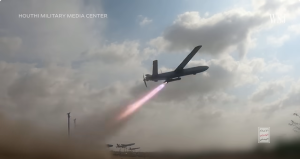 Houthi Drone. Screengrab via Youtube.
The Houthis and Saudi Arabia broke a four-year truce after Iran and its Yemeni proxy attempted to establish a direct flight path between Tehran and the Houthi-controlled capital of Sanaa. The flight openly flouted the Saudi-imposed air blockade of the Iran-backed terror group, established to prevent the flow of arms and support.
Saudi Arabia struck Sanaa International Airport on July 13 to prevent an Iranian plane returning the Houthi delegation from slain Supreme Leader Ali Khamenei’s funeral from landing. It ultimately landed at another Houthi-controlled airport.
The internationally recognized government of Yemen (IRG) described the flight as a violation of its sovereignty and claimed responsibility for the strike — though the IRG’s limited military capacity means Saudi Arabia likely conducted the strike at the IRG’s request. In response, the Houthis attacked an airport in southern Saudi Arabia and issued a warning to airlines to avoid Saudi airspace. Earlier in the month, Saudi Arabia and the Houthis exchanged threats after Riyadh attempted to prevent an Iranian plane from arriving to pick up the delegation.
The Houthis, and their sponsor in Tehran, have been pushing the bounds of Saudi tolerance to redefine the Saudi-Houthi relationship. During the war in Gaza, the Houthis were preoccupied with attacks on Israel and Red Sea shipping. Now, the group’s attention is returning to Yemen where it faces not only anti-Houthi government forces, but their Saudi backers.
After Years of Aggression Abroad, the Houthis Are Refocusing at Home
In early July, the Houthis launched an attack on Yemeni government positions in the west coast governorate of Hodeidah resulting in some of the deadliest fighting in recent years. The Houthis killed 16 government-aligned fighters while 2 December News Agency, a media organization affiliated with the pro-government National Resistance Forces, reported dozens of Houthi deaths.
The Houthi General Mobilization Forces also announced their readiness “to support and supply the [Houthi] army with fighters, at any time and place the leadership directs.” The General Mobilization Forces is a newly established organization, which claims hundreds of thousands of trained fighters, intended to provide reserve forces for the Iran-backed terror group and modeled on the Iranian Basij force of the Islamic Revolutionary Guard Corps.
Saudi Arabia Is the Linchpin of the Anti-Houthi Coalition
During the Yemeni civil war that followed the Houthi seizure of Sanaa in 2014, Saudi Arabia led the international coalition to fight the Iran-backed terror group until the UN brokered a truce in 2022. Since then, the Saudi role in the country has grown. In December 2025, Saudi Arabia consolidated its influence across government-controlled Yemen when southern secessionists, backed by the United Arab Emirates, attempted to expand their territory. Saudi Arabia, which opposed secession and supported other political and armed forces across Yemen, responded by driving the Emiratis out of the country. Riyadh now supports the IRG, covers military salaries, and sponsored Yemeni efforts to consolidate command and control of the various anti-Houthi armed factions.
Latest Escalation Is an Opportunity To Refocus on Countering the Houthis
The Houthis are prodding Saudi Arabia to evaluate the strength of the 2022 truce and the willingness of the latter to intervene militarily. Washington can support Riyadh to prevent the balance of power from tilting in favor of the Houthis and their patrons in Iran.
If the Houthis continue attempts to create an air link to Iran, one punitive measure that Riyadh could implement and Washington could support is a more comprehensive disabling of Sanaa International Airport — if the IRG requests it — rather than holing the runway in a manner that the Houthis can quickly repair. The Trump administration should also encourage a repair of Saudi-Emirati relations to strengthen cooperation in the anti-Houthi coalition.
Washington should also weaken the group’s financial networks that enable its weapons procurement. This would require pressure on Oman to expel Houthi leaders based in Muscat who access the international financial system via Omani institutions. Washington should also expand targeting of Houthi crypto networks, which play an increasingly large role in enabling them to circumvent the global financial system.
Bridget Toomey is a research analyst at the Foundation for Defense of Democracies (FDD).
Edmund Fitton-Brown is a senior fellow at FDD. For more analysis from the authors, please subscribe HERE.
Follow FDD on X @FDD. Follow Bridget on X @BridgetKToomey. Follow Edmund on X @EFittonBrown. FDD is a Washington, DC-based, nonpartisan research institute focusing on national security and foreign policy.
Israpundit is entirely dependent on readers support. Please help me continue educating people with the truth about what is going on in Israel and around the world.


Why oh why did the Saudi’s target the airport instead of the plane loaded with Houthis???