
Reading a chronicle of the Israeli peace movement now is a fascinating reminder of how far the Labor Party and the Israeli left has drifted.
Moshe Phillips
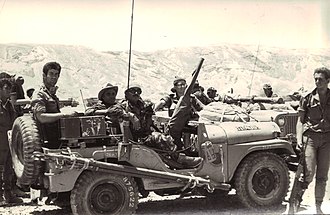 Fighters of the Shaked Patrol. Amos Yarkoni, unit commander, sits in the Jeep commander’s chair, behind the machine gun. Sinai, Six-Day War, June 1967. By Rafi Rogel, Attribution, Wikipedia
It didn’t make headlines when it was published, but Rael Jean Isaac’s Israel Divided: Ideological Politics in the Jewish State remains one of the most important books published in English about contemporary Israel. On the book’s 50th anniversary, it’s worth looking back at what she wrote, and what we can still learn from her.
In the 1970s, American news media coverage of Israel was scant and superficial. Wars and terrorist attacks briefly garnered the media’s attention, but the ideological ferment stirring in the Jewish state was largely unknown beyond its borders.
Published by Johns Hopkins University Press (April 1, 1976), Isaac’s book was reviewed not only by academic journals but by The Jerusalem Post, The Times Literary Supplement, The New Yorker, Commentary magazine and other general-interest periodicals.
Isaac’s readers were given a deep dive into the question that would eventually lead to the Hamas-led terrorist attacks in southern Israel on Oct. 7, 2023: Should Israelis embrace their miraculous 1967 Six-Day War victory and create Israeli communities throughout the liberated territories, or should they retreat from those lands in the hope that withdrawal would lead to peace with the surrounding Arab states?
Isaac focused on the two key sectors of Israel’s ideological divide: On one side, the Land of Israel Movement, pioneers of the campaign for Israeli territorial integrity; on the other, the self-described “peace camp,” which advocated territorial retreat.
“The major force of the Land of Israel Movement’s ideology is that it represents normal traditional Zionism,” according to Isaac.
Despite those who suggested alternate locations for a modern homeland for the Jews, she wrote, “the tie to the Land of Israel was clear, as was the sense of Jewish ownership by divine mandate that time could not alter … .”
American readers in 1976 must have been a little surprised to read Isaac’s account of the formation and makeup of the Land of Israel Movement. It didn’t fit neatly into stereotypes about left and right. Instead, the movement was an amalgamation of religious and secular, right-wingers and left-wingers. Isaac regarded that diversity as a source of strength. “(A)bsorption of individuals from a variety of backgrounds constituted one of its major contributions to the history and development of Israeli politics,” she explained.
One of the most powerful observations made in Israel Divided may have been in the chapter titled “The Peace Movement.” The author wrote: “The peace movement drew for membership upon traditional groupings which maintained perspectives that made it highly probable they would seize upon the Six-Day War as an event which made possible the realization of long-held goals. There were few well-known converts in the peace movement. While well-known individuals from [the far left] Mapam crossed over to the Land of Israel Movement, there were no prominent members of Gahal [forerunner of Likud] to lend comparable drama to the peace movement by crossing over to it.”
Isaac’s detailed explanation of Israel’s ideological crosscurrents was crucial in helping American Jews prepare for the upheaval in Israeli politics the very next year, when Menachem Begin and the Likud handed the ruling Israeli left its first defeat in 29 years.
Reading Isaac’s chronicle of the Israeli peace movement now is a fascinating reminder of how far the left has drifted. The first Jewish communities built in Judea and Samaria after the 1967 Six-Day War were the handiwork of the Israeli left—that is, the ruling Labor Party.
Labor Party leaders continued to favor Jewish settlement in many parts of the territories for years to follow. But gradually, the movement’s left flank achieved greater influence, until the point, today, that hostility to all Jewish communities beyond the 1949 armistice lines has become the Israeli left’s calling card.
When the anti-settlement crusade failed to return Labor to power, some of its more ambitious activists gave up trying to persuade Israeli voters. They turned their attention to recruiting money and political support from critics of Israel in Europe and the United States.
The history of the right vs. left ideological divide in Israel has taken a strange turn in the aftermath of Oct. 7. A significant portion of the victimized communities were left-leaning kibbutzim near Gaza. Many survivors have said in media interviews that the Hamas invasion made them realize they were mistaken to believe that territorial concessions would lead to peace. Whether that disillusionment will be manifest at the ballot boxes later this year remains to be seen.
Moshe Phillips is chairman of Americans for a Safe Israel, (AFSI), which was co-founded in 1971 by Dr. Rael Jean Isaac, her late husband Prof. Erich Isaac, and other pro-Israel activists.


Ben Gurion and Mapai had been in power in the Yishuv’s institutions since 1935.
The defeat of 1977 closed 42 years of left and centre left government.
NB In 1977 the Left “Alignment” had the largest block of votes and seats.
However the religious parties which had supported Mapai decided to switch to support he new “Likud” coalition in return for a promise of more funding for the Yeshiva/Kollel sector etc.
This soon included dropping the exams in halacha etc to qualify for IDF service exemption and led to the disproportionate expansion of the exemptees from 6000 then in a populatioonn of 3 million plus or 1/500 to the present 80 000 in a Jewish populationof near 8 million ie 1/100. What these perpetual students have achieved for halacha, access to it by laity, or anything else about its application in modern life is a very nice question.