
Dr. Alex Grobman | Nov 13, 2026
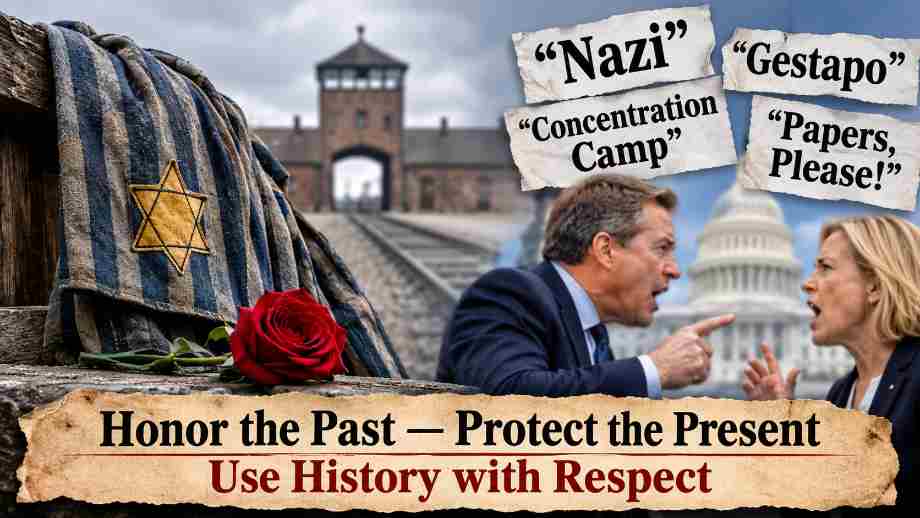 Click Image to Enlarge. Image created via AI.
The Degradation of Political Rhetoric
The normalization of Holocaust-related terminology within contemporary American political rhetoric represents a significant and accelerating degradation of civic dialogue. Modern partisan debates in the United States increasingly rely on the misappropriation of profound historical realities to vilify domestic political opponents. By weaponizing these specific horrors as routine insults, public communication strips critical historical events of their unique gravity, precision and importance. This systematic dilution not only misrepresents history but also desensitizes the public to real extremism.
That degradation is clearly visible across the political spectrum, where mainstream figures regularly misapply severe historical phenomena to routine governance. Opposing politicians, law enforcement officers and health inspectors are routinely branded as “Nazis” or the “Gestapo” over standard policy disputes. Furthermore, border detention facilities and strict administrative actions are frequently characterized as “concentration camps,” while routine identity checks or digital mandates are dismissed with the historical phrase “papers, please.” This casual borrowing of Holocaust language frames everyday civil disagreements as catastrophic moral crises.
The Unprecedented Reality of the Shoah
The danger of these analogies becomes clear only when the event being invoked is understood on its own terms. The Holocaust marks the first time in history that an entire group—every man, woman and child—was deliberately selected by a state for total destruction. The Nazi state orchestrated the attempted mass murder of every person with at least three Jewish grandparents, sentencing individuals to die merely for the crime of being born. While other historical mass murders were bounded by geography, the Nazis sought to murder the entire global Jewish population of 17 million alive in 1939, transforming the slaughter of Jewish people into a universal, borderless objective.
The Holocaust’s unprecedented scope was matched by the ideology that drove it, further separating it from standard geopolitical conflicts or routine administrative overreach. In other examples of mass murder, the impetus was rooted in pragmatic or nationalistic power struggles, such as the territorial dynamics that precipitated the Rwandan genocide or the fierce nationalism driving the Armenian genocide.
With the Holocaust, however, the genocide was built upon a “pure fantasy” of racial purity. As Adolf Hitler wrote in “Mein Kampf,: “If … the Jew is victorious over the other peoples of the world, his crown will be the funeral wreath of humanity.” Once this regime committed to this ideological fantasy, no alternative existed; as political scientist Raul Hilberg demonstrated, neither Jewish pleading nor their economic indispensability could hinder the bureaucratic process of destruction.
This fusion of ideological fantasy and state power is precisely what is lost when the Holocaust is reduced to a series of cheap political insults. Modern rhetoric thereby strips meaning from a historical moment in which, as historian Lucy S. Dawidowicz observed, the ends and the means became identical. The Germans assumed the absolute right to decide who deserved to live on this earth and, in doing so, defined the very parameters of the universe of good and evil.
Hilberg captured the magnitude of that rupture when he observed that the destruction of the Jews was an “unprecedented occurrence, a primordial act that had not been imagined before it burst forth.” When modern commentators apply the vocabulary of this unimaginable, model-less deed to standard legislative disagreements, they create a false equivalence that destroys historical fidelity, isolates generational trauma, and leaves society thoroughly unequipped to recognize genuine authoritarian threats when they actually emerge. The damage is therefore twofold: Careless analogy corrupts memory of the past while distorting how citizens recognize danger in the present.
How False Analogy Damages Democracy
The second of those consequences is often overlooked. Modern democratic erosion rarely begins with jackboots; it begins with the systematic destruction of public trust in foundational institutions. When citizens are told that a domestic political opponent is the equivalent of a genocidal dictator, it naturally follows that the institutions operating under that opponent’s tenure must be entirely corrupt. This justifies the rejection of norms such as peaceful transfers of power, legislative compromise and compliance with the rule of law.
This rhetoric does more than destroy institutional trust; it also misdiagnoses the mechanics of modern autocracy. Calling a leader “Hitler” misses how modern autocracy actually develops—not through sudden, violent coups, but through incremental legal manipulation. Modern democracies decay when executives slowly hoard power, hollow out administrative checks and balances, and place partisan loyalists in independent regulatory bodies. Framing the threat as a sudden, catastrophic fascist takeover distracts the public from watching these quiet, bureaucratic power grabs.
Executive aggrandizement, however, is only one dimension of modern democratic decay. The information environment provides another. Fascism historically relied on total state control of information; modern democratic degradation relies on the opposite—a chaotic deluge of noise that makes truth indistinguishable from fiction. The real structural threat today is information warfare. When “propaganda loops” employ hyperpolarized language, they drive audiences into echo chambers where independent journalism is vilified. Without a shared baseline of facts, a democratic populace cannot hold power accountable, rendering the electorate highly vulnerable to manipulation.
Restoring Civic Discipline
Because careless analogy damages both historical memory and civic judgment, restoring both requires discipline from writers, politicians and everyday citizens. Public figures must be held to a standard of literacy that requires them to describe modern challenges with modern vocabulary. If a politician exhibits authoritarian tendencies, those tendencies should be criticized using specific constitutional terms—such as overstepping executive authority or violating the separation of powers—rather than distorted historical shorthand.
Remembrance is not merely an academic exerciThat discipline is also indispensable to preserving the memory of the Holocaust.se; it is a moral guardrail for civilization. As Elie Wiesel observed in his 1986 Nobel lecture, “Remembering is a noble and necessary act.” But remembrance requires discipline. If the language of the Shoah is stripped of its historical meaning and turned into routine partisan invective, memory itself is weakened.
By treating the Shoah with the solemnity it commands, we honor its victims and preserve its warnings. By addressing contemporary political threats with precision and clarity, we protect the fragile, vital machinery of American democracy. These obligations reinforce one another: Historical truth sharpens civic judgment, while careless analogy corrodes both.
Dr. Alex Grobman is the senior resident scholar at the John C. Danforth Society, a member of the Council of Scholars for Peace in the Middle East and on the advisory board of the National Christian Leadership Conference of Israel (NCLCI). He is a Holocaust scholar who has written extensively on the subject including “Denying History: Who Says the Holocaust Never Happened and Why Do They Say It?” with Michael Shermer.
Israpundit is entirely dependent on readers support. Please help me continue educating people with the truth about what is going on in Israel and around the world.


Leave a Reply
You must be logged in to post a comment.