
Peloni
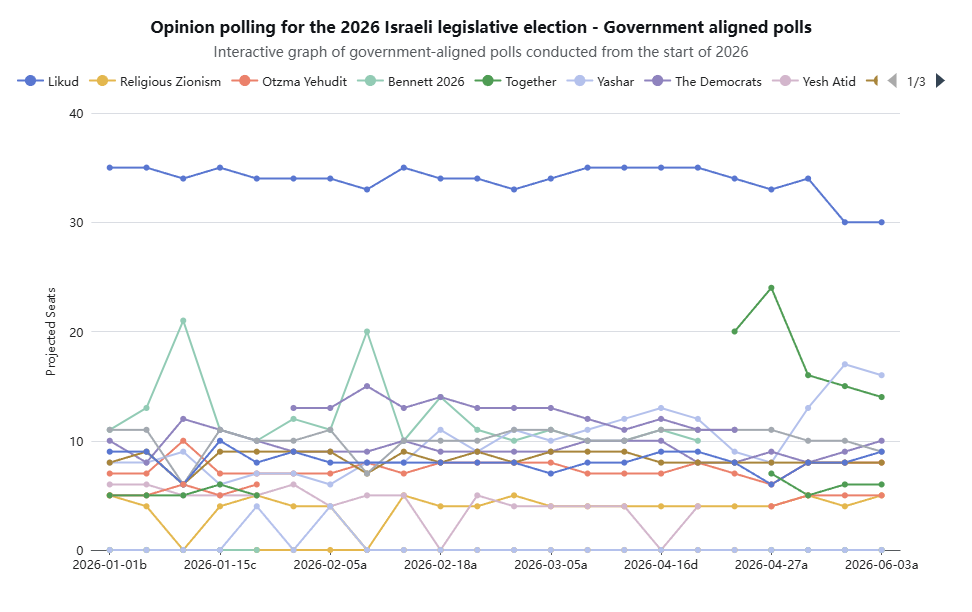 Government aligned polling trends. Screengrab via Wikipedia
In is increasingly clear that the polls predicting the coming election in Israel is falling into two distinct camps. One set of polls has results that favor the Right Bloc, and the other favors the Left Bloc. The actual polling results can be found HERE. When following the trends of the polling, it is clear that the two tracts show the traditional Right Bloc winning mandates numbering somewhere between the high 50’s to low 60’s in polling results associated with Direct Polling and Filber’s Polling, for I24 and Channel 14, respectively. All the other polls show the traditional Right Bloc gaining mandates numbering only the low 50’s to high 40’s.
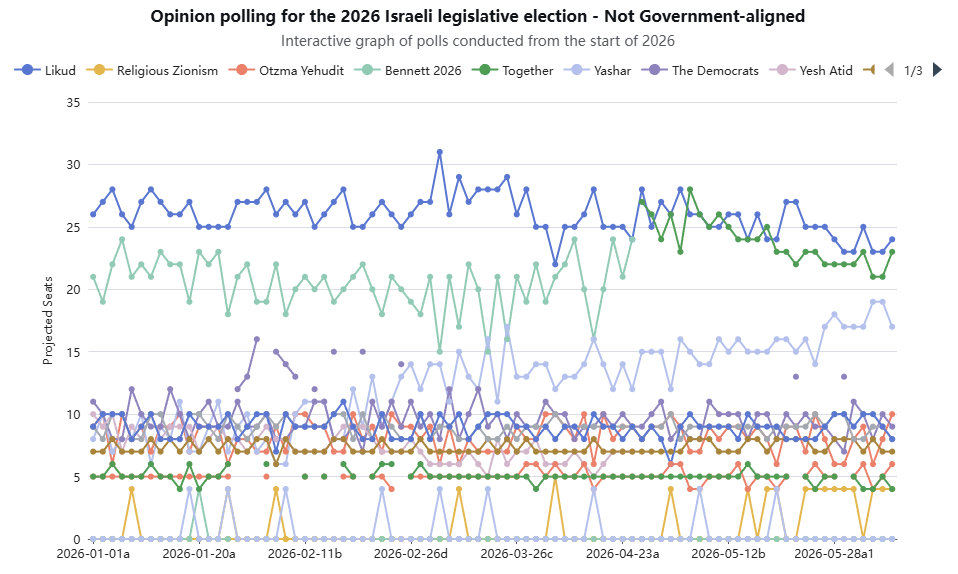 Government opposed polling trends. Screengrab via Wikipedia
Hence the discrepancies which separate these two separate polling results might be accurately described as being government aligned and government opposed polling results. The result of these predictions can not be more significant as a majority of 120 seats is required to form a government. Hence it would seem critical to gain some insight into what might explain the consistent gulf which lies between the two polling trends. In short does the Right Block have a chance at forming a government in the next Knesset or not?
Before looking more closely at this, let’s take a step back and consider the polling results which predicted the last election. Notably, Direct Polling, which was previously controlled by Shlomo Filber and Zuriel Sharon, acting in coordination with Channel 14 reporting, provided the most accurate polling predictions in the last election regarding the tallying of mandates won in the election by the two blocs. Interestingly, a year ago, in June 2025, Filber sold his interest in the company and transferred control of Direct Polling to Sharon. Direct Polling now provides polling and analysis for I24 while Filber has continued his connection with Channel 14. These two polling groups have consistently provided the government aligned polling results discussed above. Contrasting to this, all the other polling organizations have results which present no possibility of the Right Bloc forming a government following the next election.
So which polls are right, and why are the polling results so poorly aligned? Indeed, rationale which separates these two groups of polling results is worth considering in more detail.
In a recent tweet, Filber provides an important context which separates his methodology from the others and which in turn explains the reasons behind the two sets of polling results.
Filber explains that the large differences between the polling organizations arises from a series of disputed assumptions regarding voter movement rather than actual shifts taking place between the political blocs. He challenges that there has been virtually no significant movement between the coalition and opposition blocs since the last election took place, one and a half ago. He goes on to suggest that the real disagreement between the polling organizations relates to how many Likud voters abandoned the party in 2023 and how large the ultra-Orthodox parties are today.
Many pollsters assume that 8–10 Knesset seats’ worth of Likud voters defected to the opposition, first to Benny Gantz and later to Naftali Bennett. Yet, Filber argues that the actual figure of defecting voters was actually closer to representing three seats. He also argues that demographic growth of the Haredi parties should have increased the strength rather than reduced it, as some polls suggest. According to Filber, these two key set of assumptions explain why some surveys have shown Bennett polling as high as 27 seats with the right-wing bloc at only about 52 seats, whereas Channel 14’s polling showed Bennett peaking at around 17 seats while the right-wing bloc remained in the 62–64 seat range.
Filber goes on to further note that the recent rise of Gadi Eisenkot’s party in May 2026 exposes a further flaw in many polling results. While agreeing that Eisenkot has attracted former Likud voters, Filber argues that these voters are not leaving Likud today, but rather, that they left Likud in 2023, spent the past year supporting Bennett, and are now shifting their support from Bennett to Eisenkot.
A critical criticism which Filber delineates as misdirecting many polls is that they effectively count these same voters twice, ie continuing to credit Bennett with their support while simultaneously adding them to Eisenkot’s totals.
Filber concludes that if pollsters increased the projected strength of the Haredi parties, offset the relatively small number of former Likud voters who left in 2023 with voters who have since moved back into the right-wing bloc, and stopped double-counting those former Likud supporters in both Bennett’s and Eisenkot’s numbers, the results would closely resemble the Channel 14 polling, which projects a substantially stronger right-wing bloc than most other Israeli surveys.
While Filber’s criticism is leveraged at the accuracy of the polling organizations lowering expectations for the Right Bloc, it clearly provides an explanation for the divide which separates the results from the various polling organizations. Filber’s analysis proved to be more accurate in the last election, and while time will tell if this trend follows thru in the next election, it seems that the distinguishing factor will likely depend on whose assumptions prove to be more accurate.


https://www.timesofisrael.com/liveblog_entry/tv-report-claims-bennett-liberman-discussing-post-election-merger-to-give-them-most-seats-in-bloc-stop-eisenkot-from-becoming-pm/
@Sebastien
Recall what Smotrich said several months ago: We don’t care how the Left divides their votes.
This is still true today. The election will be won by the national camp based on how many votes they waste on untenable new parties. The Left would like to distract from this fact, and the fact that they really don’t have a strategy which will defeat Netanyahu if electoral discipline is enforced. So we will see.
@Peloni humor
We will find out in the coming election, which if any of the pollsters are accurate. Also, a party or two may enter the election still and this may further erode some current parties.
This is true in every election. The same trends have been apparent in the Legacy pollsters in every election cycle. No reason to expect anything different this time around, but we will see, as you note.