
Peloni: Anni suggests that the Middle East is no longer afraid of Iranian dominance, but of an Iranian demise which sees the region engulfed in flames. As such, the Gulf states are looking to the US as a mediating power which can keep the post 12 Day War region from spiraling into such a scenario by negotiating with Iran, restraining Israel and giving the Sunni states nearly all that they request. Her conclusion is that by playing such a role, the US has made its slogan of America First irrelevant and replaced it with a Gulf First reality, as the stabilizing effort by the US revolves around supporting the Gulf states’ interests and not that of the US or its real ally Israel.
Behind Closed Doors: Panic, Economics, and a Collapsing Iran
Aynaz Anni Cyrus | Nov 28, 2025
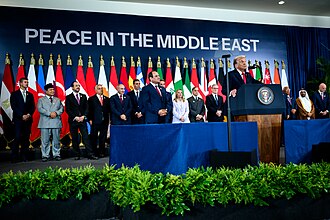 U.S. President Donald Trump speaks during a global leadership summit on the end of the war in Gaza between Israel and Hamas at the Tonino Lamborghini International Convention Center in Sharm el-Sheikh, Egypt, Monday, October 13, 2025. Photo by Daniel Torok – Flickr, Public Domain, Wikipedia
The Middle East went through a twelve-day shockwave five months ago, a rupture that broke every old assumption about power, fear, and survival. Nations that once postured as regional lions are now whispering in Washington’s hallways like anxious shareholders at a collapsing corporation. And at the center of this panic sits Mohammed bin Salman, Saudi Arabia’s crown prince, the man who spent the better part of a decade locking horns with Iran, suddenly presenting himself as a peacemaker between Tehran and Washington.
Americans are not being told the truth about what is driving this new “Arab mediation.” It isn’t a humanitarian gesture. It isn’t diplomacy. And it certainly isn’t a new era of tolerance. It is exactly what desperate regimes do when the pieces on the board shift faster than they can keep up.
There is no single explanation for why the Arab states are scrambling to mediate. The truth is far more layered than any Western analyst will admit. Different capitals are bracing for different outcomes: some fear a weakened Iran that lashes out; some fear a collapsing Iran that spills chaos across borders; some fear a vengeful Iran that burns the region on its way down, and some fear a revived, secular Iran under real leadership that would instantly eclipse the Gulf’s artificial stability. And over all of it hangs a newer, sharper fear, an Israel whose military reach now overshadows every Arab red line.
These scenarios don’t contradict each other.
They compete with each other depending on one thing: America’s next move.
Every Arab capital is running calculations based on U.S. policy, not regional autonomy.
And that is why they are sprinting toward “mediation”: because the future of the Middle East no longer depends on their decisions, it depends on America’s.
Since neither Washington nor the Arab capitals will say any of this out loud, here’s what’s actually driving this moment.
The War That Broke the Myth


@Peloni
OK. so much for that.
Looking at past recipients of the Nobel “Peace” Prize, “Merchant of Death” works for me.
Time to end 1500 years of continuous bloodshed and slavery…
Why waste words?