
Between The Hammer Of European Conditions For Economic Aid And The Anvil of Commitment to Nationalistic-Islamic Indoctrination.
Y. Yehoshua | MEMRI | Feb 11, 2026
The issue of incitement in the Palestinian school curricula places the Palestinian Authority (PA) in a bind that threatens its economic and its political stability. On the one hand, its economic survival depends on reform of the school curricula: On May 7, 2025, the European Parliament voted to freeze its education budgets until a comprehensive reform is carried out to bring the curricula up to UNESCO standards – that is, until antisemitism, incitement to violence, and glorification of terrorism are completely removed from them. The demand for curricular reform was also included in the August 4, 2025 New York Declaration promoting the two-state solution, and found expression in PA President Mahmoud Abbas’s personal commitment to French President Emmanuel Macron.[1]
On the other hand, the EU demand that the PA remove inciting content clashes with the Palestinian national narrative and sparks intense public opposition. This is because the Palestinian street sees changing the curricula as submitting to foreign dictates and eradicating the Palestinian national identity. The situation is the same as the dilemma of stipends for Palestinian prisoners and families of “martyrs” (“pay to slay”)[2]: While the West demands a halt to the payments to terrorists as a condition for legitimacy and aid, the PA fears that compliance would be political suicide and be perceived as betrayal of the symbols of the struggle.
This tension regarding the reform of the Palestinian curricula recently erupted into a media storm, after the Ramallah-based independent Quds News Network, which is known to be critical of and even hostile to the PA, published an investigative report stating that the Palestinian Education Ministry had yielded to European Union directives and made some 300 “substantial” edits in schoolbooks, including the removal of “content that is national in nature” and the alteration of “fundamental terminology” and “historic and cultural concepts.” The Quds report enraged opponents of the PA, who accused the latter of betraying the values of the Palestinian struggle; in response, the PA claimed that the report was false and that the changes made to curricula were carried out by Israel in schools in East Jerusalem.
An examination of the examples presented in the Quds report reveals a complex picture: In some cases, the PA actually refused to comply with demands to make changes to its curricula – raising questions regarding the extent of the PA’s assent to the EU’s conditions.
This report will present the Quds investigation and reactions to it by the PA and its opponents.
Quds News Network Report: The PA Is Making Significant Changes To Its School Curricula Under European Pressure
The Palestinian Quds News Network reported that the PA’s Education Ministry has acceded to pressure by the EU and has implemented comprehensive changes in dozens of school textbooks for first grade through tenth grade. The report is based on two official Education Ministry documents that were leaked. The first document is a January 19, 2026 letter sent by PA Education Minister Amjad Barham to acting Finance Minister and Minister for Planning and International Cooperation Estephan Salameh, which includes comments by the Education Ministry to the EU’s demands to amend the school curricula ahead of a meeting with EU representatives on the issue at the end of the month. The second document is a report on the issue by the ministry’s National Center for Palestinian Curricula.
Based on these documents, the report claimed that the PA has made approximately 300 changes to the curricula in accordance with the EU demands, including changes in terminology referring to the Israeli-Palestinian conflict and to the Palestinian armed struggle. These terms reportedly include “Zionist,” “jihad fighter,” and “prisoner.” In addition, the report said that national poems glorifying sacrifice have been removed, such as the poem “I Will Sacrifice Myself for You, O Homeland,” which was part of the first grade curriculum. The changes also include the removal of references to “the first fida‘i [fighter willing to sacrifice his life] in Islam,” and to individuals involved in terrorism – such as Dalal Al-Mughrabi, a Fatah terrorist who was the deputy commander of the 1978 Coastal Road Massacre, in which 35 Israelis were killed and 71 were injured.
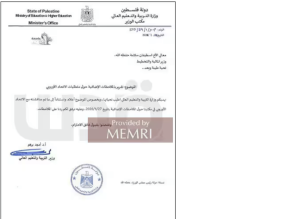
The letter sent by PA Education Minister Amjad Bahram to acting Finance Minister and Minister of Planning and International Cooperation Estephan Salameh presenting Education Ministry comments about the EU demands for changes in the textbooks
According to the report, a map of Palestine was removed from one of the textbooks, and changes were made to references to Jerusalem, such as replacing the phrase “Jerusalem, capital of Palestine” with “Jerusalem, capital of the monotheistic religions, capital of Palestine.”
Other changes that have reportedly been made at the EU’s request are meant to remove or obscure the narrative of the Palestinian right of return by removing or changing content referring to cities inside of Israel’s 1948 borders to which the PA has been demanding a Palestinian right of return. For example, the report said that one map of Palestine marking cities within Israel has been removed, and that the names of many cities within Israel (such as Acre and Nazareth) were omitted from an Arabic-language textbook, as well as phrases evoking these cities and the wish to return to them, such as “yearning for Ramla,” “yearning for Safed,” “the return,” and the poem “We Shall Return.” In addition, the phrase “Palestinian cities on the coast” was changed to “Arab and Jewish cities in Israel.”
The report also indicated that phrases encouraging extremism were removed from the new Arabic-language textbooks: the term “attack” was replaced with the term “calm,” and the phrase “the jihad fighter won” with the phrase “the student rose.” The expressions “martyrs,” “jihad is its pinnacle,” “we are a fighting people” and “the Palestinian women are fighters” were removed, and the phrase “Islam opposes extremism” was added, along with other content encouraging peace and coexistence, such as references to cooperation between Jews and Arabs in agriculture.[3]
The Examples Given In The Quds Report Indicate Only Partial PA Compliance With The EU Demands
Even though the Quds report aimed to present the PA as surrendering to dictates by the EU and the demand for reform, the examples given in it indicate that, in some of the cases, the opposite is true and the PA refused to comply with the demands for amendments. For example, one of the pictures in the report indicates that the PA refused to remove an activity from a first grade schoolbook about the national anthem “Fida’i [fighter willing to sacrifice his life],” which is about the Palestinian struggle and the sacrifice of one’s life for the sake of Palestine, and which the PA officially adopted as its anthem upon its establishment. According to the caption of the picture, the PA asserted that it “cannot remove the content containing the internationally-recognized national anthem.”
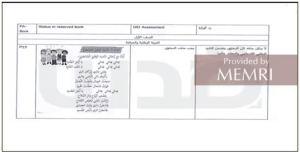
The picture demonstrating the PA’s unwillingness to remove its national anthem “Fida’i [fighter willing to sacrifice his life]” from the first-grade curriculum
Another example demonstrates the PA’s refusal to remove content in a third-grade textbook defining Jerusalem as “the capital of Palestine,” on the grounds that “the lesson is about the Palestinian narrative, and not about any other narrative,” and that “according to international documents, Jerusalem is the capital of the State of Palestine.” The PA also refused to remove the sentence “Jerusalem is the capital of Palestine” for the same reason.
The Quds report itself also indicates the changes were partial, and that most of them involved replacing phrases in the Arabic-language textbooks. For example, according to the report the phrase “Jerusalem, a Palestinian city” was changed to “a city sacred to Palestinian Muslims and Christians,” which disregards the city’s Jewish connection. Likewise, the phrase “Safed, the fortress of the Galilee” was changed to “Safed, the most beautiful of the cities of the Upper Galilee in Israel and Palestine,” which implies that the Upper Galilee is part of Palestine.
The PA Responds To The Criticism: These Are Changes Made By Israel In East Jerusalem Schools, Not By The PA
The Quds Report Sparks An Uproar: Any Change To The Curricula Is A Crime Against The Palestinian People
The report sparked criticism against the PA, particularly from its political opponents in Hamas and its parent organization, the Muslim Brotherhood. For example, Gaza-based journalist Fayez Abu Shamala, who is close to Hamas, wrote: “The PA is complying with Israeli demands to change the curricula and erase historical evidence from them. What is strange is that the Zionist enemy forced the PA to delete the word ‘Zionism’ from its curricula, while U.S. presidents [Joe] Biden and [Donald] Trump boast that they are Zionists… Is Zionism a symbol of honor, sanctity, and human nobility in the U.S, whereas in Palestine it means crime, murder, destruction, and terror? This whole matter of the Zionists and their lackeys [i.e., the PA] is strange.”[4]
Political analyst Marwan Al-Aqra’ told the Hamas website that “any change to the curricula that is intended to distort the Palestinian narrative or erase national consciousness serves the goals of the occupation [i.e., Israel]… and constitutes a crime against the Palestinian people, their history, and their struggle.” He called on civil society organizations “to act urgently in order to compel the PA Education Ministry not to submit to Western dictates that undermine the Palestinian principles and identity.”[5]
Journalist Ali Sa’ada wrote in the daily Al-Sabil, affiliated with the MB in Jordan: “300 political distortions in the textbooks from first grade through tenth grade. This is nothing less than a reshaping of the Palestinian identity and consciousness with the aim of producing a student devoid of any national or historical awareness… This is a curriculum that eradicates the spirit of resistance… The PA is belittling the struggle and the sacrifices of the Palestinian people. This is a betrayal of the blood of the martyrs and the suffering of the prisoners, the wounded, and their families.”[6]
The Response Of The PA Education Ministry: The Report Is False
In response to the Quds report and to the public uproar it caused, the PA Education Ministry issued a sweeping denial of the allegations against it. In a statement released on February 7, it claimed that the findings published by “media outlets receiving funding from outside Palestine,” referring to the Quds News Network, were false, and that the best proof of this is the content of the textbooks themselves. The ministry noted its “full commitment to UNESCO standards” and claimed that the changes presented were not made by the PA Education Ministry but by Israel, in schools in East Jerusalem: “These are changes carried out by the occupation in schools in Jerusalem, the capital of Palestine, as part of its policy of Israelizing the city,” the statement said. It urged the media and the citizens to refrain from spreading what it called false information published by dubious platforms and accounts, intended to inflame public opinion.[7]
Education Ministry spokesperson Sadeq Al-Khadour likewise denied the reports about the changes to the curricula, saying: “The books are in the students’ possession, and all parents can see for themselves and discover that what is being circulated is not accurate at all.” He stressed that “the national curriculum is part of [our] identity and sovereignty.”[8]
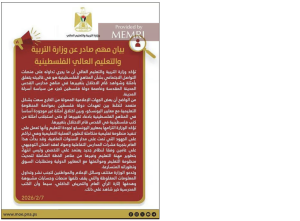
The Education Ministry’s denial: These were changes made by Israel in East Jerusalem schools (Moe.edu.ps, February 8, 2026)
* Y. Yehoshua is MEMRI Vice President for Research.


Leave a Reply
You must be logged in to post a comment.