
Peloni: The little discussed history of Albania during WWII is an important oversight. At the beginning of the war, there were somewhere between 200-600 Jews living in Albania, but at the war’s end there were some 2,000. Even after the Germans occupied Albania and demanded the list of Jews in the country, locals refused to comply and fake documents were provided to the Jews.
Visar Malaj | January 24, 2024
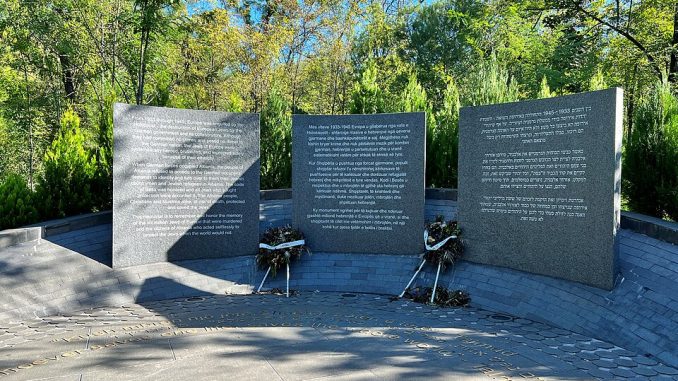 Holocaust memorial in Tirana, Albabua with inscriptions in Hebrew, English and Albanian. (Photo by Bdx – Own work, CC0, Wikipedia)
Background
As a recipient of the EHRI-Conny Kristel fellowship, I spent a short research period at the Fondazione Centro Di Documentazione Ebraica Contemporanea (CDEC) in Milan, Italy. CDEC is an independent research institute for the study of the history and culture of Jews in Italy, with particular reference to contemporary Italy and the Nazi-fascist period. The CDEC Foundation is broadly recognized as the main institute in Italy for the history and documentation of the Shoah.2 The time I spent at CDEC was fundamental for my research, which is focused on the fate of native and foreign Jews in Albania during the Holocaust. CDEC contains a significant number of documents, books, and other materials, directly and indirectly connected to the experiences of Jews in Albania before and throughout World War II (WWII).
Please follow the link for the EHRI institution description of the CDED:
Albania was the only Nazi-occupied country with more Jews after WWII than before. Almost all native Jews survived the Holocaust, and other thousands of Jewish refugees were protected during the period from 1939 to 1945. The tradition of Besa, a moral commitment to society, was the main motivation underlying these altruistic acts.3 Besa is the crucial element of the Doke or Kanun, an unwritten pagan code that most probably originated from Illyrian tribal laws.4 Rescue in Albania can be divided into three main periods: King Zog’s reign (January 1933 – April 1939), the fascist Italian occupation (April 1939 – September 1943), and the Nazi German occupation (September 1943 – November 1944).
In the first period, Jewish refugees from other nations were openly invited and assisted by the Albanian government. The local Jewish community was well integrated in the Albanian society and could practice their religion openly.5 Many of them owned small enterprises, mostly in urban areas, such as Vlorë, Durrës and Berat. Government officials and diplomats followed the King’s order to grant visas and citizenship to every Jew that necessitated living in Albania.6 The country was used as a safe transit station to reach more stable territories, outside the influence of Hitler. King Zog did not implement fascist policies in his country, despite the deep financial dependence on Mussolini’s Italy.7 He tried until the last days before the fascist invasion to preserve the independence of the country, despite not being successful.
During the second period of rescue, thousands of Jewish refugees remained trapped in Albania, but despite that, arrivals continued at a high rate. The Italian authorities ordered the repatriation of every foreign Jew, but they were never forced to leave the country.8 Albanian and foreign Jews were relatively safe during the fascist rule, but they were excluded from any political involvement. Moreover, they lived under continuous fear of being targeted for deportation to concentration camps and elimination.


The West Betrays the Jews Again
https://open.substack.com/pub/lel817/p/the-west-betrays-the-jews-again?r=1q2uiq&utm_campaign=post&utm_medium=web&showWelcomeOnShare=true
@Laura
So very well stated!