
Peloni: Despite the fanfare in Lebanon, the security threat from Hezbollah remains no more likely to be resolved than does the security threat in Syria at the moment. Recalling that 45% of the Lebanese Armed Forces remains to be Shiite is just one of the factors demonstrating this fact.
by: Yaakov Lappin and Tal Beeri | Alma | August 7, 2025
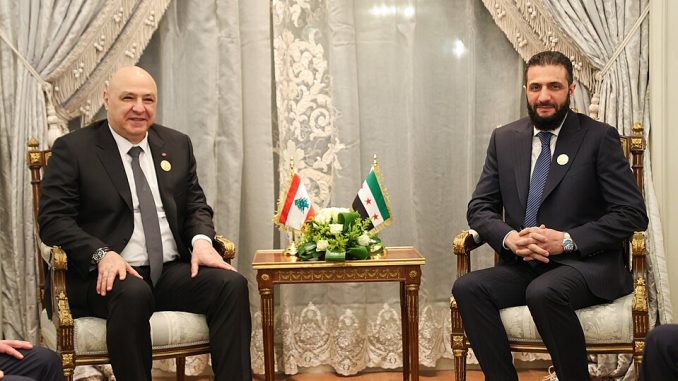 Joseph Aoun met with Ahmed al-Sharaa. (Photo by Presidency of the Syrian Arab Republic – Presidency of the Syrian Arab Republic, Public Domain, Wikipedia)
Executive Summary
Despite a flurry of international diplomatic activity intended to stabilize the situation on the Israel – Lebanon border and the Israel – Syria border, the basic requirements on Israel’s part for a safe and sustainable withdrawal of the IDF from forward positions in southern Lebanon and southern Syria do not exist for the time being, and it is doubtful whether they will exist in the near future.
In Lebanon, the basic identity of Hezbollah as a Shiite – religious – ideological – armed movement, makes its voluntary disarmament – an Israeli demand and a condition for withdrawal from southern Lebanon – impossible.
Likewise, the Lebanese army does not have the ability to fundamentally, systematically, and truly disarm Hezbollah, even if it and the new Lebanese government have the intentions to do so.
To date, the removal of Hezbollah’s military capabilities has been carried out mainly by a successful Israeli war effort in 2024, in the form of a maneuver, senior leadership assassinations, the beeper operation, and massive aerial attacks.
After the ceasefire agreement, on November 27, 2024, Israel continues to be the only significant factor that prevents Hezbollah from rebuilding its strength, through daily aerial attacks, and according to reports, periodic ground raids.
Hezbollah’s arsenal of weapons is the source of its power and its main value for its patrons in Iran; Giving up what remains of the firepower capabilities, or the intention to rebuild, would be an act of ‘ceasing to be’ for Hezbollah.
In Syria, the new Sunni regime under the leadership of Ahmed al-Sharaa is driven by the main goal of re-establishing centralized state sovereignty over all parts of the country.
This goal directly conflicts with Israel’s supreme security demands for an expanded and demilitarized southern-Syrian buffer zone, which includes the territories south of Damascus.


Leave a Reply
You must be logged in to post a comment.