
By Farrell Bloch | Am Thinker | Oct 31, 2025
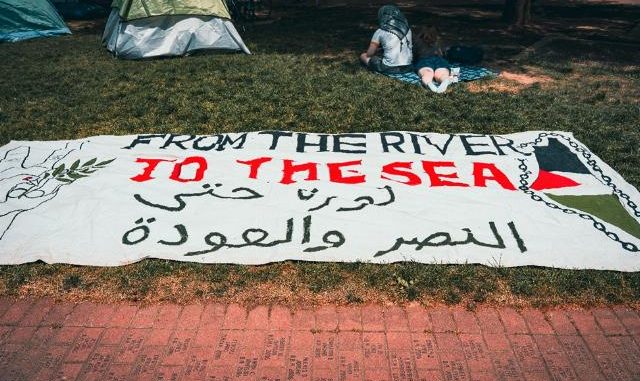 Image: Ted Eytan
The primary goal of pro-Palestinian protestors is vilification of Israel rather than support of Palestinian Arabs, as is suggested by these activists’ silence when Palestinians are murdered by other Arabs, most recently Hamas’ executions of opposing Gazans. Indeed, their limited perspective lacks focus on other contemporary ethnic conflicts such as Arabs attacking Africans in Sudan and Muslim persecution of Christians in Nigeria. The most apparent explanation for the anti-Israel monomania on campuses, in the United Nations, and elsewhere is that Israel’s direct opposition consists of populous, politically active, and oil-supported Muslims.
But why do non-Muslims join the anti-Israel frenzy — even to the point of celebration of Hamas’ October 7, 2023, massacre of Israeli citizens? Two easy answers are ignorance and antisemitism. But these factors are hardly comprehensive. Observers have noted that anti-Israel sentiment is fostered by biased reporting, tendentious analysis, and lack of historical knowledge. Again, true but incomplete. Rarely noted are several factors extrinsic to the conflict itself.
As to media bias, several watchdog organizations publicize the frequent misreporting and misinterpretation in the mainstream media. For example, academics, journalists, and others characterize Israel’s military campaign as genocide despite Israel’s warnings to Gazan civilians prior to attacks on nearby military targets, provision of food to this overwhelmingly hostile population, and achievement of a remarkably low civilian-to-military fatality ratio even though Hamas uses its own people as human shields. This assessment is bitterly ironic given a prevalent Hamas’ goal of genocide of Jews, foreshadowed by the October 7 massacre. Related is the charge of Israeli apartheid that is contradicted by the prominence of Arabs in all walks of life including Israel’s Supreme Court, parliament, and military — again in contrast to the Judenrein Palestinian — and other Arab-controlled areas where even Jewish passersby would risk their lives.
Moreover, with limited knowledge of history, protestors claim as indigenous the descendants of 19th and 20th-century Muslim immigrants from Algeria, Egypt, and Syria into the Palestine region , overlook that so-called settlements include areas once populated predominantly by Jews (notably the Old City of Jerusalem, ethnically cleansed of Jews by the Jordanian Army in 1948), and disregard the mass expulsion of Jews from Arab countries shortly after the modern state of Israel was reborn. Despite Israel vacating Gaza in 2005, some still describe the area as Israeli-occupied. Few are aware of the goal of Islamic supremacy reflected in past and intended future colonialism and conquest. Eliminating Israel has been the enduring Hamas and Palestinian Authority intention, hence their refusal to negotiate several two-state proposals over the years.
Now for issues extrinsic to the underlying conflict that support an anti-Israel orientation:
- Israelis are considered white and Palestinians people of color. Progressives tend to favor people of color, regarded as victims, over whites, deemed oppressors, no matter the historical or contemporary evidence. Thus, discussion of colonization and slavery imposed by nonwhites is omitted in contemporary academic departments. Ironically, only a minority of Israelis would be considered white, although most Diaspora Jews are white. The black Ethiopian and mostly brown Mizrachi and Sephardic Jews are not seen much in the West by those condemning Israel on racial grounds. Moreover, some Arabs, including Palestinians, would be regarded as white.
- Israel has been a loyal American ally so anti-American sentiment extends to Israel. Moreover, Judeo-Christian values at the heart of traditional American belief and disfavored by some are ultimately traced to Judaism and then to the lone Jewish state.
- Vilifying Israel promotes the idea that Jews can be as horrific as any other people in control so the antisemitic history of Christians and Muslims can be interpreted as the inevitable tyranny of powerful majorities rather than antisemitism in particular. According to this framework, Jews have been an historical exception only because they have not had their own state. But the strongly negative interpretation of Israel’s behavior fosters the idea that Jews, like other peoples, are capable of oppressing others. Under this framework, past persecution of Jews is regarded as no more than the unfortunate common example of subjugation of weaker peoples, a sin of which the Jews can now not be excused and for which the Holocaust and other antisemitic campaigns can no longer be considered singularly evil.
- Europeans to a considerable extent have adopted an attitude of subservience to their recent Muslim immigrants. Europeans accept even criminal behavior from younger, passionate, strongly-identified Muslims. Just one example is the United Kingdom’s refusal — for fear of being labeled Islamophobic — to arraign the Pakistani and Bangladeshi grooming gangs who raped and abused hundreds of English girls. In part, Europeans’ submissive stance reflects that immigration is necessary to counter native population and concomitant labor force decline.
- Given fashionable globalization, nationalism is not in vogue among intellectuals, so the Zionism of a Jewish state is considered by academics and others a noxious anachronism. But other countries with nationalistic fervor and even religiously-oriented governments, such as the Muslim countries where Sharia law prevails, are conveniently disregarded within this criticism while Israel is highlighted. Also not considered is that imperialism, rather than national pride, has been a proximate cause of war and conquest. To the extent Israeli policy favors Jews, for example with regard to immigration, it is no different from other countries expressing ethnic or religious preferences. Historically multiethnic countries lacking such criteria, such as the contemporary United States, are global outliers.
- Ignorance of economics nurtures the idea that affluent individuals must have exploited poorer ones rather than having earned their wealth fairly. A not uncommon belief is that wealth is predominantly unjustly attained by colonialism, conquest, political favoritism, inheritance, and exploitation of labor and oppressed people’s natural resources. Such factors have indeed influenced patterns of wealth accumulation but technological advances, private property, and the rule of law have had much more contemporary impact. Thus, the relatively more affluent (but far from universally well-off) Israelis are less preferred by progressives than the Palestinians. A related issue is that aid granted to Palestinians often finds the pockets of their wealthy leaders or is used to amass weapons, build tunnels for military operations, and attack Israelis rather than to improve the lives of the local population.
- Israel’s relatively high fertility rate, singularly among economically advanced nations producing more than enough children to increase the population, suggests an optimistic future orientation that more than overwhelms Western reluctance to bring babies into a world deemed inevitably to face such eventual catastrophes as nuclear war, pandemics, and, especially, climate change and other environmental devastation. It is common for opponents of large families, or of any children, to emphasize that those in advanced economies should limit family size because high-consumption societies have a major impact on resource usage and environmental decline. But rare are politically incorrect objections to the large families in much of the less developed world. Thus, observers chastise Israel, especially its Orthodox Jews, for excessively large families while eschewing criticism of the relatively high Palestinian fertility rate or, more generally, Muslim encouragement and establishment of large Islamic families that, if present trends continue, will in a few decades outnumber the nominally Christian populations in Europe and elsewhere.
These seven points lay the groundwork for an anti-Israel orientation even before historical and contemporary events are considered — and can explain the surprising perspective of some women, gays, and others who are oppressed under Islamic law while generally accepted and thriving in Israel: Their prevailing political stance overwhelms the contrasting treatment they would experience in Israel as compared with that in Gaza, the West Bank, and other Muslim societies. Alternatively, perhaps the universities and mainstream media have managed to obscure Islam’s subjugation of not only infidels but also Muslims who violate Sharia.


Leave a Reply
You must be logged in to post a comment.