
Peloni: Notably, America’s traditional European partners have been dissembling themselves for sometime now, ignoring realities of defense while simultaneously calling for greater involvement in the Ukraine War. The current blunder of disregarding the threat from Iran, both the threat of its missile development as well as its threat over the closure of the Strait of Hormuz, reinforces Europe’s eagerness to maintain policies which are antithetical to their own interests. To what purpose might a military alliance serve when partnering with nations which consistently ignore its own vital interests, both in their own region, and in the Middle East. Furthermore, their attempts to block America dealing with the threats from China and Iran have demonstrated that Europe is not only ignoring their own security interests, but also leveraging their influence to force America to do the same.
| All Israel News | Published: April 3, 2026
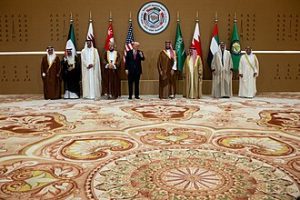 President Donald Trump with leaders of the Gulf Cooperation Council, May 14, 2025, in Riyadh, Saudi Arabia. Photo by The White House – Flickr, Public Domain, Wikipedia
During his two terms as president of the United States, Donald Trump made it clear to our long-time traditional allies in Europe that America would no longer do all the heavy lifting financially or otherwise. Now, with the military conflict with Iran continuing to rage on, the president is back at it again. He’s not happy with some of those so-called “friends” of America. Increasingly, the president is turning to Gulf states as trusted allies and partners. More on that in a moment.
In President Trump’s address to the nation this past week, you could hear his frustration. He had a clear message directed at America’s allies: step up. He made it crystal clear that when it comes to securing the Strait of Hormuz – the critical oil passage being threatened by Iran – the United States shouldn’t be doing this alone.
“We will be helpful, but they should take the lead,” he said, pointing directly at countries that rely heavily on that oil flow. His message to our allies essentially came down to if you depend on it, you protect it.
He even pushed it further, calling on other nations to show what he described as “delayed courage” and take control of securing the Strait themselves. Many of those same allies, especially in Europe, readily proclaimed, “This is not our war.”
If you really want to understand Trump’s frustration, just listen to what he’s been saying about NATO lately. In just the past week, Trump has openly floated the idea of the United States pulling out of NATO altogether.
Trump called NATO a “paper tiger” and said he’s “absolutely” considering leaving the alliance, pointing directly to the lack of support during the Iran war.
All of this tension has been building for quite some time. There have been disputes over defense spending within NATO for years. Then add recent tensions – like European hesitation on Iran, disagreements over military strategy, and even clashes over issues like Greenland – and you see the trend.
Trump is a man of action, so he’s not going to just sit idly by while our allies dither. Instead, he’s been looking for willing partners. Enter the Gulf states. Right now, they’re proving more willing to engage in the kind of cooperation Trump is looking for.
Granted, Saudi Arabia, the UAE, Bahrain, Kuwait and other Gulf nations have a lot at stake when it comes to a weakened Iran, but it goes beyond that.
President Trump has been working on this Gulf state coalition for years. It didn’t start with the war in Iran. That’s been the payoff, but it goes all the way back to 2017.
Back then, Trump’s very first foreign trip as president wasn’t to Europe. It wasn’t to Canada. It was to Saudi Arabia. That 2017 trip produced a massive arms deal and it really signaled a reset in how the U.S. would deal with the region. More alignment against shared threats – especially Iran.
Fast forward to President Trump’s second term, and we see more of the same. Once again, the president made Saudi Arabia his first overseas trip, locking in new economic agreements, expanding defense cooperation, and strengthening ties with Gulf leaders.
It hasn’t been just Saudi Arabia, but you get the idea. Trump is essentially working on an Abraham Accords 2.0 and it’s moving along and paying dividends in the war effort in Iran.
The Saudis have provided key logistical cooperation – everything from airspace coordination to intelligence sharing tied to Iranian targets and movements.
The United Arab Emirates is helping to facilitate regional security coordination and maintain backchannel communications.
Bahrain hosts the U.S. Navy’s Fifth Fleet, and that presence has been essential in securing shipping lanes and projecting power near Iran, especially around the Strait of Hormuz.
Kuwait provides basing access and logistical support that allows American forces to move quickly across the region.
Even Qatar, which has nefarious ties to Hamas leadership, has stepped up diplomatically – serving as a go-between in sensitive discussions with enemies of both America and Israel.
All of this is ultimately helping America and Israel in their current fight against Iran. It’s also beginning to reshuffle the deck, where Israel and key Arab nations are no longer operating in separate lanes, but increasingly in quiet coordination.
What Trump has done here is bring to the forefront that Iran isn’t just Israel’s problem anymore – it’s everyone’s problem in the region. Gulf states and Israel are finding themselves on the same side of the same fight, whether formally or not.
Leave it to President Trump to throw out conventional structures, where trusted allies are no longer just blindly trusted. It’s now one based less on tradition and more on transaction. That’s the Trump Way, and it’s reshaping the Middle East and American foreign policy.


Leave a Reply
You must be logged in to post a comment.