
Peloni
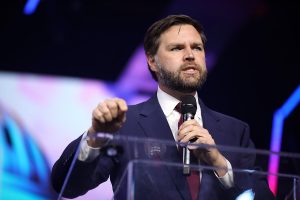 By Gage Skidmore from Surprise, AZ, United States of America – J. D. Vance, CC BY-SA 2.0, Wikipedia
In a recent interview, VP JD Vance announced his opposition to free market economics, Margaret Thatcher, and meritocracy, to which Steve Moore responded the release of a corrective statement which he followed up with the following two interviews:
What Moore misses in his analysis of Vance’s lack of respect for the fundamental principles on which Western civilization has been founded is that Vance’s career and rise to power has been in no small part due to his ability to wield influence so as to support his political success, what some might describe as crony capitalism.
In fact, Vance’s advancement in life has been tied at the hip to his relationship with Peter Thiel which began after meeting him in 2011 while Vance was in his first year at Yale. Their subsequent correspondence may or may not have influenced Vance’s subsequent judicial clerkship, but it was clearly related to Vance’s success in the world of venture capitalism. Thiel’s endorsement of Vance’s book was yet another aspect of the burgeoning benefits springing from Vance’s mentorship with Thiel. Hence, this protege-mentor connection between these two is arguably a better basis under which to ascribe Vance’s financial success than any form of meritocracy and this trend is naturally enough followed by Thiel’s support for Vance in his senatorial victory and later his being picked by Trump to stand only a heartbeat away from the most powerful position in the world.
So Vance’s lack of support for meritocracy would seem to be less of a point of being poorly informed than of a reflection of how he himself achieved so much in less than twenty years time. He might easily and honestly ask his naysayers such as Moore to present an example of meritocracy which raised someone from Vance’s background to the position he holds today. Of course, success earned on the shoulders of others provides for a poor learning curve of what made the American nation the envy of the world, which explains Vance’s obvious derision of meritocracy, free market economics and those who advocated such fundamentally foundational Western values such as Margaret Thatcher. Hence, while Moore explains Vance’s failure to support the values of Western democracy as being due to bad advice, it is arguably more a consequence of Vance’s own lived experiences which makes his fundamental anti-democratic world view all the more troubling and problematic.
Indeed, one might ask why the likely next leader of the Make America Great movement is cherishing values which have instead lead to making America in need of the Make America Great movement in the first place.
One more point to raise in all of this, is that as JD Vance was being pulled from success to success, we might want to look more closely at the puppet master who has paved the way for Vance to now advocate for defeating the enemies of democracy by adopting the values on which democracy’s enemies now stand, but first, one more astute review of Vance’s plans for America:
Who is Peter Thiel
Click Link for Insightful Analysis:
Peter Thiel’s Apocalyptic Vision: Why One Tech Billionaire Threatens Democracy
So, while looking more closely at Peter Thiel, perhaps Steve Moore was actually correct about Vance having been receiving advice from the wrong people, only this advice has actually filled the past 15 years during which Vance’s entire path to power and wealth has been in no small part the product of his acting on this advice.
So is Vance really to be the next champion of Americanism? Is his criticism of American values likely to affect his advancement as Trump’s successor? And why in the world is it that he stands as Trump’s successor in any event? All good questions.


JD Vance is Unfit to be President
https://open.substack.com/pub/lel817/p/jd-vance-is-unfit-to-be-president?r=1q2uiq&utm_campaign=post&utm_medium=web&showWelcomeOnShare=true
I think the outcome of the 2026 elections will bring new clarity as to where the GOP is headed for in 2028, especially regarding Vance and Rubio. IMO, there is currently a war going on: Vance/Shitkoff/Kushnireentuchas vs Rubio/Hegseth/Ratcliffe.
The fact that his son in law is aligned with Vance I think is causing Trump some cognitive dissonance.
Pertinent satire
https://youtu.be/mVUVPen3xNQ
Richard Dreyfus plays an actor hired to impersonate a deceased dictator.
“Free and Fair Elections: The illusion of choice”
https://youtu.be/e7E9SS-X4YY?is=o_rlESynQSeQ9qD8
Satire
https://youtu.be/s2NNZdigSXg?is=MMwtHdH-OohOINDN
@Peloni Post disappeared.
@Sebastien,
Thanks, it’s back.
We need to look to Trump. He chose Vance as his vice president. If he is happy with him, he will remain. I’m not sure if the selection of a vice president is covered by laws and/or regulations, but I doubt he can’t fire him.
Vance has been noted as influenced by Alexander Dugan, who wants, among many other things, a very strong nation state to control its markets. It would be capitalism without liberalism, i.e., fascism.
I’m not calling Vance a fascist, but this is worth noticing.
(Poor Usha. Did she know what she was getting into?)
Why not? I am.
Rod Dreher, the Trump hating editor of “The American Conservative” is a big fan of Vance. Dreher’s Father was an “Exalted Cyclops” in the Ku Klux Klan.
Tucker Carlson sits on the Board of Advisors for “The American Conservative”
Put 2 + 2 together.
https://www.theamericanconservative.com/who-we-are/
@John GaltI VI
I was completely unaware of this.
Dreher has been away from The American Conservative for about 4 years at least. I remember him being a contributor there, not an editor. He’s now on Substack.
I read Dreher’s substack posts regularly and have come to learn much about him. He can’t stand Trump’s personality, demeanor, and his transactiuonal nature, but often says that he likes many things he has done.
Dreher had a friendship with Tucker that ended when Tucker went south with Candace, Fuquentes, Qatar, etc. They don’t speak to each other anymore. Dreher says he is a philosemite and supports Israel (to some extent) and Israelis (though he’d like to see us convert.)
Upon reading Vance’s book he introduced him to Tucker, who then had Vance on his show over 40 times in a few years. IMO, Vance would be nowhere if not for Lord TuckTuck.
There’s something about his rise that reminds me of Obama’s. …
-Dreher’s written a lot about his difficult relationship with his KKK father.
-‘The American Conservative’ is strongly aligned with the ‘Quincy Institute for Responsible Statecraft’, which was a creation of the unusual combo of Koch and Soros.
Hopefully, Vance keeps kicking himself in the …….! That way he will not be viable candidate for the Presidency.
My thoughts exactly!
Clearly being an antisemite doesn’t seem to matter much to most people, even Republicans. But espousing anti-Maga values does. Keep it up Vance!
As time goes on I think the world will see Vance take a sharp detour from Trump’s policies. Rubio should be the obvious pick for those who are MAGA.
Vance is a work in progress, who is gradually going down a different path. I don’t trust him and never did.
@Harris
I couldn’t agree more. The fact that America has not yet solved its election problems, and the fact that Vance is becoming more and more at ease in publicly acknowledging his true political identity as discussed above in this article, indicates something very troubling. So we will see what comes from this, but the fact that America can’t fix its electioneering issues, even with Trump in office, suggests the possibility of a very dark future in America, not too dissimilar from the description discussed by Vance above.