
The Hanson Proposal: Bypassing Tehran Through a Government-in-Exile
By Amil Imani |
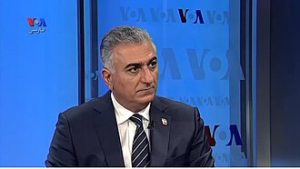 Reza Pahlavi, Crown Prince of Iran. By ir.voanews.com, Public Domain, Wikipedia
For over four decades, Washington’s posture toward the Islamic Republic of Iran has oscillated between containment, targeted economic sanctions, and episodic diplomatic engagement. Historian and military strategist Victor Davis Hanson argues that this paradigm has proven utterly ineffective at checking Tehran’s regional aggression or supporting the democratic aspirations of the Iranian public. During a high-profile broadcast exchange with commentator Mark Levin, Hanson put forward a provocative shift in U.S. foreign policy: formal diplomatic recognition of an Iranian government-in-exile headed by Crown Prince Reza Pahlavi.
Hanson’s proposal fundamentally challenges the conventional wisdom of Middle Eastern diplomacy. Rather than treating the clerical regime as the permanent, sole legitimate authority in Tehran, the United States would actively construct a parallel diplomatic reality – one that isolates the ruling theocracy, provides an institutional anchor for internal and external opposition, and charts a credible path toward democratic restoration.
The core of Victor Davis Hanson’s proposal rests on fundamentally shifting American foreign policy away from the perpetual management of the Islamic Republic and toward its active delegitimization. During his discussions with Mark Levin, Hanson argued that decades of containment, economic sanctions, and episodic negotiations have only subsidized the clerical regime’s survival while ignoring the overwhelmingly secular, pro-Western aspirations of the Iranian public. By proposing that Washington explicitly bypass Tehran and formally recognize an Iranian government-in-exile, Hanson challenges the traditional diplomatic status quo. This strategy aims to strip the ruling theocracy of its international standing, isolate its diplomatic channels, and create a structured external pressure point that forces the regime to absorb the full financial and political costs of its domestic tyranny and regional proxy warfare.
The core pillar of Hanson’s argument is that the United States must stop according de facto legitimacy to the Islamic Republic. For decades, Western powers have operated under the assumption that negotiations – whether over nuclear proliferation, regional proxies, or maritime trade – are the only practical mechanism for managing Iranian hostility. Hanson rejects this premise, asserting that engaging with the regime merely subsidizes its survival and undermines most of the Iranian populace, who remain inherently secular, anti-theocratic, and pro-Western.
By formally recognizing a government-in-exile, Washington would send a clear signal: the ruling clerics no longer possess the legal or moral authority to represent the state of Iran on the global stage. Hanson emphasizes that the U.S. should explicitly refuse to negotiate with the current regime and instead engage directly with this provisional alternative. This shift would strip Tehran of its status as an accepted diplomatic actor, isolating its diplomats, restricting its international standing, and forcing the regime to absorb the full political and financial costs of its domestic oppression and regional subversion.
A central pillar of this strategy is establishing a unified political anchor by tapping Crown Prince Reza Pahlavi to head the provisional government under strict, conditional parameters. Rather than facilitating the return of an absolute monarchy, Hanson stresses that U.S. recognition must be contingent on Pahlavi acting strictly as a temporary steward whose primary mandate is organizing free, multi-party democratic elections within one to two years of the regime’s collapse. This approach directly addresses the historic fragmentation of the Iranian opposition, providing internal dissidents, potential military defectors, and foreign allies with a legitimate focal point. By pairing Pahlavi’s long-standing advocacy for secular democratic pluralism with formal Western backing, Hanson’s framework seeks to convert passive resistance into an organized successor state ready to manage a stable post-theocratic transition.
As Mark Levin noted during their discussion, Pahlavi has spent decades advocating for political pluralism, secularism, and human rights rather than personal power. Structuring recognition around a strict transitional deadline guarantees that the government-in-exile remains a vehicle for democratic self-determination rather than an autocratic alternative.
One of the greatest historical obstacles facing the Iranian pro-democracy movement has been fragmentation. While internal uprisings – such as the “Woman, Life, Freedom” movement – demonstrate widespread domestic resistance, the lack of an organized political head has allowed the Islamic Revolutionary Guard Corps (IRGC) to suppress protests piecemeal.
An officially recognized government-in-exile fundamentally alters this dynamic:
- Unified Political Anchor: It provides a singular, legitimate focal point around which internal dissidents, military defectors, and international allies can rally.
- Administrative & Financial Utility: A formal exile entity could issue international documentation, establish independent funding channels, and represent Iranian national assets currently frozen abroad.
- Psychological Pressure on Tehran: As Levin pointed out, the existence of an internationally backed alternative government creates intense strategic anxiety within the clerical establishment, signaling that a structured successor state is prepared to take power the moment the regime falters.
Hanson’s strategic vision extends beyond diplomatic symbolism; it represents a comprehensive doctrine for long-term Middle Eastern stability. The Islamic Republic functions as the principal engine of instability across the Levant and the Persian Gulf, funding a network of armed proxies. Hanson argues that attempting to manage or appease this system is a proven failure.
By aligning American power directly with the democratic aspirations of the Iranian people, the U.S. can help catalyze the collapse of the theocracy from within. Establishing a recognized government-in-exile bridges the gap between Washington’s stated commitment to Iranian freedom and its practical foreign policy, transforming passive opposition into an active strategy for democratic transition. Hanson’s proposal provides an actionable, realist blueprint for ending forty-five years of hostility – not through endless war or futile appeasement, but through the deliberate, institutional delegitimization of the clerical dictatorship.


It’s nice to see someone thinking outside the box but this proposal will not change anything. Whoever the US thinks it’s talking to is not in a position to agree to anything. This is an old Russian tactic to never send anyone to ‘talks’ that can make binding decisions.