
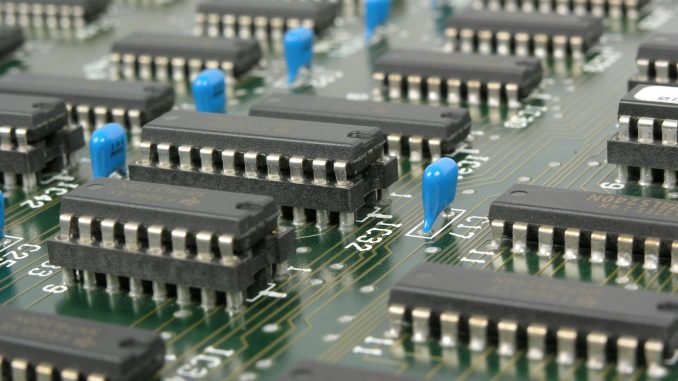
 Image via Pixabay
President Donald Trump’s team just gave China’s rulers the technology they need to beat us in the artificial intelligence race. If he doesn’t reverse this decision, it may be remembered as the moment when America surrendered the technological advantage needed to bring manufacturing home and keep our nation secure.
His advisers, including Nvidia CEO Jensen Huang, persuaded him to lift his ban on exporting Nvidia’s powerful H20 chips to China, which desperately needs these chips to make its AI smarter. The president should have stuck with his gut.
In exchange, the U.S. government has apparently become a financial beneficiary in AI chip sales to China: Press reports indicate that Nvidia and AMD (another chipmaker) have agreed to turn over 15% of their China chip revenues as a condition for obtaining export licenses, an arrangement that effectively monetizes what was supposed to be a national security restriction.
Don’t believe the claims that these chips aren’t very advanced. Before Trump banned them from export to China in April, H20s were instrumental in China’s DeepSeek AI model that shocked the world in January. DeepSeek’s CEO publicly admitted that United States “bans on shipments of advanced chips” are his company’s biggest challenge. In May, a senior executive at Chinese tech giant Tencent said he expected the ban on the H20 to “widen the gap” the U.S. enjoys over China in AI.
China’s lack of unfettered access to U.S.-designed AI chips is America’s clearest advantage in the AI race. By reversing the ban, the White House is helping Beijing’s Communist regime close the gap.
While it makes sense to sell advanced Nvidia chips to U.S. allies and trusted partners, the regime in Beijing is waging a new cold war against the United States. In December, Mike Waltz, then Trump’s pick for national security adviser, said Beijing was “literally putting cyber time bombs on our infrastructure, our water systems, our grids, even our ports.”
In April, the Chinese military released a video titled “The Robot Dog’s Time to Kill Has Come.” It showed an AI-enabled, four-legged terminator unit, made by Chinese robotics firm Unitree, with an assault rifle mounted on its back, running alongside human soldiers and firing at a target. It was a small peek into Beijing’s AI-enabled military ambitions.
Nvidia has shrugged off concerns that its chips could assist the Chinese military. That view is uninformed at best. Procurement records reviewed by Business Insider show recent attempts by China’s People’s Liberation Army (PLA) to procure Nvidia’s chips for a range of weapons systems, including robotic dogs.
Should this really come as a surprise to the Trump administration? Last month, Cadence Design Systems pleaded guilty to criminal violations of U.S. export controls after its semiconductor design technology, diverted through a sanctioned Chinese entity, powered PLA hypersonic missile simulations.
President Trump was turning the tide against this sort of corporate perfidy during his first term.
Yet now the White House is embracing Jensen Huang’s argument that selling the company’s advanced chips to China somehow helps America by keeping it dependent on U.S. technology. Commerce Secretary Howard Lutnick echoed this view when he said: “You want to sell the Chinese enough that their developers get addicted to the American technology stack.”
The logic of wanting China to be “addicted” to advanced U.S.-designed chips is fatally flawed. This is like saying we should feel gratified that 9/11 terrorists hijacked U.S.-made airplanes because it demonstrated their dependence on American technology—or that America should export more reliable nuclear warhead technology to North Korea to make it more dependent on U.S. know-how.
Ask Nortel Networks or Lucent Technologies how well their strategy of keeping China “addicted” to Western technology worked out. Those telecom giants, now extinct, once dominated global markets and thought that going all in on China would secure their future. Chinese upstarts such as Huawei systematically absorbed their expertise, displaced them in China, and then destroyed their viability globally. (For an example of the opposite view on whether the U.S. must keep its most advanced technologies away from China, read last week’s article by Richard Vigilante in The Free Press.)
Soon after Trump approved selling H20s to China, Beijing summoned Nvidia for questioning about chip “safety.” The Communist regime’s aim should be clear: Turn up the heat on Nvidia to reveal its technology so that Chinese chipmakers can replace the American tech giant even faster. Reportedly, Chinese officials are already pressing U.S. officials to relax additional controls on high-bandwidth memory chips that have constrained China’s efforts to build its own AI chips.
Even the unions whose workers Trump promised to protect see through this. “There are real questions as to whether the Nvidia export control decision will really advance our interests or China’s and whether jobs are being traded away,” said Michael Wessel of the United Steelworkers.
He’s right: Nvidia is already designing a new chip on its next-generation Blackwell architecture to supercharge China’s manufacturing and robotics. While Trump is working to bring manufacturing back to America, Huang is bringing China the technology it needs to build the factories of the future.
“I hope to get more advanced chips into China than the H20,” Huang told reporters in Beijing in mid-July. Good for Huang. Bad for America.
Incredibly, Huang and members of Trump’s senior staff have claimed that by selling China advanced chips, the Beijing-backed tech company Huawei will be disincentivized to make more advanced chips of its own. This ignores history: Beijing has been focused on technological self-reliance since the founding of the People’s Republic of China; China produced its first transistor in 1956.
If lifting the ban really was a setback to China’s chip-making ambitions, then why has the Chinese embassy in Washington been posting videos celebrating Huang’s praise of Huawei and China’s manufacturing prowess?
Nvidia is effectively choosing Chinese customers over American ones. Global demand for advanced AI chips is outpacing supply, and producing H20s for China could constrain the production of AI chips for U.S. customers.
When we worked for President Trump in his first term, we saw him do something revolutionary: He overturned the standing policy consensus on China that had ruled Washington since the late 1990s. That consensus was premised on the naive belief that bringing a Communist dictatorship into the World Trade Organization would make it freer and friendlier through trade.
Instead, that consensus hollowed out American manufacturing and emboldened a regime bent on undermining U.S. interests. Trump knew better. He challenged that failed orthodoxy with tariffs and export controls, the first president to confront China’s brute force economics. Now, his team has put this accomplishment at risk.
AI leadership will determine who controls the global economy, deters or wins wars, and sets the rules for the 21st century. We shouldn’t hand our adversaries the tools to beat us.
President Trump should immediately halt all H20 sales to China, block Nvidia’s Blackwell and future China-specific chips, and persist in closing loopholes that let China make, buy, or access advanced AI chips.
This is Trump’s legacy moment. Will he be remembered as the president who secured American AI dominance? Or as the president who triggered a second China shock for Nvidia’s short-term profit margins?
Matt Pottinger was President Trump’s longest-serving deputy national security adviser. He chairs the China program at the Foundation for Defense of Democracies. Liza Tobin served as China director at the National Security Council from 2019 to 2021. She is a senior fellow at the Jamestown Foundation.


Leave a Reply
You must be logged in to post a comment.