
Peloni: Yes, Trump should at the very least address the shifting sea of Jew Hatred being espoused by what was believed to be a moderate visionary leading the Saudi kingdom. Trump should also address the Saudi influence being peddled in US schools and colleges, just as he should address the same with Qatar. These are not small issues. As Mark Levin noted previously, foreign policy and domestic policy in the US are not unrelated. Indeed, America is changing and the change taking root is emanating from a top down and bottom up strategy, where education indoctrinates the young, and political influencers influence those beyond schooling age. It is a dual focus with foreign influence at play in both of these arenas, all with the aim of conquering the West. As Trump is failing to address either of these assaults on the West, the West will continue to fall, even as Trump and his strongest supporters continue to claims other victories on other topics are turning the tide in the collapsing West. I would argue the truth, however, is something altogether different.
A growing campaign of anti-Jewish rhetoric in Riyadh threatens the Abraham Accords and demands American leadership.
Israfan | Jan 29, 2026
 At the signing ceremony of the Russian-Saudi documents. Saudi Crown Prince Mohammed bin Salman Al Saud. By Kremlin.ru, CC BY 4.0, Wikipedia
In recent months, a troubling shift has emerged from the heart of the Arabian Peninsula. Once poised on the brink of historic peace with Israel through the Abraham Accords, Saudi Arabia has instead amplified virulent anti-Jewish rhetoric from influential clerics and intellectuals. This development isn’t just bad for Israel it undermines American security interests and the very foundations of peace in the Middle East.
In December 2025, a senior imam at the Grand Mosque in Mecca delivered a sermon praying for divine punishment on “the Jews,” dismissing Israel as a “cruel Zionist entity.” Such language from the holiest site in Islam is not a private opinion it carries the weight of state sanctioned legitimacy. This sermon echoed throughout the region, reinforcing stereotypes and deepening divisions rather than building bridges.
Shortly afterward, a respected Saudi academic publicly accused the United Arab Emirates of acting as “Israel’s Trojan horse” in the Arab world, alleging that normalization efforts were nothing more than a threat to Saudi dominance. He painted the UAE’s partnership with Israel as betrayal and urged a recommitment to a rigid, outdated worldview that pits Islam against Jews. This isn’t merely academic posturing; it reflects a broader narrative gaining traction across Saudi media and social platforms.
These developments come at a time when regional dynamics are already in flux. Analysts note that Saudi messaging has taken a sharp turn away from moderation toward alignment with Islamist forces in Qatar and Turkey and away from the pragmatic cooperation once envisioned. Even state-linked outlets have broadcast editorials denouncing Israel and questioning its legitimacy, a stark reversal from tentative steps toward openness just a few years ago.
The implications are profound. The Abraham Accords, once a breakthrough in Arab-Israeli relations, offered a new strategic architecture in the Middle East one grounded in mutual respect, economic partnership, and a shared interest in countering extremism. Now, that architecture is under strain as Saudi Arabia’s leadership embraces discourse that inflames old hostilities and undermines the potential for peace.
Experts point to several reasons for this shift. Some suggest that internal uncertainty about economic transformation has driven the kingdom to lean into traditional alliances with Islamist movements, rather than bold economic diversification. Others highlight geopolitical anxieties particularly the idea of Iran and Israel finding common cause as a catalyst for this rhetorical turn. Whatever the cause, the consequence remains the same Saudi Arabia’s current trajectory is eroding the foundations of regional cooperation.
This moment demands American leadership. The Abraham Accords are one of the most significant diplomatic achievements of recent decades, fostering collaboration between Israel and moderate Arab states. Undermining this progress through silence emboldens those who oppose peace and fuels narratives that threaten both Israeli and American interests.
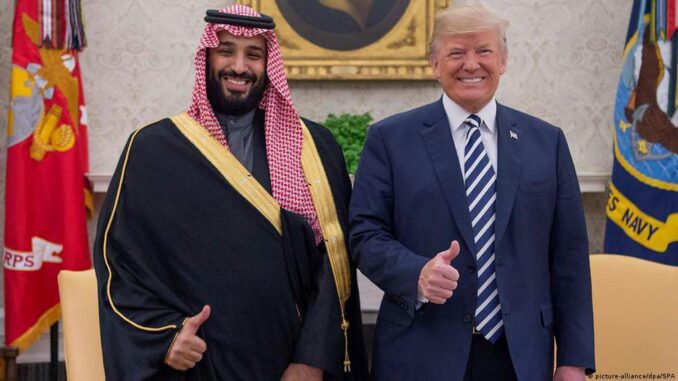
President Trump, whose administration helped launch the Abraham Accords, has the stature to push back. He can make clear that antisemitic rhetoric from any partner is unacceptable, and that true partnership requires respect, not invective. He also has an opportunity to reassess military deals, including advanced aircraft and weapon systems, to ensure they serve stability rather than fuel regional polarization.
The United States should reaffirm its commitment to the Abraham Accords and to the shared values that underpin them: respect for sovereignty, cooperation across cultures, and rejection of hatred in all forms. Peace in the Middle East will not be won by ignoring inflammatory rhetoric, but by confronting it with unambiguous conviction and principled leadership.
Israel’s contributions from innovation and economic growth to intelligence cooperation and cultural exchange stand as powerful examples of what can be achieved through partnership. Let that spirit guide the next chapter of diplomacy in the region.


Agreed!
I never noticed it ever turning away from antisemitism.
@Laura
They specifically did make changes moving away from antisemitism. Notably, those changes included textbooks which remove the antisemitic teachings which were present in countries such as Jordan and Egypt. Jews could walk freely in Saudi Arabia without disguising their religion, and a heredi reporter who visited the kingdom noted that he felt quite at ease in the Kingdom while noting that he would never take such a risk as to visit Egypt or Jordan undisguised. Notably, MBS even authorized a heredi rabbi, Rabbi Jacob Herzog, to minister to the needs of Jews living in the country.
So far, Trump has ignored the Islamic threat to the country! Is he practicing taqiyya!
If not, why!
What does true partnership mean in the world of Islam!
Why is the vast majority of “peaceful” Muslims refusing to confront Islamism, jihadism, etc.?
Did anyone on this site actually believe that the Saudis (in particular) would ignore the writings of the Qran in favour of whatever Trump was offering as part of “the Deal”?
If so, how foolishly naive…
I’m glad this came up at this time, because although there may be some Muslim states who see material benefits in the Abraham Accords, SA isn’t one of them. In fact, the hatred of the Jews stems directly from the expulsion of Haggar and her son Ishmael from the House of Abraham… Difficult to believe? You bet, but what else could be the motivation for such unrelenting hate?