
By
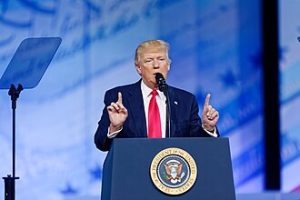 U.S. President Donald Trump. Photo by Daniel Torok – Flickr, Public Domain, Wikipedia
The Islamic Republic of Iran is, for the moment, a mid-range military threat to the United States, and will remain so until it can manufacture both nuclear warheads and the ballistic missiles capable of carrying them all the way to the east coast of America. It is a major threat to Israel, and the Israelis are fighting with everything they have got to limit Iran’s ability to hurt the Jewish state. Both Israel and the United States, in fighting Iran, are also helping to limit the damage Iran can do to the Gulf Arab states. Iranian missiles and drones have attacked seven of those states —Qatar, the UAE, Saudi Arabia, Kuwait, Bahrain, Iraq, and Oman. Those missiles and drones have hit oil and gas facilities, airports, desalination plants, power plans, anti-missile batteries, and much more.
Since February 28, when the war began, the American government has spent about $30 billion, and is now adding to that amount by about $1.2 billion a day. Trump, who frequently has bad ideas, has just had a good one. To wit, he believes that the fabulously rich oil states of the Gulf should be asked to contribute to the war effort. These states cannot fight, but they have plenty of money; collectively they have trillions of dollars, a small part of which should help pay the Americans for all the expenses they have incurred as they continue to do battle with the mad dogs of Tehran. More on Trump’s desire to be repaid in large part by the Gulf Arabs can be found here: “Trump interested in calling on Arab states to help pay for Iran war, White House says,” Reuters, March 30, 2026:
US President Donald Trump would be interested in calling on Arab countries to pay for the cost of the Iran war, White House Press Secretary Karoline Leavitt told reporters on Monday, adding that she thinks Trump would have more to say on the issue….”I think it’s something the President would be quite interested in calling them to do,” Leavitt said.”It’s an idea that I know that he has and something that I think you’ll hear more from him on.”…“Despite all of the public posturing you hear from the regime and false reporting, talks are continuing and going well. What is said publicly is, of course, much different than what’s being communicated to us privately,” Leavitt said.
The Iran war is not popular in the United States. A majority of the population fears that this war could become an expensive quagmire, as were the wars in Iran and Afghanistan. But Trump has no intention of getting bogged down in Iran, as the U.S. did in those previous two wars, by trying to remake the country. Trump does not plan to leave in situ an American army of occupation to remake the country, but rather, shares Israel’s goal of weakening Iran’s organs of oppression, the Islamic Revolutionary Guard Corps and the Basij, so severely that the people of Iran, 90% of whom are opposed to the present regime, can again rise up without fear of being immediately cut down. It is not only that the IRGC and Basij have lost men and materiel, but there is a serious drop in morale, with reports coming in of IRGC men leaving their units and refusing to return.
Another worry is the expense. People remember that in both Iraq and Afghanistan, the Americans ended up spending trillions of dollars. The former cost us $3 trillion, while he latter cost America $2.3 trillion. Trump can reassure Americans that he has no intention of spending anything like that sum and furthermore, unlike his predecessors, he will demand that the rich Arabs help out, for it is they who will benefit if the source of their trouble, the Islamic Republic, is so weakened militarily that it can no longer threaten any of its neighbors, or, in the best case, is even overthrown by a populace that has nothing left to lose.
Once the soothing news has spread that the Gulf Arabs will be contributing tens of billions of dollars to the United States Treasury, opposition to the war against Iran will lessen. Iran’s hope that domestic opposition in America to the war will bring it to a speedy close on Iran’s terms will disappear. And what is $25 billion, or $50 billion, or even $100 billion to such deep-pocketed states as Saudi Arabia, the UAE, and Kuwait, each of which possesses a sovereign wealth fund of more than $1 trillion?


Leave a Reply
You must be logged in to post a comment.