
Peloni: How about this turn about? The opposition to support the US given the nominal request being made by Trump was itself rather revealing about the state of the alliance between the US and its erstwhile allies. Even as they have come to capitulate in supporting Trump’s request, it is a remarkable distance of support and capabilities to what Israel has demonstrated in recent weeks and over the past year. Of course, partnerships indicate common interests and like minded values. While no two nations are a perfect match for such things, Europe in particular has demonstrated once again that it has meandered far from where it once stood in decades past, even as they were at the time far from a lock-step supporter of US leadership. As Trump noted, there will be consequences for Europe in light of these changes, even with their move to finally acquiesce to Trump’s request.
By Pamela Geller |
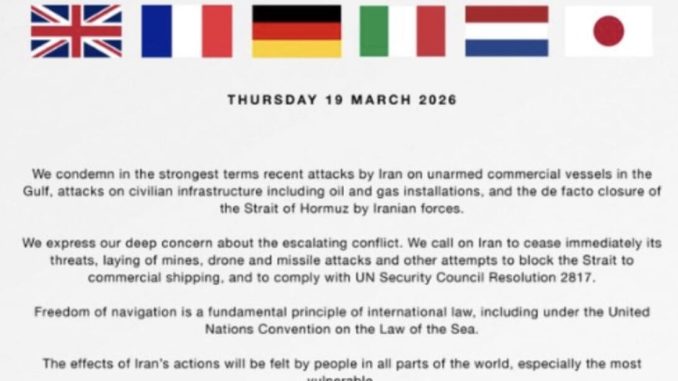 Image via Gellerreport.com
Well, that was quick.
Score one for Donald Trump. European leaders—including Keir Starmer and Emmanuel Macron—initially rejected his request to help escort commercial shipping through the Strait of Hormuz. Trump responded by openly questioning America’s commitment to NATO’s collective defense, pointedly referring to these countries as “allies” in quotation marks and calling the relationship a “one-way street.” Speaking to reporters at the White House, he framed the Hormuz standoff as a “litmus test” of NATO’s reliability.
Britain, France, Germany, Italy, the Netherlands and Japan condemned attacks on commercial vessels and said they were prepared to “contribute to appropriate efforts”
It’s one thing to posture for the cameras; it’s quite another to see your supply of oil stopped by madmen.
Britain, France, Germany, Italy, the Netherlands and Japan condemned attacks on commercial vessels and said they were prepared to “contribute to appropriate efforts”
He’s the greatest.
So French.
Five European nations and Japan ready to ‘contribute’ to securing Hormuz
By Mohamed Elashi, Euro News, March 20, 2026:
The conflict around the Strait of Hormuz is starting to draw in global powers, as disruptions to shipping and energy flows raise concerns about wider economic fallout.
European nations and Japan have said they are ready to support efforts to improve security in the Strait of Hormuz, as the war with Iran continues to disrupt shipping without a concrete military role being outlined.
In a joint statement, countries including Britain, France, Germany, Italy, the Netherlands and Japan condemned attacks on commercial vessels and said they were prepared to “contribute to appropriate efforts” to help ensure safe passage through the waterway and support stability in global energy markets.
The statement did, however, not provide details on how they would do so or the extent they would be willing to commit resources.
ADVERTISEMENTAt the same time, maritime data shows the strait has not been completely shut. Around 90 ships, including oil tankers, crossed the waterway in the first two weeks of March. That is far below normal levels, but indicates that limited traffic is continuing.
symbol
00:0002:00
Read MoreAnalysts say the strait is now operating on a selective basis, with some vessels allowed through while others face higher risks.
Disruption and attacks at sea
The crisis began on 28 February when the United States and Israel launched strikes on Iran, raising immediate concerns about the safety of shipping routes in the Gulf.Within days, tankers were damaged in attacks and shipping companies began delaying voyages as risks increased.
A helicopter raid targets a vessel near the Strait of Hormuz in April 2024.
A helicopter raid targets a vessel near the Strait of Hormuz in April 2024. AP Photo
A Malta-flagged container ship was hit by a projectile while passing through the strait, forcing its crew to abandon the vessel.Shipping data showed dozens of vessels slowing or waiting in Gulf waters, while many others delayed movements as operators reassessed whether it was safe to transit the narrow passage.
At least 20 vessels have been attacked in the area since the start of the conflict.
Iran has warned it could target ships attempting to pass through the strait if attacks on its territory continue.
Despite the disruption, some ships have continued to get through, often under specific conditions.
Vessels linked to Iran or from countries that maintain ties with Tehran have been among those able to transit, while others have relied on diplomatic arrangements to pass safely.
ADVERTISEMENTIran has continued exporting oil during the conflict, with trade data suggesting millions of barrels have still been shipped despite the slowdown in traffic.
The disruption has fed into global energy markets, with oil prices rising sharply and shipping rates increasing as insurers and operators factor in the risks of sailing through the strait.
The Strait of Hormuz is one of the world’s most important energy routes, carrying around a fifth of global oil supply and key liquefied natural gas exports from the Gulf.


Very unexpected after all the shouts about “Not our war!!” and so on.
The French just answered that question!!
We have noticed that false-flagged Iranian and Chinese ships have been able to get through. That may also mean that there is a safe channel or no mines at all.
No wonder their harbor on Kharg Island was attacked.