
Peloni: Below offers an important context to the US emboldening and strengthening Iran in the region. Erdogan’s goals are centered around conquest, not stability, and it has made no pretense about its enmity and focus of coordinating its expansionist goals around the denigration and isolation of Israel. Diffusing this problem can only be addressed by the US, but not in the way the US is currently acting as it seems to be strongly guided by the Turkish delights of Amb. Tom Barrack’s pro-Erdogan fantasies.
Ankara’s anti-Israel campaign under Erdogan signals a deeper strategic confrontation and rising Middle East tensions.
Sinan Ciddi | April 2, 2026
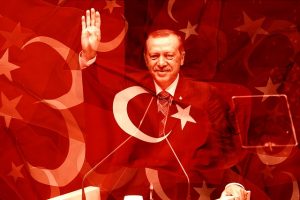 Image by Gerd Altmann from Pixabay
Ankara has crossed yet another line in its steadily escalating confrontation with Israel. An indictment by an Istanbul court to indict Prime Minister Benjamin Netanyahu and 34 other Israeli officials for a period of up to 4596 years is not a legal maneuver grounded in sanity – it is a political stunt.
The charges include “genocide” and “crimes against humanity.” They fit squarely within a broader pattern: Turkey, under President Recep Tayyip Erdogan, is heightening tensions with Israel in ways that risk the potential for armed conflict.
However, Erdogan’s escalatory posture towards Israel is intentional and calculated, and it predates the current Iran war.
The roots of Ankara’s hostility towards Israel go back to 2008, when Erdogan began systematically dismantling Turkey’s once strong partnership with Israel. What had been a fruitful and trust-based relationship, anchored in intelligence sharing, military cooperation, tourism, and trade, gave way to a campaign of vilification and hostility.
At the 2009 Davos summit, Erdogan personally insulted Israeli President Shimon Peres by referring to Israel as a country that killed children. This was followed by Ankara’s eager willingness to permit Hamas to establish a permanent organizational presence inside Turkey, where the US-designated terrorist entity has since used as a base to plan terror attacks inside Israel, recruit militants, and fundraise.
Erdogan’s support of Islamist causes began with Hamas. Ankara’s patronage of jihadist entities during the Syrian civil war, as a means to topple the Bashar al-Assad regime, is well-documented, as is Turkey’s willingness to advocate for and support the Muslim Brotherhood movement.
In the case of Hamas, Erdogan’s defenders are quick to point out that it is necessary and beneficial for Turkey to be on speaking terms with Hamas. They argue that Turkey can play a vital role as a mediator between Hamas and Israel.
But Ankara doesn’t maintain a dialogue with Hamas because it is interested in fostering peace between Israelis and Palestinians. It has a relationship with it so that it can help weaponize the entity against Israel.
Turkey hardens position against Israel since the October 7 massacre
Since the October 7 attacks, one can see that Turkey’s position towards Israel has hardened into outright hostility. The Erdogan regime is not interested in fostering peace. Through its media surrogates, it is openly advocating for the elimination of Israel.
According to influential columnist Ibrahim Karagul of Yeni Safak newspaper, Jews have “corrupted human genetics,” and measures should be taken to dismantle Israel’s existence as a state.
Ankara’s rhetoric has intensified to an unprecedented degree. In an official statement, the Turkish Foreign Ministry recently compared Netanyahu to Hitler – a grotesque and inflammatory accusation that serves no diplomatic purpose other than escalation. Such language does not merely reflect anger; it is designed to mobilize domestic and regional audiences while isolating Israel internationally.
Turkey’s alignment with entities such as Hamas places it at odds not only with Israel, but with the broader Western security architecture to which it ostensibly belongs. It also helps explain Ankara’s strategic preferences elsewhere in the region.
Despite its rivalry with Iran, Turkey has consistently signaled that it prefers the survival of the Iranian regime to its collapse. A weakened or fragmented Iran could create instability, but it could also eliminate a counterweight to Israel.
Erdogan’s words suggest that Turkey’s approach is moving beyond rhetorical and political confrontation and toward the implicit threat of military action. In 2024, Erdogan hinted that Turkey could take steps against Israel, similarly to its interventions in Libya and Nagorno-Karabakh – two cases where Ankara deployed military assets, advisers, and proxy forces to shape outcomes on the ground. These are not idle comparisons; they are signals.
The risk, then, is not simply diplomatic deterioration, but miscalculation. Turkish Foreign Minister Hakan Fidan has suggested that Israel may soon designate Turkey as its primary adversary, particularly in a post-Iran scenario where Tehran no longer occupies that role.
This framing is revealing. It assumes that Israel requires a singular enemy and that Turkey is prepared to step into that position.
The Turkish court’s decision to imprison Israeli officials can be understood not as an isolated provocation, but as part of a broader strategy. Erdogan’s government is leveraging every available instrument – legal, rhetorical, diplomatic, and potentially military – to challenge Israel’s position in the region.
This is not the behavior of a cautious mediator. It is the posture of a state seeking confrontation while maintaining plausible deniability.
For the United States and its allies, the implications are serious.
Turkey remains a NATO member, yet its actions increasingly diverge from alliance interests. By deepening its ties to Hamas, tolerating – or even encouraging – anti-Israel incitement, and signaling a willingness to escalate militarily, Ankara is testing the limits of statecraft.
If left unchecked, this trajectory will not only further destabilize Turkish-Israeli relations but also complicate US efforts to manage an already volatile Middle East.
Sinan Ciddi is a senior fellow at the Foundation for Defense of Democracies.


Will Erdogan take the mantle of Jihadism!
Israel needs to find a device to split Turkey from NATO. One way would be to invite an proven attack by Turkey on Israel to justify acts of self defense. This is both painful and deadly for both sides. Alternatively, some lever must be found to justify NATO discarding Turkey from the coalition. If neither option can come to fruition, we will face a much larger problem when all those other NATO members like UK, France, Spain, Italy and others feel they have to put Israel in its place (their opinion).
Turkey has already got away with a singular but unreproached act of imperialism and settler colonialism in North Cyprus. It is conscious of its past – as Iran and several others – including the Arab World’s misguided career with Israel and others since 1948.
If the Turks try a Gallipolli on Israel’s beaches they will find things as hard as did the British and French in 1915. But should the succeed the Palestine Arabs will have to do as they are told by Ankara as any ideas of democratic liberal freedoms will also return to the Kishle.
The tragedy in the current volatility is that we have two centuries of experience since the Enlightenment that democratic secular government better returns national peace and prosperity than the medieval sectarianism and its violent chivvying as in Northern Ireland or Pakistan. Here first Iran and now Turkiye are heading a return to pre-Enlightenment authoritarian clericalism of no advantage to the advance of science and technology nor more tolerant social relations.