
Peloni: This is an important article which details the quiet but significant Jihadi goals being pursued by Erdogan in its efforts to save the Mullahs from their well deserved and hopefully soon eradication.
By | Mar 9, 2026
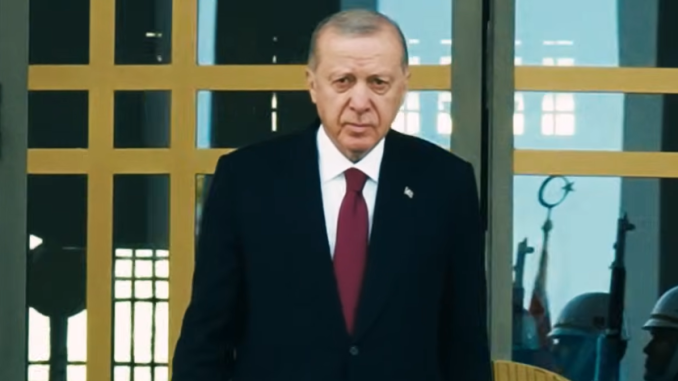 Turkish President Recep Tayyip Erdogan. Screengrab via Youtube
In the face of the current war on Iran, Turkey has been unusually quiet. Beyond calling for an immediate end to the war, along with China and Russia, it intercepted an Iranian ballistic missile over its territory on March 4, and merely echoed unavailing calls for “diplomacy” rather than joining in the long-overdue strike on Iran aimed at crippling its advanced military capabilities. But now comes a more realistic report about Turkey, reflective of its identity. “Turkey’s Iran strategy: Preserve the mullah regime — or ensure its successor remains anti-Western,” by Abdullah Bozkurt, Nordic Monitor, March 8, 2026:
The Islamist government of [Turkey] has adopted a strategic approach toward Iran that prioritizes the survival of the clerical regime in Tehran. Should that objective fail, Ankara appears determined to shape any political transition in a way that prevents the emergence of a pro-Western or Israel-aligned government.
Recent developments reveal that Turkey’s Iran policy is not driven merely by regional diplomacy but by a deeper geopolitical calculation: maintaining an ideological and strategic axis that counters Western influence in the Middle East while protecting Erdogan’s own political positioning at home and abroad.
While the Erdogan government, joined by much of the co-opted opposition in Turkey, has ratcheted up anti-Israel rhetoric in the aftermath of attacks on Iran, it has deliberately downplayed the Iranian mullah regime’s unprovoked missile launch against Turkish territory. Government propagandists have even gone so far as to blame the incident on Israel, portraying it as a supposed false-flag operation despite offering no evidence to support the claim.
For Ankara, Iran’s stability is viewed as a national security interest. Turkish policymakers increasingly interpret attempts to take down terrorism-sponsoring mullah regime as part of a broader geopolitical struggle involving the United States and Israel. They frequently frame protests or internal unrest in Iran as movements influenced by foreign powers, echoing narratives long promoted by Iranian leaders themselves.
Turkey has been noticeably quiet about the war against Iran, as it tries to balance its Islamic supremacist ambitions while also cleverly navigating its NATO membership, which is key to keeping it well armed as a powerful global player.
Turkey is a detriment to the West and Israel. Consider: Turkish President Recep Tayyip Erdogan has referenced Hamas as a “liberation organization,” hosted its leadership in Ankara, and granted them Turkish passports. Turkey and Qatar are well-known Muslim Brotherhood supporters. Turkey also supports Syria’s jihadist President Ahmed al-Sharaa, and has sought an increased partnership with Iran. It even considers the Taliban a friend. Erdogan also “hailed a massive pro-Palestinian rally in Istanbul on New Year’s Day as a ‘historic moment.’” He stated that “it sent a clear message that Palestine is not alone.” He threatened Israeli Prime Minister Benjamin Netanyahu, saying: “What this Pharaoh called (Israeli Prime Minister) Benjamin Netanyahu has done will not go unpunished, because he incurred the curses of countless oppressed people, from the young to the old.” As if that were not enough to wake up the West, the Begin-Sadat Center for Strategic Studies also states regarding the Islamic State’s short-lived caliphate in Iraq and Syria:
The ability of ISIS to become a functioning state so quickly is largely due to its relationship with President Erdodan in Turkey.
ISIS has had strong connections to Turkey over the years, whether through its oil industry or through its willingness to shield wanted members of the Muslim Brotherhood. This “neighborly” relationship was essential to ISIS’s success, and it continues to be reflected in Turkish decision-making.
The Council on Foreign Relations points out that the Kurdish-led Syrian Democratic Forces (SDF) became the chief ally to the US against ISIS during the Syrian war, to gain a global reputation “as the most effective ground forces” against the group. While incurring thousands in personal losses, it reduced the group “to a fraction of its 2014 peak.” The United States trained Iraqi Kurds, backed Syrian Kurds with airpower, and armed them on the ground.
The US-Kurdish alliance enraged Erdogan, who viewed the US strategy against ISIS as “tantamount to backing the PKK,” a group that Turkey has outlawed, and with which Turkey has carried on a violent struggle. Despite the size and power of the Turkish military, “Kurdish militias have proven resilient and their fighters, if not their cause, have gained international recognition after successes against the Islamic State.”
Another success has been SDF management of the Syrian al-Hol ISIS camp. That is, up until the Turkish-backed installment of al-Sharaa, whose government launched an offensive against the SDF. As a result, over 23,000 ISIS-linked prisoners escaped. Most were brides of ISIS jihadis and their children; many of these children went through jihad training as “Cubs of the Caliphate.” NBC News quoted SDF spokesperson Farhad Shami in the Kurdish news website Rudaw, saying “that around ‘1,500 ISIS militants — including both foreign and Syrian nationals — had been released’ by Damascus-affiliated armed groups from Shaddadi prison in southern Hasaka as well following fighting there.” The resulting dire implications for the region and also for many EU countries that maintain open-door migration policies is significant. Al-Sharaa also signed a constitutional declaration that mandates that the Syrian president must be Muslim, and it established the supremacy of Islamic jurisprudence, that is, the Sharia.
One can see a pattern emerge. The alternative to America’s alliance with Kurdish fighters that enraged Turkey during the Syrian war would have been to let ISIS rapidly proliferate regionally, and advance its mission toward a global caliphate, while Erdogan would have further exploited his “neighborly” relationship with ISIS, as described by the Begin-Sadat Center for Strategic Studies. Now, in the case of the current Iran war, Erdogan would rather maintain the status quo with the Islamic Republic of Iran’s mullahs, in order to continue building his own regional power base as he engages in “a deeper geopolitical calculation.”
Erdogan is ready and willing to exploit any and every opportunity for power. He did it with ISIS in the Syrian war. He did it to establish al-Sharaa as leader in Syria. He does it with the Muslim Brotherhood, and he’ll do it again by exploiting the war on Iran however he can. The most fundamental difference between Turkey and Iran is the crude modus operandi of the latter, which has become a hallmark of the regime. However, the key ingredient that both share is their ability to exploit Western interests to the hilt. Western leaders poured billions into the coffers of Iran because of a bogus nuke deal that was based on lies, Iran finally admitted. Meanwhile, Turkey continues to exploit NATO.
The Carnegie Endowment explains that a mega-shift in the geopolitical landscape, which the current war threatens to bring about, does not benefit Erdogan. This is particularly so if Israel’s long-term goal of eliminating the existential threat that the Islamic Republic poses is recognized. Israel’s goal is of critical importance not just for its own survival, but for American interests as well. Think of what will happen if Democrats win in the future. Iran possesses the most expansive missile arsenal in the Middle East, with the capability of striking parts of Europe. According to the Defense Intelligence Agency, Iran has space launch vehicles it could use to develop a militarily-viable Intercontinental Ballistic Missile “by 2035 should Tehran decide to pursue the capability,” especially since its systems “have nuclear-capable variants.” The anti-Trump activist media expectedly denies that Iran is seeking nuclear weapons, but given Iran’s rate of military progress, its nuclear ambitions are indeed plausible and even likely. Even after Operation Rising Lion in June, which targeted Iran’s nuclear infrastructure and ballistic missile capabilities, the operation failed to neutralize Iran as a threat. The regime’s resilience and will must not be underestimated.
While regime change is important to the people of Iran, it is also critical to regional and global stability. Israel’s motivations, according to the Carnegie Endowment, “are viewed as more structural and long term, aimed at reshaping the regional balance of power in ways that marginalize others, most notably Turkey.”
As Turkey evaluates its own interests in the face of a widening conflict, its hope is for more influence, first under a seemingly benign role “to assume a greater share of the responsibility for regional security, stability, and peace,” but in reality, Turkey seeks its own regional dominance, and ultimately a global caliphate. Since ongoing instability would presumably require American ongoing involvement, this does not bode well for a country with big ambitions for primary leadership in the region.
Long before the war on Iran began, Turkey was revealing itself to be the new Iran.
As America and Israel target Iran’s capabilities, Turkey should not be left unimpeded; it should be carefully watched. The worst thing that could happen would be to allow Turkey to build up its arsenal further. While Greece has “‘fiercely’ lobbied France to halt sale of radar-guided, air-to-air Meteor missiles to Turkey, several EU countries are moving ahead with arms sales with Turkey.” They include Italy and Spain.
Turkey has been expanding its influence, and bullying Greece in the process. In 2022, tensions rose to the point that there were widespread fears of war between the two NATO members. Yet no NATO member other than Greece, or any country, for that matter, has even attempted to hold Erdogan to any standard of accountability. Also in 2022, while Erdogan was leveraging the Russia-Ukraine war to gain advantage, he also held talks with Vladimir Putin in order to deepen ties with Russia, and completely disregarded NATO’s concerns.
Erdogan has openly stated his intention of reviving the Ottoman Empire, and has even revealed a “map of ‘Greater Turkey’ that goes back to the era of the Seljuk Empire and its defeat of the Byzantine Empire in the 1071 Battle of Manzikert.” He is also cracking down on domestic political opponents who could unseat him in elections, even detaining and jailing them.
NATO and EU members are facilitating Erdogan’s ambitions by looking the other way. Erdogan has stated that “Turkey has nothing that contradicts” Taliban “beliefs.” Yet its status as a NATO member remains unchanged.
What would anyone expect the devious Erdogan to do in the face of the Iran war? Exploit it, of course. The mullahs of Iran are merely a tool that Erdogan seeks to exploit, as he did ISIS when he sought to destabilize Syria under its former President Bashar al-Assad; all while he makes fools of Western politicians by giving them the impression that he is genuinely interested in regional and global peace.
The Carnegie Endowment further points out:
The escalating rivalry between Turkey and Israel is already visible across several theaters, from Syria and the Eastern Mediterranean to the Horn of Africa. The current crisis risks extending this competition into Iranian soil as well, especially amid signs of Israeli and U.S. support for Kurdish factions, including the PKK-affiliated Kurdistan Free Life Party.
Just last week, the CIA was reported to be arming Kurdish forces as ground troops to help foment a “popular uprising in Iran.” According to the Associated Press, “The Kurdish groups are widely seen as the most well-organized segment of the fragmented Iranian opposition and are believed to have thousands of trained fighters. Their entry into the war could pose a significant challenge to the embattled authorities in Tehran and could also risk pulling Iraq further into the conflict.”
But what will that do to US-Turkish relations? Given Trump’s ill-advised partnership with Erdogan in Gaza, the moment of truth may well be approaching, when Erdogan at least begins to expose his real intentions as the full-blown jihadist he really is.


Turkiye have been brandishing their threats for years now. They have been committing genocide for years now but love to claim that Israel is the criminal. The Turks urgently need a new regime before something unpleasant happens.
NATO needs Turkiye exactly where it is to keep the Russians in check. They have no other purpose and the likelihood that they would join NATO forces where needed rather than in the Gaza Strip is close to zero.
They are not needed in the Gaza Strip. They would take sides with Hamas rather than keep the peace.